Interview: Tung-Hui Hu

March 3rd, 2016

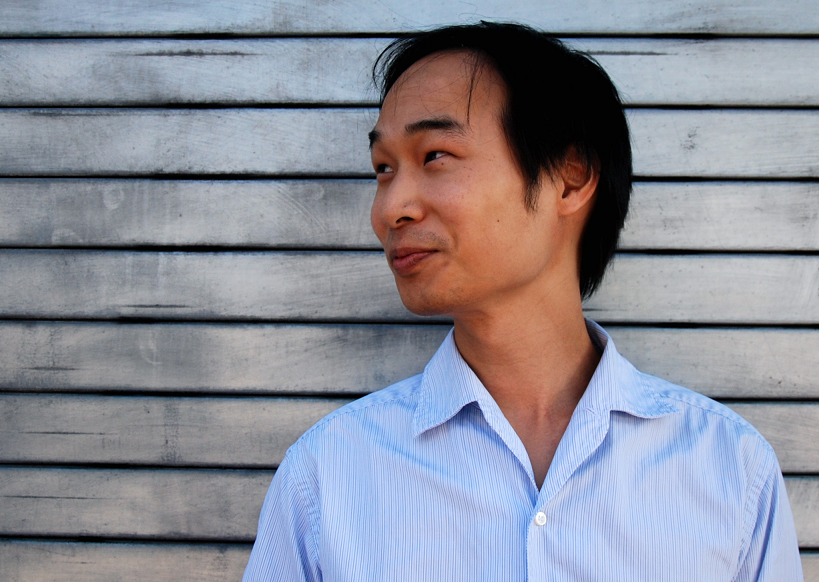
hh_big_croppedMidwestern Gothic staffer Giuliana Eggleston talked with poet Tung-Hui Hu about his book A Prehistory of the Cloud, making poetry wait, feeling untied from any specific place, and more.

**

Giuliana Eggleston: What’s your connection to the Midwest?

Tung-Hui Hu: I don’t have a strong family connection to the Midwest, but I do, as Kevin Young says in his marvelous poem “Ode to the Midwest,” “want to be doused/in cheese//& fried”. Also, I like thinking about the Midwest as an odd kind of geographical paradox. Almost everyone I’ve met from the Midwest tells me that the state they’re from is at the center of the Midwest—whether that’s Michigan or Minnesota or Kansas—and, very often, that their state is more Midwestern than other states. Everyone wants to be from the middleist state.

GE: How has being an assistant professor at the University of Michigan and living in Michigan influenced your writing?

THH: I’ve been influenced by a number of poets from Detroit—Francine Harris, Jamaal May, Tarfia Faizullah, Matthew Olzmann as contemporaries, and Robert Hayden and Philip Levine, to name just a few historical figures. I’m lucky to live in a vibrant community of writers and readers in Ann Arbor, which means that I get to hear every author worth her or his salt come through town.

GE: You’ve recently written A Prehistory of the Cloud, an academic book that investigates the real vs. the virtual in the context of the digital cloud, but you also write poetry. How do you approach each type of writing? Do you have a preference?

THH: A Prehistory of the Cloud is the result of me going around asking questions such as: Why is the NSA data center in Utah in the same place as the former Pony Express messengers? (Well, it turns out that computers, like horses, need water to cool off.) It tells a story of how the cloud grew out of older networks—and older ideas of power. I move more deliberately through academic work, because you have to get the facts right and there is a chance that you might have to defend your work in public. I prefer writing poetry, but it’s intense and demanding, like shots of espresso; you can’t exist only on that kind of diet.

GE: What do you need in order to write?

THH: I need to be off the Internet. Which isn’t as easy as it sounds, since, as you mention below, I’m a former computer scientist, which means I’m pretty good at finding an Internet signal in th9780262029513e middle of nowhere.

GE: You’ve worked as both a political consultant and a computer scientist. What led you to writing poetry? Do you see either of those experiences related to your writing?

THH: I started writing poetry first, in high school—terrible stuff—and just kept going. There’s little crossover between poetry and these other forms of work, which I did to pay the bills. But I have always felt that poetry is a patient literary form (even as it’s capable of great urgency): people have been writing and singing poetry for thousands of years, and will continue to do so for a long time to come. For that reason, I’ve felt that poetry is able to wait for me: I’ll do something else, knowing I’ll always return to writing.

GE: Many of your poems have a strong sense of place. Do you have a specific goal with place when you are writing poetry? Has living in the Midwest, specifically in Michigan, had an influence on the sense of place in your poetry?

THH: There’s a train that goes from DC to Boston, and I think I’ve lived in almost every city that it stops at. Because I moved around so often as a child, I’ve always felt untied from any specific place. Perhaps the word is “cosmopolitanism”—a sense that I’m bound by a sense of community with complete strangers, rather than a specific locale, and that I could be anywhere at any given time. Although I don’t know it as well as I might, southeastern Michigan has more of this quality than one might expect. I think of the Japanese restaurant in Novi that caters to Japanese automobile executives rotating in through their overseas shift, or the McNamara terminal at Detroit Metro airport in early morning, where bleary-eyed travelers are connecting between countries, and the overhead speaker repeatedly announces to them: “Michigan is in the Eastern time zone”.

GE: How does being a poet change the way you view the world?

THH: It makes you look at the world through differently shaped obsessions every week. One week, because you’re writing a poem about geology, you’ll only notice the sparkly texture of stones, or the marble floor inside a building. The next, because you’re writing a poem about grief, your poet radar might only pick up things shaped like tears.

GE: What’s next for you?

THH: I have the 2016 academic year off as a result of a NEA fellowship, so I’m going to do some traveling. My current goal is to spend as much as possible circumnavigating the Southern hemisphere while avoiding the North, seeing if I notice any cultural connections between the various Souths.

**

Tung-Hui Hu is the author of three books of poetry, The Book of Motion (2003), Mine (2007), and Greenhouses, Lighthouses (Copper Canyon Press, 2013), as well as a study of digital culture, A Prehistory of the Cloud (MIT Press, 2015). His poems have received awards from the National Endowment for the Arts and the San Francisco Foundation, and appeared in places such as Boston Review, The New Republic, Ploughshares, Gastronomica, and the anthology Family Resemblance: An Anthology and Exploration of 8 Hybrid Literary Genres. Hu teaches poetry and digital studies at the University of Michigan.

Chicago Women in Publishing Event

CWIPlogoThe Chicago Women in Publishing Fair is coming up on March 16, 2016 and aims to connect Chicago’s publishing professionals in an expanded event that brings together many organizations from the literary world such as the DePaul University, MA in Writing and Publishing Program, Loyola University Press, Northwestern University Press, University of Chicago Press, Poetry magazine and US (Midwestern Gothic)!

Learn about and network with members of Chicago’s publishing community at the second annual CWIP Publishing Fair. Launched in 2015, this successful event has been expanded to include more exhibitors, representing different aspects of publishing in the city.

The exhibitors include companies and professionals that can help you market your services, share job opportunities, sell books, or gain exposure to the Chicagoland publishing community. Local publishers, authors, agents, universities, and other publishing-related vendors (like us!) will attend, making it the perfect place to discover your next opportunity. We’ll be at the event, but even if you don’t come see us, there’s plenty for anyone who appreciates fine lit.

CWIP Publishing Fair
Where: Four40 Building (Room 302/Bucktown) 440 S. LaSalle Street Chicago, IL 60603
When: Wednesday, March 16th from 5:30PM to 8:30PM
How: Register online at their event page, small fee to attend
Additional details at the CWIP website

|

No Comments

|

Contributor Spotlight: Z.G. Tomaszewski

ZG Tomaszewski, illustrated by Hayley HungerfordZ.G. Tomaszewski’s poem “Ethel Ave” appears in Midwestern Gothic Issue 20, out now.

What’s your connection to the Midwest, and how has the region influenced your writing?

My Midwest was initially inherited. I was born in Grand Rapids, to Manistee-born parents. My chosen Midwest is mostly water and woods, it is also all the abandoned factories from childhood, those ages not all too long ago misplaced, but being explored.

My earliest influences were rivers—naturally, they still are. What I find irreplaceable, beyond that, in our great state, are all my fellow writers, those who have come before me. When I was younger, acknowledging my own seriousness toward writing, I would walk into a bookshop, new or used, and be thrilled to pull from a shelf the books from Wayne State or New Issues. These presses have had a significant role in my writing. If I wasn’t reading and connecting to many of the Michigan poets they published, there’s no question I would not have been as encouraged to write, keep writing, and enter the conversation. So, for me, Midwest writers, rivers, forests, lakeshores, alleyways, old houses, all that’s on the map.

What do you think is the most compelling aspect of the Midwest?

It’s an incredible, ill-defined territory. Seems as though every time I consider the Midwest it gains shape or losses something. I like that orphic quality.

How do your experiences or memories of specific places—such as where you grew up, or a place you’ve visited that you can’t get out of your head—play a role in your writing?

One role as a writer has been as the anthropologist-traveler. Or, a river. Leaving the known, collecting and depositing, and so on, then returning to the known and making it unknown again.

Place is central. I once heard someone say, “We’re all born with a way of walking through space.” That’s poetry. The poem, then, is realizing how we’re walking through what space.

Of course, I have lived outside the Midwest: Vermont and Montana, and have journeyed at length elsewhere. I think saying I’m from the Midwest is just to say ‘I’m from some where.’ Generally it’s easier to identify our geography than who we are or what we’re all about. Place gives us a starting point. Well, at least some coordinate on the map of the other. We are born of place, to be placed. One is harder than the other.

Discuss your writing process — inspirations, ideal environments, how you deal with writer’s block.

I’m not inspired to write. I’m inspired to paint, draw, sculpt. Do I do these? No. So I struggle to for a second and, ultimately, resign to write. I do not experience writers block. There’s no invisible wall put up by metaphysical masons in my mind. I do not need Murakami’s “entrance stone” to push through. Look at it this way: I’m living, breathing. How is that not composition? You know, it’s a matter of metabolizing. When I’m not actively writing, which is more often than doing so, I’m still thinking about writing, reading, experiencing the world and its sensory stimuli. Now, if I think I wrote a masterpiece a year ago and haven’t written what’s felt like another since, well, that’s another thing altogether that I do not choose to be involved with. Call it writers block if you must. Maybe you’re trying to hard. Maybe there’s too much ego at stake.

How can you tell when a piece of writing is finished?

There’s that troubled question. To answer it is more troubling. How do I talk about a feeling I have especially if I do not know where its source is? When one writes, has been writing for a long time, and that person is all the while reading and rereading, then I believe they will come to encounter their intuition more. Intuition is a primal wisdom. It’s reaction already born within the action. All I’m saying is, trust it; it knows its place better than you know its place. Listen and listen and listen to your response. After that, listen and listen and listen to other responses. Those perceptions will enhance your own. They will, believe it or not, inform your view of what you have been working on.

A mountain has a different view of the river than a tree or the bird flying out from the tree or a grasshopper or the fern.

It’s like the cycle of rain. Remember making a pinwheel in elementary school, how the rain comes from clouds, how the clouds form from groundswell and all that? The poem is elemental. Catch the instant of transition and you’ve got something.

Who is your favorite author (fiction writer or poet), and what draws you to their work?

I’m drawn to a shared awareness of emotional truths. When it’s written with unquestionable honesty—whatever that means—and if the imagination informs reality or vice versa, that’s enough to attract me. There’s not one topic or motif that I’m brought in by. Anyhow, I return to Stanley Kunitz, Li-Young Lee, Patricia Fargnoli, Hermann Hesse, Seamus Heaney, Huraki Murakami, Gabriel Garcia Marquez, and the works of Rilke. Tomorrow I might add the brotherhood of James Galvin, Donald Hall, Philip Levine, James Wright, and Galway Kinnell. Yesterday, at any given minute, you could’ve heard me mentioning at the bus stop Robert Haight, John Rybicki, Robert Fanning, Judith Minty, Patricia Clark; then, before the door closed: Russell Thorburn, Chris Dombrowski, whispering ‘Oliver’ and ‘Frost’ to myself as the engine heated back up.

What’s next for you?

My first book of poems, All Things Dusk, was just published by Hong Kong University Press—chosen by Li-Young Lee as the 2014 International Poetry Prize winner. So, I’m going on the road, periodically, reading here and there. Furthermore, my second volume, from which “Down on Ethel Avenue” is on loan here, feels situated but waiting to be housed.

Where can we find more information about you?

HKU Press/Columbia University Press. My author WordPress. Great Lakes Commonwealth of Letters. Plus, new poems in The Cortland Review, Ruminate Magazine, diode, and The 3288 Review.

|

No Comments

|

Voices of the Middle West Reminder

voices_header

Just a quick reminder that our Voices of the Middle West literary festival is coming up on Saturday, March 12th! Here are some of the highlights:

- Keynote from Ross Gay, finalist for the 2015 National Book Award
- All day bookfair with over 40 presses from the region
- Open Mic Event
- FREE to the public

We also have some wonderful panels on subjects such as: Storytelling as Community, Personal Histories: Where Memoir and Fiction Meet, Publishing Panel: Unheard Voices, and Local Color: Is there a Midwestern Character?

Finally, don’t miss the kickoff event: On Friday, March 11th, at 7PM, Literati bookstore is hosting authors from the Voices festival for a reading event that is FREE and open to the public. However, space will be limited so arrive early in order to secure a spot! Find more information here: https://www.facebook.com/events/198047517213305/

How to Attend
When: March 12th from 10AM to 6:30PM (keynote speaker at 5PM)
Where: East Quad at the University of Michigan (701 E University Ave, Ann Arbor, Michigan 48109)
Parking: Metered street parking or parking available in parking garages nearby (Forest/Church street parking structure)
Price: FREE!

For more information, visit the Voices Lit Fest page and our Facebook event

|

No Comments

|

Issue 21 cover and contributor listing

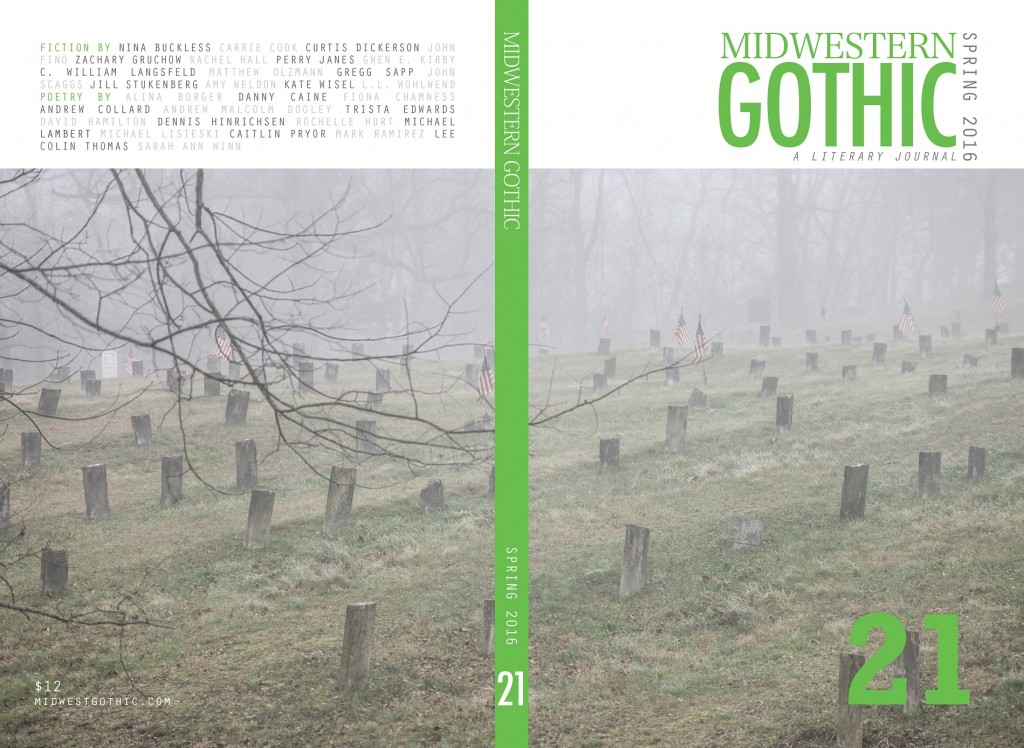
Not only is the dream of spring alive—and, hopefully, here to stay soon!—but our upcoming Spring issue represents our 5th Anniversary of Midwestern Gothic! We are so excited to still be doing what we love, and sharing issues with you four times per year. We’re doubly excited to show off this beautiful cover for Issue 21 (Spring 2016):

Issue21_Spring2016_cover_full

Cover image copyright (c) Michelle Pretorius.

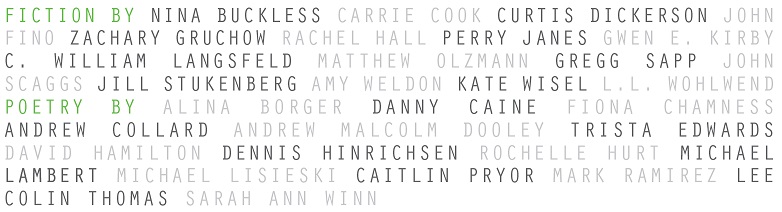
And check out our stellar contributor line-up for this issue:

Issue21_Spring2016_cover_full_contribs

Issue 21 drops on April 1, 2016—mark your calendars and help us celebrate this momentous release!

|

No Comments

|

Interview: David Nicholson

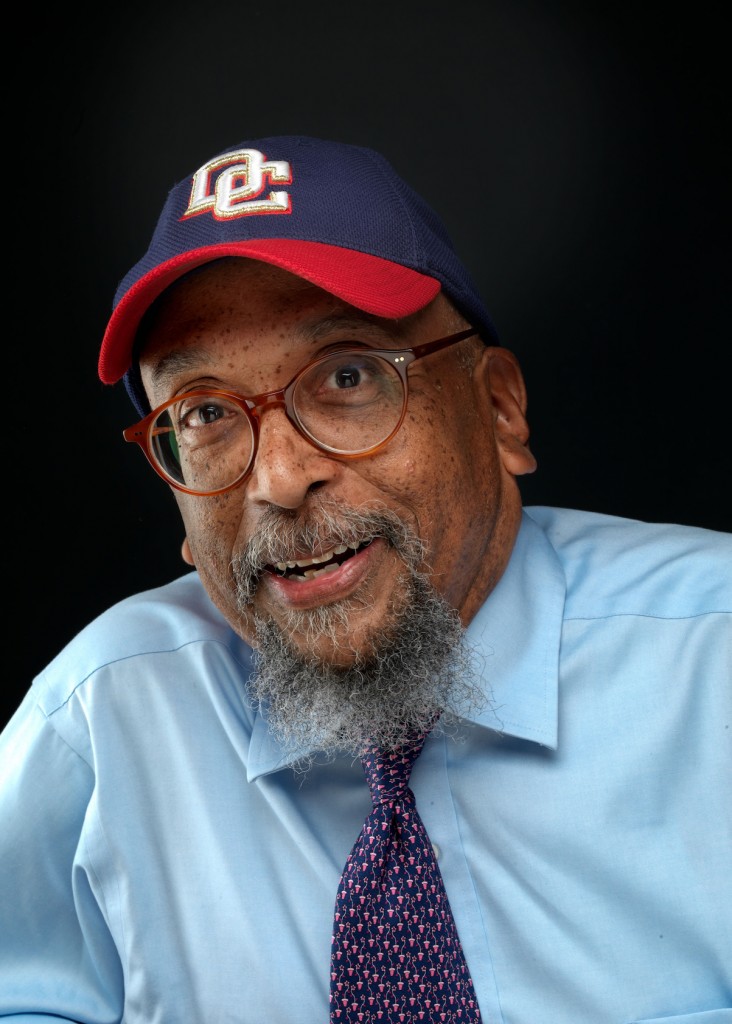
Nicholson_Eyes_OpenMidwestern Gothic staffer Giuliana Eggleston talked with author David Nicholson about his first book, Flying Home: Seven Stories of the Secret City, founding Black Film Review, working as an editor and book reviewer, and more.

**

Giuliana Eggleston: What’s your connection to the Midwest?

David Nicholson: I am a Midwesterner by convincement, in the same way I am a Southerner, the difference being I’ve actually lived in that part of the country. I lived two years each in Milwaukee, Dayton, and Iowa City in the late 1970s and early ‘80s. I sometimes wish I’d stayed in Milwaukee-it was a great town-but Washington, D.C., was and always will be home.

GE: How has your own experience growing up in Bloomingdale, Washington, influenced your creation of your fictional world? Do you find that using aspects of your own life is helpful in making a fictional place seem more real?

DN: The stories in my collection, Flying Home: Seven Stories of the Secret City, are set in an imagined version of Bloomingdale, the Washington neighborhood where I grew up. Obviously, my experiences there are part of what influenced and inspired me. But my time in the Midwest was also important-I decided to write about Washington late in my Iowa sojourn; I’d had to leave home to discover how much home inhabited me.

Early in “Gettin’ on the Good Foot,” the first story in Flying Home, the main character sees a James Brown poster with the title of one of Brown’s songs, “Papa’s Got a Brand New Bag.” Thinking about the scene after I’d written it, I was convinced I really had seen the poster when I first came back to Washington from Jamaica as a child. But I couldn’t have-the song was released in 1965, and we’d come back in 1960.

Maybe I made it up. Maybe I didn’t. I still don’t know. The only thing that matters is whether the scene is real to the reader.

GE: You used to work as an editor and book reviewer for The Washington Post Book World. Do you think that has had an impact on how you perceive reviews of your own work?

DN: I haven’t had that many reviews, but yes with this qualification: I read all reviews as if I were going to edit them. I can tell (or think I can) whether the reviewer really likes the book or is avoiding being honest about not liking it. And I (think I) can tell when the reviewer hasn’t really engaged with the book. I’ve been lucky. Reviewers have liked, and engaged with, my book.

GE: Aside from writing fiction, you are also the founding editor of Black Film Review. Do you see the two art forms as connected? Can the same be expressed through film as through literature?

DN: They are distinct media, with some overlap. Film is a visual medium, but you can’t have a movie without words. The script comes before anything else, most of the time anyway. Conrad to the contrary, however, I don’t think fiction can match the visual impact of the movies.

It’s interesting to me, though, how hard it is to make a great book into a movie. It’s so much easier to make a great movie from a bad book. Rereading The Godfather a year or two ago, I was amazed at how poor the writing was. But I’ve watched the first two films in Coppola’s trilogy many, many times. Each time, I find something new to marvel at.

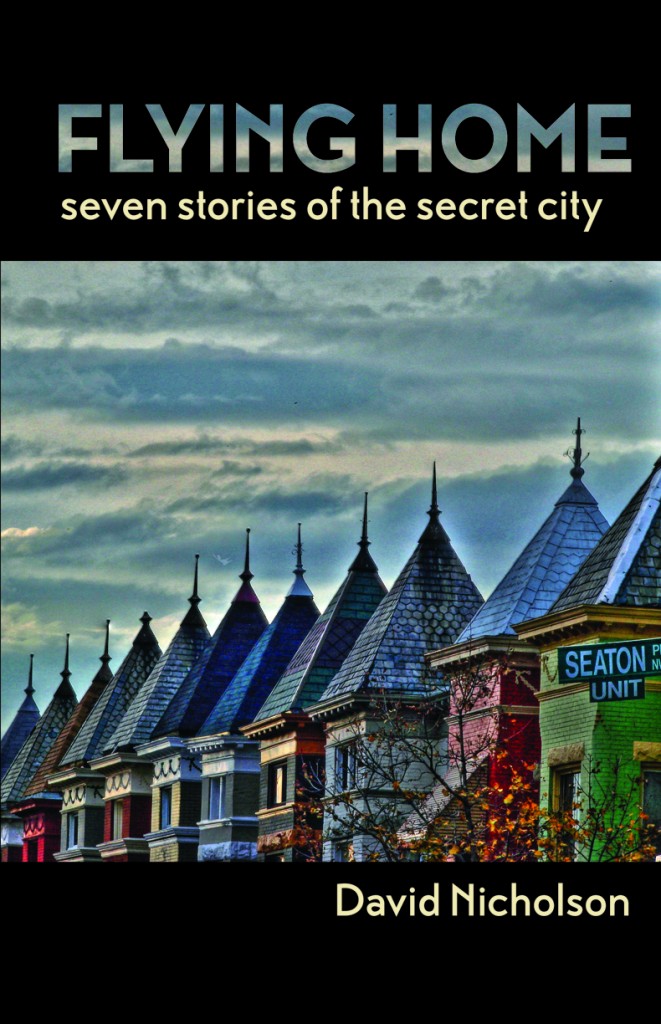
Flying_Home_Cover_v2_MailableGE: Many of your characters in Flying Home: Seven Stories of the Secret City are ordinary working people. What about this type of lifestyle speaks to you in your writing?

DN: I wanted to write about men and women like the people I knew growing up, and to render them in the full range of their humanity. Most of the people I knew back then were working-class. There were others who weren’t, of course, including most of my family. Those folks just didn’t find their way into these stories.

GE: What do you hope to reveal to your readers about the “secret city” that is Washington, D.C.? What is secret about it?

DN: A lot has changed since W.E.B. Du Bois wrote his 1932 Crisis article, “The Secret City: Impressions of Colored Washington,” but I think we black Americans still live in the equivalent of a secret city: To a large extent, the truth of our interior and emotional lives is missing from literature and popular media. I hope, in some small way, my book corrects that.

GE: What effect did you hope to achieve by writing seven stories set in the same place, as opposed to one long narrative?

DN: To be honest about it, I wasn’t really thinking about an effect. Each of the stories was conceived separately. It was only when I began to think about putting together a collection that I saw the stories were set in the same place and many featured the same characters.

GE: What’s next for you?

DN: I’m rewriting a novel, The House of Eli, whose main character is Shepherd, the Smithsonian curator in the story “Flying Home.” In the novel, Shepherd finds himself literally haunted by the ghost of a slave who was freed after saving the life of his master during the Revolutionary War.

I am also working on a biography of the Rev. William David Chappelle, an A.M.E. bishop who died in 1925. He was the comedian’s great-grandfather, but my interest grew out of research for a family history/memoir, “The Simonses of S Street: The Story of an American Family.” That book begins with the earliest ancestor I’ve been able to document, a slave who bought his freedom in 1819. I’m up to 1916 in both books.

**

David Nicholson’s stories have appeared in Stress City: A Big Book of Fiction by 51 D.C. Guys, Kiss the Sky: Fiction & Poetry Starring Jimi Hendrix, Best Stories from New Writers, and Best African American Fiction 2010. His essays have been anthologized in Black Men Speaking and Speak My Name: Black Men on Masculinity and the American Dream. He is a graduate of the University of the District of Columbia and studied at the University of Iowa Writers Workshop. Nicholson is a former editor and book reviewer for The Washington Post Book World. The founding editor of the magazine Black Film Review, he has received several grants from the D.C. Commission on the Arts and Humanities, and served on DCAH playwrighting and fiction awards panels. He has taught at the University of Maryland and Johns Hopkins University’s Washington, D.C., campus. A long-time resident of Washington, D.C., he now lives in Vienna, Va., where he is at work on a biography of A.M.E. Bishop the Rev. William David Chappelle and a family history/memoir, “The Simonses of S Street: The Story of an American Family.” Flying Home: Seven Stories of the Secret City is his first published book.

|

No Comments

|

Contributor Spotlight: Brad Felver

photoBrad Felver’s story “The Era of Good Feeling” appears in Midwestern Gothic Issue 20, out now.

What’s your connection to the Midwest, and how has the region influenced your writing?

I’m an Ohioan in my bones, and though I’ve lived other places, I think I always remained an Ohioan. But it took living elsewhere to realize what a sturdy Midwesterner I truly am.

The most profound way that the Midwest has influenced my writing is through general work ethic. Because look around. Midwesterners know how to work! Honestly, I like to work, probably because I was raised by people who taught me—true or not—that there’s as much goodness in hard work as there is in accomplishment. So I work a lot, which is good because I’m in this world populated by people who are, quite frankly, a lot smarter than I am. Working hard is the only way I can keep up. When I slack off, I feel guilty. (That’s probably the one-two punch of being raised Catholic in the Midwest—all guilt, all the time.)

From the standpoint of story, though, all this means there is conflict at the very heart of the Midwest: it simply can’t exist without lots of people doing hard, thankless, important work. So, lots of my characters have these quietly deep-seeded resentments that they just let brew in them for their entire lives. Unraveling those is fascinating work, and they help infuse the stories (I hope) with an undercurrent of conflict.

What do you think is the most compelling aspect of the Midwest?

Understatement. Everything is understatement here. Even the landscape is understated in its beauty. (I used to live in Colorado, and I loved it, but I don’t think for a minute that Colorado and Ohio would know how to talk to each other.) There’s just no trace of swagger to the Midwest, all meat and potatoes, and I’m a meat and potatoes kind of guy. I live in northwest Ohio now, a place that is just oppressively flat, but there’s a sort of austere beauty to it. These flat, green fields spread out in every direction until they get eaten up by the horizon. It’s not traditional beauty, but maybe we grade on a curve around here.

How do your experiences or memories of specific places—such as where you grew up, or a place you’ve visited that you can’t get out of your head—play a role in your writing?

There’s a little patch of land in Mercer County, OH where our old family homestead sits. That’s home for me even though I never actually lived there. I still smell that farm every day. It’s the place where I learned to love the natural world, where I learned how to drive, how to shoot a gun, how to cast an open-bale. It’s where I learned to loving tinkering in the garage. Fifteen years ago, I set my first-ever story there, an earnest but truly terrible bit of writing, and I still frequently return to dramatized versions of it.

My family had to sell the farm a few years ago. It had been in the family for 151 years. Now when I think about it, happiness and sadness mix together into some strange nostalgia cocktail.

Discuss your writing process — inspirations, ideal environments, how you deal with writer’s block.

I try to write every day, and I usually fail. I used to be much better about it, but I have a young son, and spending time with him always wins out. I also teach and have a wife I like to see. Most days, the hours just seem to evaporate right in front of my eyes. I’ve had to re-train myself to pick away at stories in between things, and I’ve found it makes me so grateful—and so ravenous—for even two or three hours of uninterrupted writing time. After 3 hours, though, I’m totally bushed. I know people who can go on these marathon sessions for eight, ten hours, and I find that generally insane and impressive. I’d rather do wind-sprints for ten straight hours than write for ten straight hours.

How can you tell when a piece of writing is finished?

The first thing the clues me in is that it moves me emotionally in some way. If I’m drawn to reading it again and again, especially the ending, that’s a good sign. That tends to mean I’ve cinched together all the dramatic and thematic threads into something coherent. I also like that thing Twain supposedly wrote in a letter’s post script: “I’m sorry this letter is so long. I didn’t have time to make it shorter.” For me, that means I’ve taken the story I want to tell and distilled it down to its absolute smallest, most efficient essence. By the time I’m done, the ABV in a story has to be very, very high. Moonshine high.

Who is your favorite author (fiction writer or poet), and what draws you to their work?

The first person who comes to mind is Marilynne Robinson, so that probably means something. I adore everything she’s ever written, from fiction to her essays on Calvin, but I go back to her novel Home most often. She always has these perfect gestures that extract profundity from the ordinary. Home has this shattering power in part, I think, because of its restraint. Her characters always leave something unsaid, but the reader realizes it’s unsaid even if the characters don’t. Dramatic irony of that sort is so hard to manage, but she makes it look easy. I’ve found that her words often manage to break the plaque in my brain free.

What’s next for you?

I’m trying to finish a novella that takes place on a little island in Galway Bay at the moment. It’s giving me fits, but I’ll figure it out eventually. I’ve found that if I just keep working on something long enough, solutions tends to just emerge. I’m also picking away at stories and essays that are in various states of disrepair. I hop around on projects often, which I used to avoid. Now, I don’t. I think it’s just part of my process, and I think there are positives to be found. If nothing else, it means I’m always working on the project that has me the most jazzed, and I think that helps me avoid vanilla prose. (The downside, of course, is that I probably put off writing really difficult bits.)

Where can we find more information about you?

Oh, I suppose the Google Monster is the best place to start if you’re really curious. I’m pretty awful at self-promotion. I had a website but then forgot about it, and I guess the Internet ate it.

|

No Comments

|

Interview: Kathy Fish / Robert Vaughan

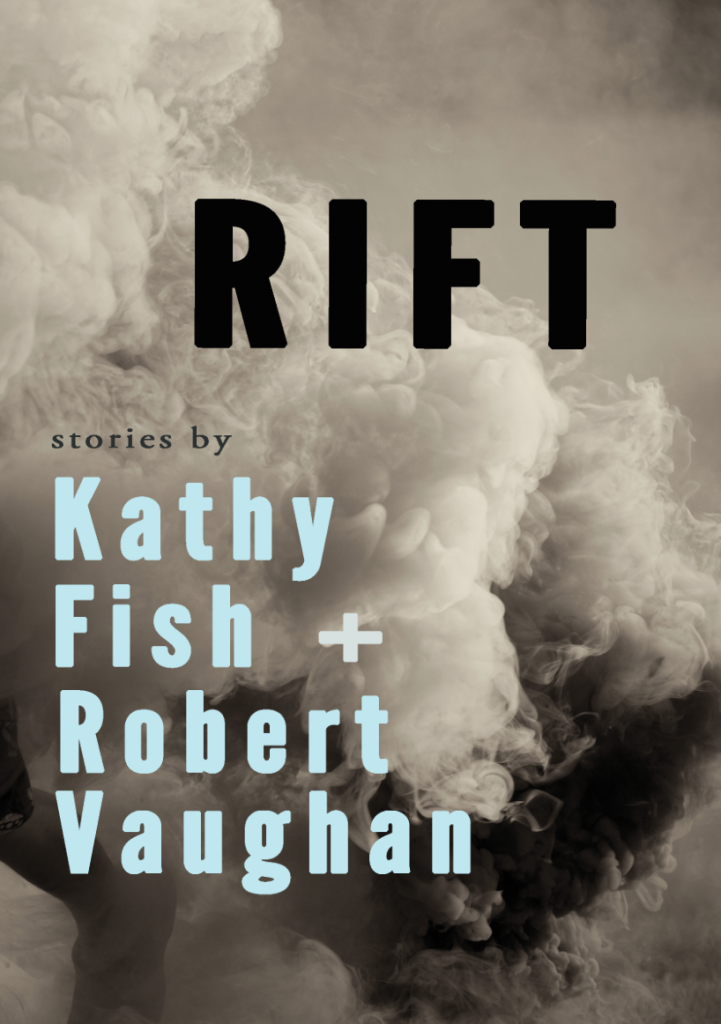
Photo on 8-31-15 at 12.44 PMMidwestern Gothic staffer Rachel Hurwitz talked with authors Kathy Fish and Robert Vaughan about their collaborate collection of stories Rift, flash fiction, trusting their work, and more.

**

Rachel Hurwitz: What’s your connection to the Midwest?

Kathy Fish: I was born and raised in northeast Iowa. Though I moved away from the Midwest in my mid-twenties I feel very deeply Midwestern both as a writer and person.

Robert Vaughan: I moved to Milwaukee, WI in 2003 and have lived in the Midwest ever since. It’s the longest I’ve ever lived in any one house, including my childhood.

RH: Rift is a collection of short stories intricately woven together by form as well as repeated phrases and ideas. What inspired you to write a collection collaboratively in this way?

KF: Robert and I have known each other as writers in the small press world for years. We met personally in Santa Fe for a reading hosted by the lovely Meg Tuite. Early in 2015, I joined an online workshop with Robert, Bud Smith, and Michael Gillian Maxwell, when Meg vacated her spot to work on her novel. As we began to work together and trade stories, Bud Smith, who among a million other things, runs Unknown Press, came to us with the idea of a collaborative book for Robert and me. I loved the idea! But let both Robert and Bud know that I had very few stories actually written at that point. Just a handful of things I’d written in the workshop with them. They were very patient with me and said, well, let’s just see what happens over the next few months.

RV: When Bud (Unknown Press) first asked me would I be interested in a collaborative book with Kathy, my initial reaction was she wasn’t going to say yes! Once she came aboard, within a month or two, we created an explosion of new work. We were thrilled with what was coming out of the Night Owl Café, and it seemed, because we were working together, and sharing the weekly prompts, that certain themes and ideas began to show up in our stories rather organically. In other words, it began to feel like a truly collaborative experience, without having to force anything.

RH: Subsequently, how did you create the mirror-like format? Did one write something in a certain style and the other would try to compose something in the same style or was it more individualized?

KF: We never set out to mirror each other’s stories, actually. As we said, it evolved organically. But Robert really was the mastermind behind pairing the stories within the book. He was able to see the book from a big picture perspective and found natural pairings for our stories. It was something we discussed and worked on at length and I gave my input, but must credit Robert with his vision in this regard.

RV: Thanks, Kathy, although you also had much input about our pairing decisions. It was all so very democratic! We’d also assembled all 36 stories of our own into the four sub-sections of RIFT prior to the pairings. And fundamentally, both Kathy and I tend to approach flash with an open, experimental bent, so I think we have that in common with the stories we selected for RIFT as well.

Screen-Shot-2015-11-02-at-9.21.04-AMRH: Rift is divided into four parts—Fault, Tremor, Breach and Cataclysm—forming a sort of crescendo to the stories as each builds upon the last. Did you intend for this collection to be in parts, or was that something that happened organically during the process?

KF: That was not initially something we were going to do, but as the collection grew, we wanted to find a way to organize the 72 stories. I suggested we look more deeply into the concept of “rift” and find a through-line of sorts. That’s when we noticed that some stories were, well, more cataclysmic and some much quieter. Once we settled on the four terms, it was amazing how easily the stories seemed to fall into the various categories. For my part, I laid the printed stories out on my dining room table and placed sticky notes on them, with the four words, working rather quickly.

RV: I did the same thing on my office floor! Post-it notes, and sub-sections galore. So ultimately we ended up with nice stories for each of the four parts of RIFT.

RH: Similarly, how did the process of writing Rift evolve and how long did it take to complete?

KF: I’d say it took roughly nine months to complete. It was a very focused and intense process. We were both writing a lot of new stories. And I had to as I had nothing really new that had not already been published in previous books! I wanted my contribution to Rift to be all new material. I can say for my part I’ve never worked so hard and so quickly and it was just an amazing process bringing our book together.

RV: Yes, it seemed like a flourish! We exchange full manuscripts options twice: first in July in Denver (I was there for a reading), and again in September. Continuing to write new pieces, while considering what to keep or dump from the original plan. It was organized chaos- a quick pace, which I liked, and uber-productive: non-stop and hyper- focused.

RH: The last two stories, Dream Maker and Akimbo, both end with absolutely beautiful images of a character opening their arms to the narrator and really the world. The two stories tie into one another exquisitely and are a truly powerful ending to the collection. How did these stories and this particular ending come to be?

KF: As we were looking at the stories on a deeper level, we began to order them, figuring out where to start the book and where to end it. Those two stories fell naturally into the Cataclysm section and we noticed the same similarity to image that you did. My story, Akimbo, had been written a few years ago, actually, and published in an anthology. I wanted to capture a couple painting a room, that had once been a nursery, in the nude and rather manically, when cataclysm strikes. It seemed perfect for RIFT and perfect to pair with Robert’s terrific story, Dream Maker. I think it was just one of those wonderful synchronicities that occur out of the blue. It was a gift. And we knew those two stories were exactly where we wanted to land our book.

RV: I’m so thrilled you felt these two paired together are an exquisite tie-in…certainly the imagery of Kathy’s Akimbo and my Dream Maker do have an open-ended, and worldly appeal. We were also looking for two pieces that had more open-ended finishes, to summon the mysteries of this great world in which we live, represented in a RIFT duality.

RH: What drew both of you to writing flash fiction specifically?

KF: I really didn’t start writing with any serious intent until after my last child was born. As a mother of four, I had very little time on my hands for writing and wanted to write complete stories. So naturally my stories were very short. I didn’t know there was even such a thing as “flash fiction” (this was in the early 2000’s). But this was a form I gravitated to and loved, still love. I love how close to poetry it can be. I love that it lends itself to experimentation and innovation. I’m really a writer who dislikes rules and templates and quickly grow bored with an academic approach. Flash allows me to write as I think, in snapshots and images and senses. It feels a little rebellious to write short shorts and that suits me perfectly.

RV: I had my first flash piece published in 1987 (included in RIFT, called Night Life). And I loved writers of short form that I read early on- Paley, Barthelme, Moore, etc. I wrote plays mostly until the early 2000’s. But I’d always kept a journal, and so my daily riffs were often flashes- often all I had time to write in addition to work. My first dip writing online was for a project called 52/250- a weekly themed workshop, anyone could join, and each week, work was posted (it’s still archived online!)- 250 words or less. From there, I bounced into other online writing sites (Fictionaut, Nervous Breakdown, etc.) and began submitting to online and print journals.

RH: What did you learn either about yourself or writing or collaborating through working so closely with another person on this project?

KF: The main thing I learned (and it was a terrific thing to learn) is to write very quickly and freely. Because I had to keep showing up, I did. I learned that the shittiest first drafts could be honed and made beautiful. I think for a long spell, I’d gotten very perfectionistic with my stories, and so plodded along, losing faith in them, in myself. Once I let go of that and allowed myself to have fun, the writing just flowed. I’m hugely grateful to Robert and our collaboration and working with all the brilliant writers I’ve been so lucky to work with over the years, for encouraging me, teaching me, and yes, pushing me a little. That list of writers if very long! But this project in particular taught me so much about just showing up on the page and creating and sharing with a sort of necessary abandon.

RV: I learned to trust my work more, to stay open to possibilities. I’d always viewed Kathy as a mentor, as someone who was more experienced, that I adored from afar. One we’d met in January, I realized that we are all in this together, in the truest sense of that cliche. We all question ourselves, and have insecurities, and when we acknowledge them, gain support, can push through and take larger risks creatively. I’m so grateful to Kathy, and the other Night Owl Café writers: Bud Smith and Michael Maxwell. And to my workshop members in Milwaukee, too. Were it not for them, I’d still be shoveling coal in the dark, wondering if it’s lie or lay.

RH: So both of you teach in some regard as well-Kathy both in the university and workshop setting, and Robert in workshops primarily. How has the workshop setting and teaching influenced your creative process?

KF: I feel very strongly that teaching is just another form of learning. You are reinforcing what you have learned by sharing it with others. Teaching is actually a little new to me and I feel the same rush of excitement and passion for it as I did when I first began writing. I’ve been so lucky to work with extremely talented writers. I feel that I am more guiding than teaching and we’re growing and getting better together. As a teacher, I’m reminding myself every day of what I need to do in my own creative process: show up, stay present, write without judgment, get a first draft down, then go back and polish.

RV: Those are great, Kathy, and I’ve learned so much from you already! There is an Asian adage that I’m going to butcher, but it goes something like this: ‘we teach what we know least about’. I feel this way about writing. There is always something more to learn. I teach so I can find out what it is. And our most effective tool as writers is to listen. Sometimes I just like to sit in a busy café, or on a train, or flight and just eavesdrop. It’s orgasmic for a writer. Much of my way into a particular piece, comes from one line I overhear.

RH: What’s next for you?

KF: I’ve been working on a novella, on and off, for quite some time. I set it aside to work on RIFT, but I plan to go back to it. I also have some stories I’d like to return to and polish with an eye to a new collection. I’m excited about both projects!

RV: Like Kathy, I set my own projects on hold to get RIFT out! So now, I’m focused on editing a couple of books, while working on Funhouse, my next full length collection- I’ve completed two of the three (or four) sections of the book. Also, Kathy and I are teaching a fiction workshop at the Mabel Dodge Luhan House in Taos, New Mexico next August 20-26, 2016. Please come!
**

Kathy Fish’s stories have been published or are forthcoming in The Lineup: 20 Provocative Women Writers (Black Lawrence Press, 2015), Yemassee Journal, Guernica, Indiana Review and various other journals and anthologies. She is the author of four collections of short fiction: Together We Can Bury It (The Lit Pub, 2013), Wild Life (Matter Press, 2012), a chapbook in A Peculiar Feeling of Restlessness (Rose Metal Press, 2008) and Rift, co-authored with Robert Vaughan (Unknown Press, 2015). She has recently joined the faculty of the Mile High MFA at Regis University in Denver where she will be teaching flash fiction. She blogs at www.kathy-fish.com

Robert Vaughan teaches workshops in hybrid writing, poetry, fiction, and playwriting. He has facilitated these at locations like Alverno College, UWM, Fox Valley Technical School, JMWW (online), RedOak Writing, The Clearing and Mabel Dodge Luhan House. He also leads writing roundtables in Milwaukee, WI. Vaughan is the author of four books: Microtones (Cervena Barva Press, 2012); Diptychs + Triptychs + Lipsticks + Dipshits (Deadly Chaps, 2013); Addicts & Basements (CCM, 2014). His newest, RIFT, is a flash fiction collection co-authored with Kathy Fish (Unknown Press, 2015). He blogs at www.robert-vaughan.com.

|

No Comments

|

Contributor Spotlight: RS Deeren

headshotRS Deeren’s story “There But Not Really There” appears in Midwestern Gothic Issue 20, out now.

What’s your connection to the Midwest, and how has the region influenced your writing?

It’s hard to talk about myself without talking about who and where I came from. My parents were from Downriver Detroit and my grandparents came by way of Ohio and Tennessee. I was born and raised in Caro, a small town in the Thumb Region of Michigan, a three county peninsula jutting out from the Lower Peninsula into Lake Huron. I went to Saginaw Valley State University and now I’m a graduate student at Columbia College Chicago. So I guess you could say that I’m thoroughly Midwest. The Thumb Region has always fascinated me, it’s a geographic dead-end fixated onto another geographic dead-end. I mean, to come up into Michigan, and the Thumb, you’ve got to have a very specific reason because, before the Mackinaw Bridge, you’d just have to go right back out the way you came when you left. I’m at a point in my life where I see the Thumb as a great place, a perfect place, to come from and also the place to go to when a life has slowed down. I want that idea to come through in my writing: generations who have put their backs to the water, keeping the rest of the world right where they can see it, where they can keep it an arm’s length away. There’s a kind of tragic safety in that which keeps me writing.

What do you think is the most compelling aspect of the Midwest?

The Midwest is always going through an identity crisis and I love that. Where I come from, there is a history of industrial life butting up to and mixing with farm life, all working class and now, with the Big Three not so big anymore, a lot of working poor, service sector jobs. Detroit isn’t so much Motown anymore but I’ve heard people calling it a potential Silicon Valley of the Midwest. I can’t really speak to that other than saying it’s something new to chew on. Now that I’m in Chicago, I’m steeped in shifting identity: a blue collar/international/city-of-parks kind of place. Then there is Madison and Minneapolis, seems like everyone wants to be in those places nowadays; traditionally working class cities with booming college appeal now. With the price of college, I can only imagine what these cities will look like in fifty years. Pittsburgh, and really all of western Pennsylvania went through this, seems like the trend is moving westward with the generations. Really, if you want to write on the human condition, the Midwest is the only place to be.

How do your experiences or memories of specific places—such as where you grew up, or a place you’ve visited that you can’t get out of your head—play a role in your writing?

Everything I write comes from memories, I just have to change everything about them before I put them on the page. There’s a concrete bridge on the road that I grew up on, spans the Cass River, small thing, unassuming. Drove over it every single day as a kid. Used to take a canoe on the river and fish under it with my family. The thing is covered in graffiti, hearts and curse words and names. I lived next to that bridge for nineteen years and never once walked under it. It wasn’t until a year or so ago when I came home for a visit that I decided to check it out. There wasn’t much, beer bottles and an old tire. But up on the, well I guess you’d call it the ceiling of the bridge, was the name of an old English teacher I had in high school and a few derogatory terms in regards to their ability as a teacher. Later, I wrote and published a short story that took place under that bridge about what is seen and unseen in a life. That’s what I go for in my writing, backroads graffiti and people who are living, active, but trapped and mostly unseen by outsiders.

Discuss your writing process — inspirations, ideal environments, how you deal with writer’s block.

I don’t sit down to write until I’ve spent a good week or two spinning a line in my mind. Something like, “I changed my name to Jamaica right after my dad died.” Something that makes me ask myself, “Why? Why do this or that or the other?” I have that first line going and as I find answers for the why’s, I start taking notes. Then once I start losing track of the idea, I sit down and write it all out before I lose it. Production via fear, I guess. Or maybe just adrenaline. The inspirations usually come from people I’ve met, the things they say, I think you’ve always got to be careful around writers, they’ll try to immortalize you.

I write alone with Jackson Browne or Bruce Springsteen playing on loop. As I write this, I’m at my desk listening to “Lost in the Flood.” I’m not disciplined enough to write in public, I’m a people-watcher.

As for writer’s block, I have recently found that once I have a draft typed up and it’s still lacking, it’s always “still lacking,” I print off the draft then copy it longhand in a journal. I get maybe three paragraphs into this and I’ll already have something new to work with. I also keep all my notes and orphaned stories that never got going. I started my first novel this summer and I’ve found that switching back from typed to longhand has helped me create more avenues.

How can you tell when a piece of writing is finished?

A piece is never finished. I think when you write realism, you’re constantly mining human life and finding new ways to tell the same three stories: love/hate, life/death, identity. Even with “There but not Really There” I still think there are things that I could have done differently. That’s writing, though, a failure at perfection, that’s life, it’s great. As for a draft? A draft is done when I get this feeling in the back of my neck, it’s almost like a kick, that says, “Yea, this is it. Yea, good for you.” Then the inner critic brings you back to reality when you start revisions.

Who is your favorite author (fiction writer or poet), and what draws you to their work?

There’s a professor who I still echo when I’m asked a question like this: That’s an unfair question, c’mon.

Boy, let’s see… I read As I Lay Dying when I was eighteen and I asked myself, “Wait… you can write stories like this?” Whenever I read Toni Morrison, I can’t help but think that her way is the only way to write character. Once I got to college, it was Donald Ray Pollock and Chuck Palahniuk, one was for myself, one was to impress this girl I once knew, both helped me write voice and refocused my writing’s point of view. A fellow MFA student turned me on to Bruce Machart. I recently met Bonnie Jo Campbell and we talked about Stanley Aladdin thermoses, the big green ones that scream, “Foreman called, I gotta go to work!” That’s the kind of writing that draws me in, Stanley Aladdin stories, doesn’t much matter who wrote it.

What’s next for you?

I just came off a very rewarding summer that ended with winning the Luminarts Cultural Foundation’s Creative Writing Fellowship and they are throwing a party in a couple weeks for that at the Union League Club in Chicago, so in the short run, I’m shopping for a suit for that. I host a writing workshop every Sunday where a few fellow writers and myself share a few oat sodas and work we’re trying to get out to lit mags. I’d like to keep that kind of writing community going. I’m plowing through the final third of my short story collection and the novel has been picking up steam. Nothing is set, though. I just put pen to paper, that’s worked for me so far.

Where can we find more information about you?

Online at rsdeeren.wix.com/written (one day I’ll own my own domain, one day) and on Twitter @RSDeeren


|

No Comments

|

Interview: Dale Marlowe

Color-headshot Hi ResMidwestern Gothic staffer Giuliana Eggleston talked with author Dale Marlowe about episodic narratives, Appalachia versus Midwest, the role of interlocutor, and more.

**

Giuliana Eggleston: What’s your connection to the Midwest?

Dale Marlowe: My people are Appalachian to the core, but my immediate family moved to the midwest in the 1960s following my great-grandfather’s murder, settling in Cincinnati, Chicago, Louisville, Columbus, Dayton, Detroit, southern Indiana. I’m one of a handful of us not born in Colts, Kentucky, in Harlan County.

My parents, my sister, and I lived in Northridge, a working-class enclave at Dayton’s north end. My folks and maternal grandmother still live there, in my childhood home. Northridge had, and has, a healthy mix of white Appalachians, African Americans, Roma, Arabs, and Latinos/as, as well as a smattering of second and third generation descendants of eastern European immigrants. Strip-clubs, adult bookstores, and liquor stores line Dixie Drive, the main drag. Prior to the Reagan era, there were even some brothels and gay bathhouses.

Well into the ‘70s and ‘80s, most residents took middle-class incomes from heavy industrial players like McCall’s, General Motors, Chrysler (or one of the dozens of machine-tool shops supporting them), Wright Patterson Air Force Base, NCR, and International Harvester. They claimed their slice of the American Dream, but guarded their heritages jealously. The neighborhoods were noisy, conflict-laden, and often hilarious.

The jobs are gone now. They took levity with them. Noise and conflict remain, but the noise comes from the conflict, and the conflict invariably arises from prostitution, drug abuse, or human trafficking. My forty-one years have tracked personally the collective, clearly criminal razing of the industrial Midwest. I’m not so much connected with the region as braided to it.

I did my first year of undergrad at St. Joseph’s College in Rensselaer, Indiana. I completed my undergraduate work at Miami University, in Oxford, Ohio. I took my JD from the University of Toledo College of Law, and did an MFA at the University of Iowa Writers’ Workshop.

Iowa is technically “the west,” I guess, as it lies map-left of the Mississippi. I’ve also lived in the Southwest, and in California. Iowa and Iowans belong to the Midwest. Iowa’s a tomato. It may hang out in the garden, but it’s really a fruit.

I started my family in Phoenix, and returned to Ohio when my father threatened to kill me if I didn’t get his grandbabies closer to home. For a decade, we lived in Tipp City, north of Dayton. For a day job, I teach English at a community college in Piqua. I should probably have a cardinal or a cornstalk or something tattooed on my ass.

GE: Is there a region that influences your writing? A type of recurring landscape or people?

DM: I seesaw between Appalachia and the Midwest, to the extent I think there’s any reality to those geographical labels. The Hocking Hills of Southeast Ohio—think Mothman—is a good example of a frontier joining Appalachia to the Midwest. It’s neither-nor, and both, and illustrates what’s better imagined as a mental continuum, rather than things to be compared.

I think of my childhood as a first-generation immigrant experience. We lived in Ohio. I’m an Ohioan. Despite that, our accent, vocabulary, slang, faith, music, and customs, all of it, came from the hills. Sometimes I feel too city for the hills, and too hill for the city. My cousins sure would tell you that. Still, Kentucky’s not home, but it’s where I’m coming from.

Sort of like the tales you hear from time to time about travelers whose countries are beset by some tragedy that removes state legitimacy? Now you’ve got this worthless passport. Stateless. What was that movie, with Tom Hanks, in the airport? The Terminal, yes. Instead of wandering around an airport in my robe and slippers, I sit behind a laptop, listing between identities.

For me, place is a spiritual portmanteau blending bluegrass and buckeye, formed of patched-together memories built of observations of environment, collected near enough in time they’ve become a “there,” a wholly new thing.

Memory, experience, time, and place generally sync up for me, but the result is a kind of authorial multiple personality disorder conflating the headspace and space-time.

I’m linked to, and influenced by two locales, and limited by neither. The “region” that influences me most lies between the ears. The disoriented familiarity jumpstart my creative faculties. That energy provides the moxie I need to move beyond off-the shelf identities prescribed by an appropriation-phobic culture. Psychic rootlessness makes me just harebrained enough to imagine I have the right, no—obligation—to inhabit any character who shows up demanding trance-channeled transcription, no matter how peculiar or foreign to me.

This has caused me to modify the “write what you know” dictum to “write what you know to be true.” I mean that. Write what you know to be true, even if it’s not. If you’re working in good faith, the worst that happens is you learn something. Most likely, even if you fuck it up, your assumptions spur dialogue.

What do I know to be true? Places more than things; narrative over “facts”—to paraphrase Faulkner: “fiction is truer than fact.” The gaps between spaces where we definitively belong, but are bad for us, where we suffer slow, gangrenous soul-rot and alienation; foothills, neither heres-nor-theres, where plains begin their rise into mountains. Tales grown in that rich black soil bloom best north of the old Confederacy, between the Alleghenies and the east bank of the Mississippi.
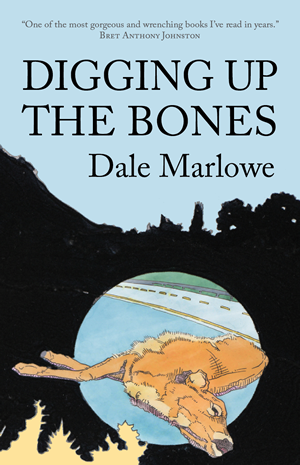
DUTBWebCover-smallGE: Your new book Digging Up the Bones, is written over the course of three generations, starting in the 1960’s. Was any research needed to write about the past?

DM: What research I conducted had more to do with little details, rather than long arcs of time. For instance, despite knowing plenty of bigots, I had trouble getting in Junie Nash’s head for Interlude at a Rather Low Order. I lurked on Stormfront for a while, watched some documentaries, and endured as much growly hate-rock as I could. To answer the question succinctly, no. Not in any formal way.

I’m one of those unfortunates cursed with good memory. Not quite eidetic, but close enough to sting. I’ve got nothing from the ‘60s, as I was halved at the time; but, I remember lots of stuff beginning in the late 70’s.

One of the first mental images I can recall is a man on television who’d dyed his beard red, white, and blue for the Bicentennial. I remember most every spurned woo I’ve pitched, lines from parts I played as high school thespian, verbatim casual conversations, affronts, and even long passages of scripture, which I adore, especially Revelation.

I’ve reinforced that “gift” with mnemonic methods cribbed from the medieval sorcerer, Giordano Bruno, and techniques popularized in The Memory Book, by NBA star Jerry Lucas. When I sat for the Ohio bar, I could locate, recall, and paraphrase long sections of the Revised Code. I’ve lost much of it in the past couple of decades, which I think proves God exists and loves me very much. The lobbyists who penned the statutes wrote so poorly laws read like cat piss smells.

The flow of Digging Up The Bones traces my life’s arc. It’s fiction, but draws on myth, told and retold, from both sides of my familyyarns that are themselves bullshit, of course. Then there are the habits and behaviors seen in friends, family, strangers, even myself. I also wove in a few threads of Southwest Ohio urban legend, as well as some nasty rumors so juicy they got stuck, permanently, in my mental grease trap. The Nashes exist only in the sense ideas do (by which I do not dismiss the “immaterial”). The meat hung on their bones was cut in physical, and emotional space, over four decades, one excruciating slab at a time.

My father, Ernest, is nothing like Errol Nash, Jr. But, like Nash, my father fought in Vietnam; he left the service with a Purple Heart and a scorching case of Post Traumatic Stress Disorder. I gained what knowledge I needed about Vietnam, and the men it scarred, in my living room.

The hippie gangsters in All Things Old Must Pass Away would’ve fit well in my dear maternal aunts’ clique; they lived with us in the late 1970’s. As teenagers, they kept the company of a dozen or so lecherous trouts. When my parents were out, the girls had their crew over. I was a well-behaved kid and I didn’t need much babysitting, so I hung back, watching people digging very, very good tunes on the hi-fi, boozing and stoned and pawing each other. These shindigs drove my parents crazy, but I loved them.

Again, I was there, but not of there.

GE: How did you go about changing the times for each generation?

DM: Nice “craft” question. That kind of stuff comes about in revision. Tiny embroideries, great fun in the gilding: I get a sly grin when I catch a gap in the text I can fill with subtle detail that, in a few words or a phrase, evokes time and place. As is often the case, less is more.

In White Folks Just Ain’t Made For This Heat, the narrator mentions the late-70’s/early-80’s Triscuit ads featuring the Partridge Family’s Sandy Duncan. That image will mean nothing to Millennials and younger, but should strike folks X-er and older like a lemon madeleine.

Yeah, tiny embroideries.

GE: Digging Up the Bones was written as a set of linked stories—what was the effect of this style of storytelling? What do you think it adds to the story? Could it have been written as one story?

DM: NYC big-pub mugwumps would call it, derisively, “episodic.”

So what? Episodic narratives can be problematic, in a structural sense, but for this effort, I embrace the epsod…episoddity?…episodicity? Whatever it is, I embrace it.

I’m not sure how to define family, but I can tell you it’s formed of discrete myths, lies, rumors, embellishments, and agreed-upon fictions that link individuals to a common narrative arc.

I can’t think of a more natural way to tell a tale where the real protagonist isn’t human, but a mutant notion of “family” built of a long string of traumas-in-common. Each character has his or her take on the crippled Nash oversoul, but even if they’ve removed themselves, they’re defining themselves in opposition.

As for “story,” v. “linked stories,” v. “novella,” v. “novel,” I’m trying to break the habit of labeling work according to structure and length. Those designations have more to do with marketing than art, have little to offer readers, and can frustrate an author’s intentions.

I have drafts of the text in novel form. My ideas of how novels work, or how they work best, made me to fret over issues neatly resolved in a less rigid format. I don’t think Digging Up The Bones worked as a novel; the benefits a unified structure gave didn’t outweigh the advantages of glimpsing defined, critical moments in the Nashes’ lives.

GE: The people featured in your novel Digging Up the Bones, seem to live on the grittier side of life, a side many are not accustomed to. What inspired you to write about these kinds of characters?

DM: I’m accustomed to these folks. They’re who I know, and who I know to be true, warts and all. They were my neighbors for the better part of my life. They’re my aunts, uncles, cousins, schoolmates and friends.

If you work in criminal law or bankruptcy or some other triage area of law, you meet lots of broken, hurting people spanning the whole socioeconomic spectrum. They may be venal, but often are justifiably so.

You come to consider bourgeois normalcy a veneer hiding common human foibles. The only difference is “the grittier side” can’t afford the camouflage.

That doesn’t mean their shortcomings are worse, just more obvious. And I sort of respect people who own their shit, even if unfortunate circumstance accounts for the disclosure, rather than some commitment to honesty.

I’m blessed in many ways, especially by acquaintance. While I bear the scent, and accent, of my background, work in law, publishing, academe, my affiliation with The Iowa Writers’ Workshop, and pure dumb luck, I’ve had the privilege to lurk among my betters.

My grandmother chides I’ve “gotten’ above my raisin’.” She gives me a hard time, but now and again I do feel like a Forrest Gump of modern American Arts & Letters. In this way, I’ve been privy to bullshit 1% cocktail-party commentary on the grittier side, but I’ve noticed there’s nuance and thoughtfulness there, too.

To the extent I think about such things, I’m inspired to take the role of interlocutor, doing my people’s stories justice while setting the scene for those who, as you put it, may not be accustomed to the gritty conditions in Appalachia, fetid trailer courts, and shitty urban neighborhoods.

GE: Aside from being a writer, you also represent people in the U.S. District Court for the Southern District of Ohio as a consumer bankruptcy attorney. What draws you to this work? Do you see this work having an influence on your writing, or vice versa?

DM: America has two systems of law; one for elites, another for everyone else. The law may ostensibly apply to everyone, (though it’s written increasingly with shameless, explicit carve-outs for the rich and powerful) but instead of guaranteeing fairness and justice, it punishes poor whites and minorities for being poor whites and minorities. In America, 2015, you get the best justice you can afford. Since 2008, not one banker has gone to jail. Think about that. Not one. If you, or I, stole $5,000, we’d do time. Steal a trillion? Well, you know.

In 2005, George W. Bush (2nd worst president in American history, after the appalling James Buchanan) and his pals enacted a bankruptcy “reform” meant to intimidate Bankruptcy attorneys, while punishing and humiliating consumer debtors. I seem to remember reading the law was written almost entirely by credit-card company lobbyists, but don’t quote me. If it’s not true, it ought to be.

Even with Bush’s, and the Congress’, spite, consumer bankruptcy remains one of the few areas of law left where an attorney can make a difference in the lives of the working class and poor.

Sure, I see jackass deadbeats. I hold my nose when to represent them. But the majority of people come to me after tragedies like divorce, illness, job loss, spousal deaths, or failed businesses. Even deadbeats disgust me less than the banks and insurance companies they inconvenience.

You know what? At least these deadbeats didn’t borrow a trillion dollars from China on my grandchildren’s behalf to pay off their buddies’ gambling debts to anonymous, private third parties. So fuck ‘em. I’ll take the deadbeats, any day, if I have to choose the quieter of two flatulent arsepuckers.

Since 2004 I’ve helped stop foreclosures, liberated hundreds from usurious credit-card debt, crammed-down predatory loans, spurred clients’ financial rehabilitations, and bested pay-day loan sharks.

Lots of lawyers think of our profession as a miserable way to make a living. That’s true for many, but it’s more fun to champion the underdog. I love the smell of unsecured debt held by a major bank in the morning.

One reason I studied law is many people in my life found themselves on the business end of criminal prosecutions, or as defendants in trifling debt-related lawsuits. None of us understood how those processes worked. And, we assumed we couldn’t afford a lawyer. I hoped to learn the law’s habits, so I wouldn’t fear it, and also maybe help those I love, and people like them, navigate its mysteries. Besides, if you can write and speak with any facility, and you don’t have other plans, the college career services lady will make you go to law school

Also, before going to law school, my for-publication writing (by which I mean formal writing subject to relentless revision, usually fiction, as opposed to less formal, conversational writing like email interviews) was much weaker. There’s an emphasis in legal writing on clarity, brevity, and an obsessive attachment to active voice that beefed-up my prose, while at the same time, curiously, caused me to prefer a less casual syntax that gives the prose what some commentators call “baroque” flourishes. I was able to bring that to the fiction, and I think the fiction is better for it.

GE: How do you begin making characters, what is first aspect of a character that comes to you? What is the process that you go through before you know a character will be part of a story?

DM: I think in mystical terms on this subject; I’ve had astrological and tarot readings done for particular characters. I meditate on the their personalities, letting them percolate in the hind part of my mind. Like materializing ghosts, they form from elements taken out of their environments, those things near them that are most like them in essence—shading, clothing, accent, posture. I listen for the character to speak in the text, as I write.

In many cases, characters arrive at Casa de Marlowe fully formed, after a flash of the epiphanic moment in a story arc that will define them. Knowing how that character will change gives me a nice before/after snapshot.

Characters can be infuriating. Sometimes they show up with their own ideas about how the story goes, and trash 5,000 hard-won words. That sucks, but when characters become real enough to disrupt their worlds I know it’s time to stop writing, and start transcribing, and get the fuck out of the way. That’s when we touch The Song, when we’re hearing it as writers, in that meditative state where we’re channeling anew some variation on that Story the Universe is telling us, ceaselessly.

I think of the craft as a vocation. Vocations usually prescribe means to cultivate awareness in those who’ve taken those vocations. Writers are disciples of the Word. Our work is a religious observance. It’s a means of prayer. The process draws many of us into a mental state akin ecstasy. The reverie is subtler, but no less potent.

GE: What’s next for you?

DM: 2014 was a watershed for me. I broke my back, had two major surgeries, two minor ones, a dozen other procedures, three lengthy hospital stays, and got some sort of slow-grow infection that tried to hollow my spine from the inside out.

I spent a year in bed, opiate-numbed. My muscles have atrophied to the point my daughters renamed me “Squishy.” We had move, as I am now too decrepit to handle two flights of stairs.

(An aside: I kicked Oxycontin, Percocet and morphine in a single month. I sat in bed and cried for two weeks. It was horrible. Now, I have nothing but empathy for addicts of any sort).

Thankfully, I’ve recovered as much as I will, but I’ll never be the same. I wish I hadn’t taken vigor, stamina, and strength for granted. I sure do miss those things.

To my surprise, the world kept spinning while I healed. Projects I was involved with concluded, for better or worse, without me. My law practice dwindled. It’s as if I watched my own midlife crisis from the outside.

I had no idea a clean slate would be so liberating. In that spirit, I’ve abandoned, at least in the near term, a trio of long-form fiction projects that have vexed me for a decade. Man, that feels good. It hurts to give up on them for now—kind of like leaving a toxic, but comfortable romance—but there are good things stirring in this silence.

Where the muses lead, I will follow.

**

(Stephen) Dale Marlowe’s work has appeared in numerous publications. He is a graduate of the Iowa Writers’ Workshop. From 2004 to 2012, he wrote features columns at Chapati Mystery, under the nom de guerre Farangi. A story collection, Digging Up The Bones, The Weight of This Life, a graphic novel (with Aaron Lindeman), and Honky Fatwas, a retrospective chronicling a decade’s-worth of essays for Chapati Mystery, are each scheduled for 2015. He is COO at Potemkin Media Omnibus, Ltd, an English professor at Edison State Community College, and as the spirit moves, he represents people in the U.S. District Court for the Southern District of Ohio as a consumer bankruptcy attorney.

|

No Comments

|