Interview: Bao Phi

September 7th, 2017

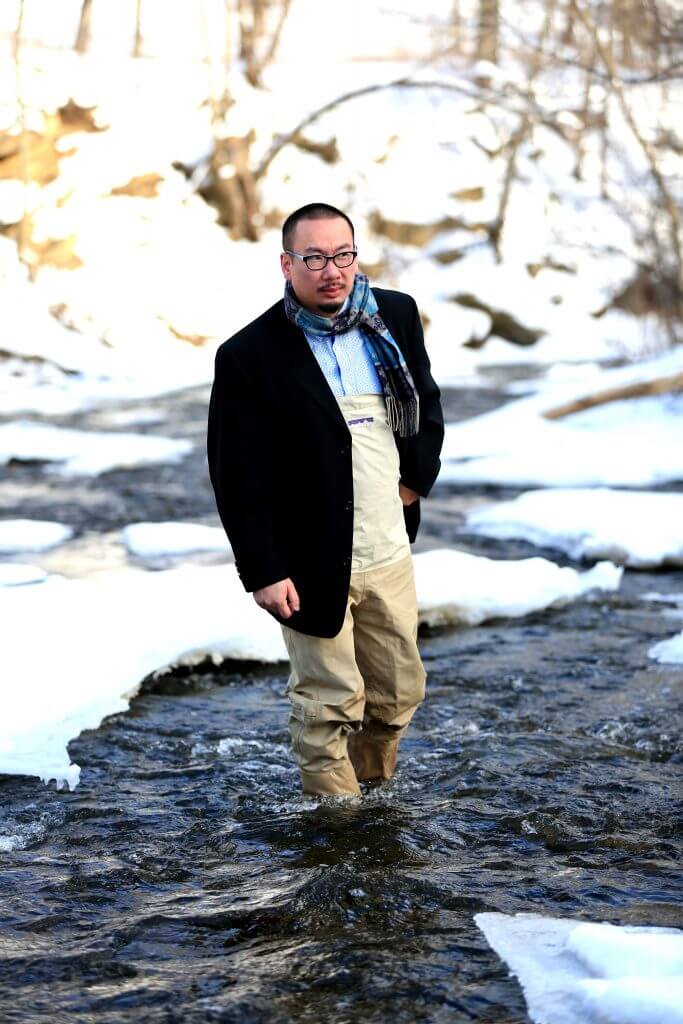
Bao Phi author headshot

Photo credit: Thaiphy Media

Midwestern Gothic staffer Kathleen Janeschek talked with poet Bao Phi about hatred from lack of understanding, approaching his work naturally, being a champion slam-poet, and more.

**

Kathleen Janeschek: What is your connection to the Midwest?

Bao Phi: Even though I was born in Vietnam, my family fled and came to the Phillips neighborhood of South Minneapolis when I was a baby. I’m pretty much a lifelong Minnesotan.

KJ: How does the varied geography of Minnesota inform your writing?

BP: When I was very young, I remember my family had a lot more connection with rural people in Minnesota. I think because we came from a country that was still very close to agriculture. We would go out to farms fairly often, and buy vegetables and meat directly from farmers. And farmer’s markets every weekend. But Phillips, where I was raised and where my parents still live, is very much the inner city – Minneapolis’s largest, poorest, and most racially diverse neighborhood. The Little Earth housing projects is two blocks from my parent’s house, and the Franklin Avenue Library, where I learned to love books, about six blocks away. My dad would often take me on fishing trips, sometimes by a mucky pond by the highway, sometimes renting a trailer at Mille Lacs. Not for sport, but for food. I got to know the city by skateboard in my junior high days, and as I got older, I go out to Greater Minnesota, sometimes for work, sometimes as a tourist. My father always tried to instill an appreciation for nature in me, and I am trying to pass that along to my daughter.

KJ: In which ways do the people of Minnesota contrast with the landscape of Minnesota?

BP: It’s funny, in the old days, I felt like the people we met in rural areas of Minnesota were more open to us. They approached us with curiosity and were very friendly, whereas people in the city seemed really racist and violent and intolerant. Families like mine were often blamed for the Vietnam War, even though my father fought on the same side as the Americans – people didn’t understand, and back in the old days it seemed like most of that hate was in the city. In terms of the people and contrast – that’s hard to say, honestly. I’ve lived here so long that I’ve gotten to meet all different types of Minnesotans, so I find it difficult to generalize. I would say the perception of Minnesotans by outsiders, however, is that we are unsophisticated, boring, minor. I don’t think that’s true, obviously.

KJ: Your poems often switch between conversational and formal language. Is this transition intentional or something that naturally occurs in your writing?

BP: It’s a combination of how I write and what happens during the editing and revision process. It’s also probably about who I am – I went through a creative writing program, but as a spoken word artist, back when the idea of a spoken word artist going through a creative writing program was somewhat rare. I also often think of something the great poet R. Zamora Linmark advised me: “don’t edit the duende out of your poetry.”

KJ: Likewise, many of your poems include words or phrases from Vietnamese. What do you hope to achieve from this medley of languages?

BP: It’s just a part of who I am. I try not to force it – I tend to use it as I would naturally use it in real life, especially with the newer work.

KJ: In American discourse, there is often a conflation between the black experience, urban experience, and poor experience. How do you seek to challenge these narratives in your writing?

BP: First of all I think it’s tremendously important to lift up and support Black, urban, poor voices and art. Simultaneously it is important for us to challenge the dominant racist archetype of the Asian as the successful, overachieving model minority that doesn’t struggle against racism in this country, or against empire and colonization. I think the key word there is simultaneously – because often, we in America get caught in binaries and competition. Asian American struggle is often obscured by the model minority myth, but I want to make it clear that this is not the fault of Black people and Black voices. Those of us on the margins – Black, Native, Asian American, Latinx, Arab, Middle Eastern, Queer, Women, and all intersections of those identities – often get boxed into one or two simplistic narratives. My hope is to challenge and explode those simplistic, un-nuanced narratives.

KJ: How do your Vietnamese and Asian identities influence your writing? Do you ever find these identities at odds with one another?

BP: Tricky. I think Viet Thanh Nguyen, author of The Sympathizer, said it best: many of the contemporary Asian American movements are rooted in the collision of third world alliance, Marxism, and socialism, but many Vietnamese in America are here due to conflict with the Communist Party of Vietnam, and so a lot of Asian American liberation rhetoric can be triggering for Vietnamese people, especially of a certain generation. It’s a challenge that should be familiar to all writers: how do you stay true to your ideals and beliefs while not alienating your community – and how do you do that artistically? It’s a constant struggle.

KJ: You’re also a slam poet–and a two-time Minnesota Grand Slam champion and a National Poetry Slam finalist–so what has slam poetry taught you about written poetry?

BP: Urgency, passion, overcoming your fear, communicating difficult ideas and stories to an audience. But honestly that’s where my interest in poetry was before I slammed. I was in Speech Team, Creative Expression, at South High school back in 1992 and 1993. We were one of the few inner city schools that competed in Speech back then. So usually I was competing against suburban white kids who wrote funny essays, and here I was, this intense, awkward, Vietnamese refugee from the hood with braces and bad acne doing angry poems about racism. Sometimes it went over surprisingly well, and sometimes, well, you can guess some of the comments I got from the white suburban judges. You know, racism doesn’t exist, anger isn’t the answer, etc. But all of that prepared me to create armor for myself.

KJ: Are there any notable differences in your creative process when working with slam poetry or written poetry?

BP: No. I write poetry, and then I figure out what’s the best way to perform that poetry in front of an audience. The reading/performance of poetry is, in itself, craft.

KJ: What are some of your greatest influences in media other than writing (eg: film, music, art, etc.)?

BP: Everything – movies, television, comic books, all types of books (moving for me always sucks because of my book collection), music, table top role playing games, video games.

KJ: What’s next for you?

BP: I’ve been pretty much writing a poem a day for the last two or three years, though sometimes I take a “vacation.” I’m kind of writing a fractured memoir in verse, kind of writing some poems about a Chinese delivery boy who opens a door to an alternate dimension. I’m a single co-parent, so i’m trying to raise a kid while working as Program Director at the Loft and continuing my artistic practice. I have my first children’s book, A Different Pond, illustrated by the great Thi Bui and published by Capstone, coming out this summer, and my daughter has requested my next children’s book be about her. I’m looking at two bedroom domiciles for me and my daughter on one person’s salary which puts me in competition with dual income households with no children in a cutthroat housing market, which means I picked a bad time to get off anti-depressants.

**

Bao Phi is a two-time Minnesota Grand Slam champion and a National Poetry Slam finalist whose poems and essays are widely published in numerous publications including Screaming Monkeys, Spoken Word Revolution Redux, and the 2006 Best American Poetry anthology. The spoken word series he created at the Loft Literary Center, Equilibrium, won the Minnesota Council of Nonprofits Anti-Racism Initiative Award. His second collection of poems, Thousand Star Hotel, was also published by Coffee House Press on July 5, 2017, and his first children’s book, A Different Pond, illustrated by Thi Bui, was published by Capstone Press in August of 2017.

Contributor Spotlight: Natalie Teal McAllister

Natalie Teal McAllister author photoNatalie Teal McAllister’s story “If There Was Ever a Time” appears in Midwestern Gothic‘s Summer 2017 issue, out now.
What’s your connection to the Midwest, and how has the region influenced your writing?

My connection to the Midwest manifests in a photograph of my great grandparents standing in front of their claim shack: just a one-room structure constructed rock by rock, the family smiling in front of it, a dog at their side. My grandfather told me stories about his father, who was a traveling Methodist minister in the panhandle of Oklahoma in the 1920s, and stories about growing up in a land where there was either too much or not enough water. Toward the end of his life, my great grandfather allegedly gave up religion by proclaiming to his family that he could worship just as well in outside in nature as he could in a church. He handed off his love of the outdoors to my grandfather, who in turn handed it off to my father, and of course, to me.

My dad and I moved to Kansas when I was 10, and although I’ve lived in Kansas City for seven years, I’m still drawn to the landscapes that are more sky than earth. Despite common belief, my corner of Kansas is far from flat. The line in If There Was Ever a Time about the hills like curled up coyotes–I’ve been thinking about that for a long time. I find that so much of my writing involves how people interact with the land they live on as well as how they interact with the history–the memories–of the place.

What do you think is the most compelling aspect of the Midwest?

I’m fascinated by the lack of physical barriers here. And the wind, which never, ever stops. I actually spent my early childhood in the mountains of North Carolina, and it was a little disorienting to move to a place where you didn’t feel the landscape cradle you. The prairie as a landscape is punishing but full of color and movement. You see this in paintings and photography, too–it’s a landscape of sky, not earth. But this makes for an interesting backdrop to stories. How can characters survive the emptiness, the brutal weather, the persistent wind?

How do your experiences or memories of specific places—such as where you grew up, or a place you’ve visited that you can’t get out of your head—play a role in your writing?

They are everything in my writing. I’m obsessed with dirt and memory. A friend of mine calls my writing historical recursion, and I love that term. I’m interested in the ways we keep repeating what has already happened, and I mean this in big and small events. We tend to do the things our parents did, and their parents did, and so on. And I wonder how much of this is genetic memory and how much of it is a record player of sorts. In that regard, does the land hold memories, too? I’d like to know. Maybe that’s what we think of when we think of ghosts.

Discuss your writing process — inspirations, ideal environments, how you deal with writer’s block.

I need a place before I can do anything. If I can’t see the place I’m writing, I can’t put characters on it. I tend to start with a mental image of something strange–maybe a dog running down the road or in the case of If There Was Ever a Time, someone told me their dying horse had been spooked by their neighbor’s motorcycle. I work backward from there. How did that dog get on the road? What does it look like when a dying horse spooks?

How can you tell when a piece of writing is finished?

This isn’t helpful, but it’s a feeling. That. That’s the word that comes to mind, anyway, when I know the story is where it wants to be.

Who is your favorite author (fiction writer or poet), and what draws you to their work?

Can I say something really cliche? I’m completely enamored with Hemingway’s short fiction. He has absolutely mastered the art of writing stories about nothing–like a cat in the rain–that are packed with sorrow and hope and humanity. And he makes it seem so simple. As for contemporary writers, I’m deeply in love with Denis Johnson’s work. I’m not sure I can point to a writer who can write a more beautiful sentence about the underbelly of society. I’m heartbroken there isn’t more from him to come.

What’s next for you?

I would love to find a home for my first novel, which is a book about three brothers who may or may not have been involved in the death of a young girl. The core of the novel is their mother–like so many mothers before her, she’s forced between protecting her babies and accepting the consequences of what they’ve done. I have two small children, and the subject of motherhood is really raw for me right now. I’ve been working on flash fiction pieces about some of the more trying aspects of mothering.

Where can we find more information about you?

Twitter is a great place to follow my musings. I’m a marketing director by day under my married name–Natalie Jackson. It’s kind of like having an alter ego.

|

No Comments

|

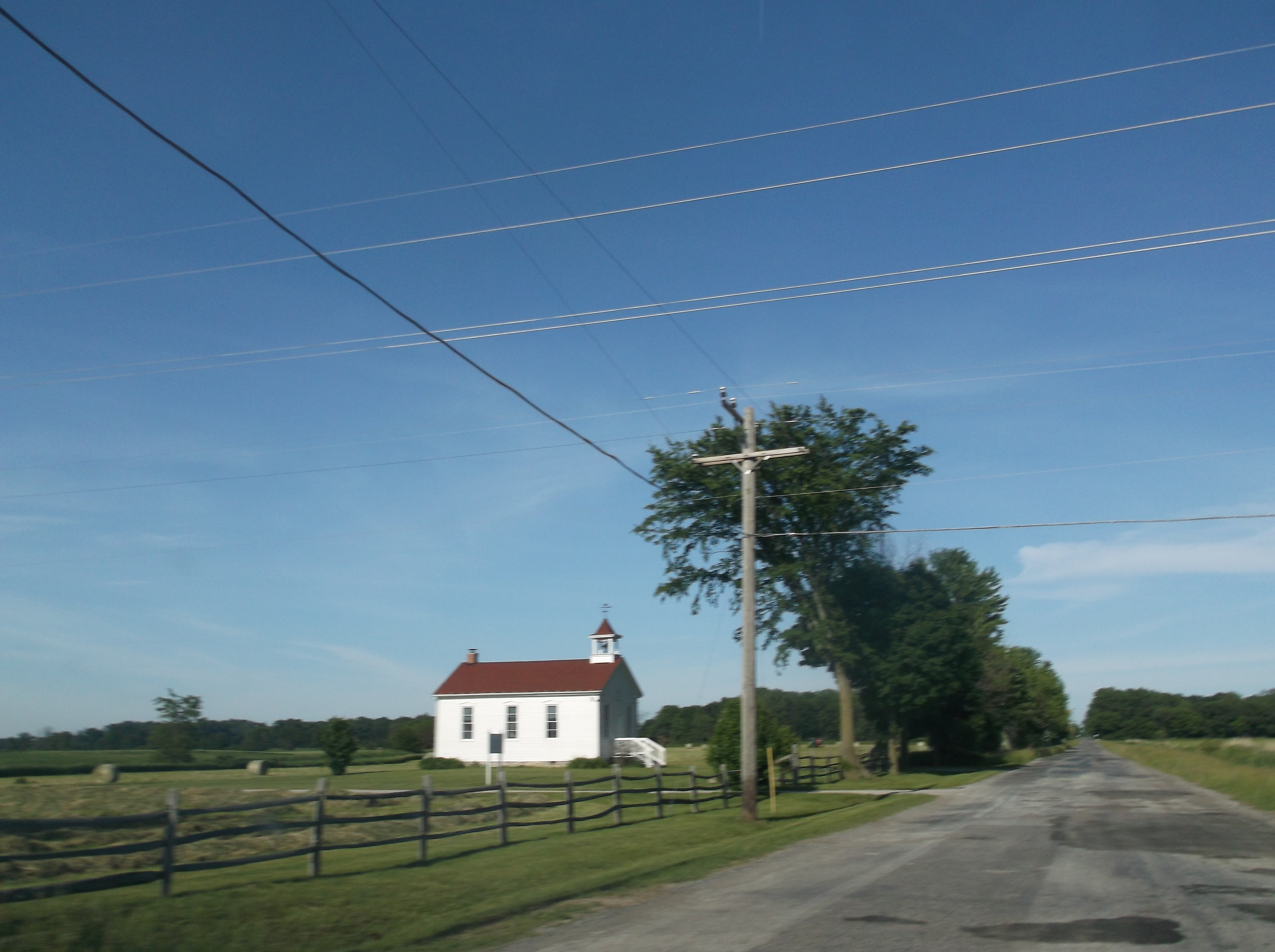
Midwest in Photos: Hart One Room School, Frankenmuth MI

“and friends this is the realest place I know,
it makes me squirm like a worm I am so grateful,
you could ride your bike there
or roller skate or catch the bus
there is a fence and a gate twisted by hand,
there is a fig tree taller than you in Indiana,
it will make you gasp.” – Ross Gay, Catalogue of Unabashed Gratitude.

Photo by: Cheryl Vatcher-Martin

|

No Comments

|

Interview: Olivia Clare

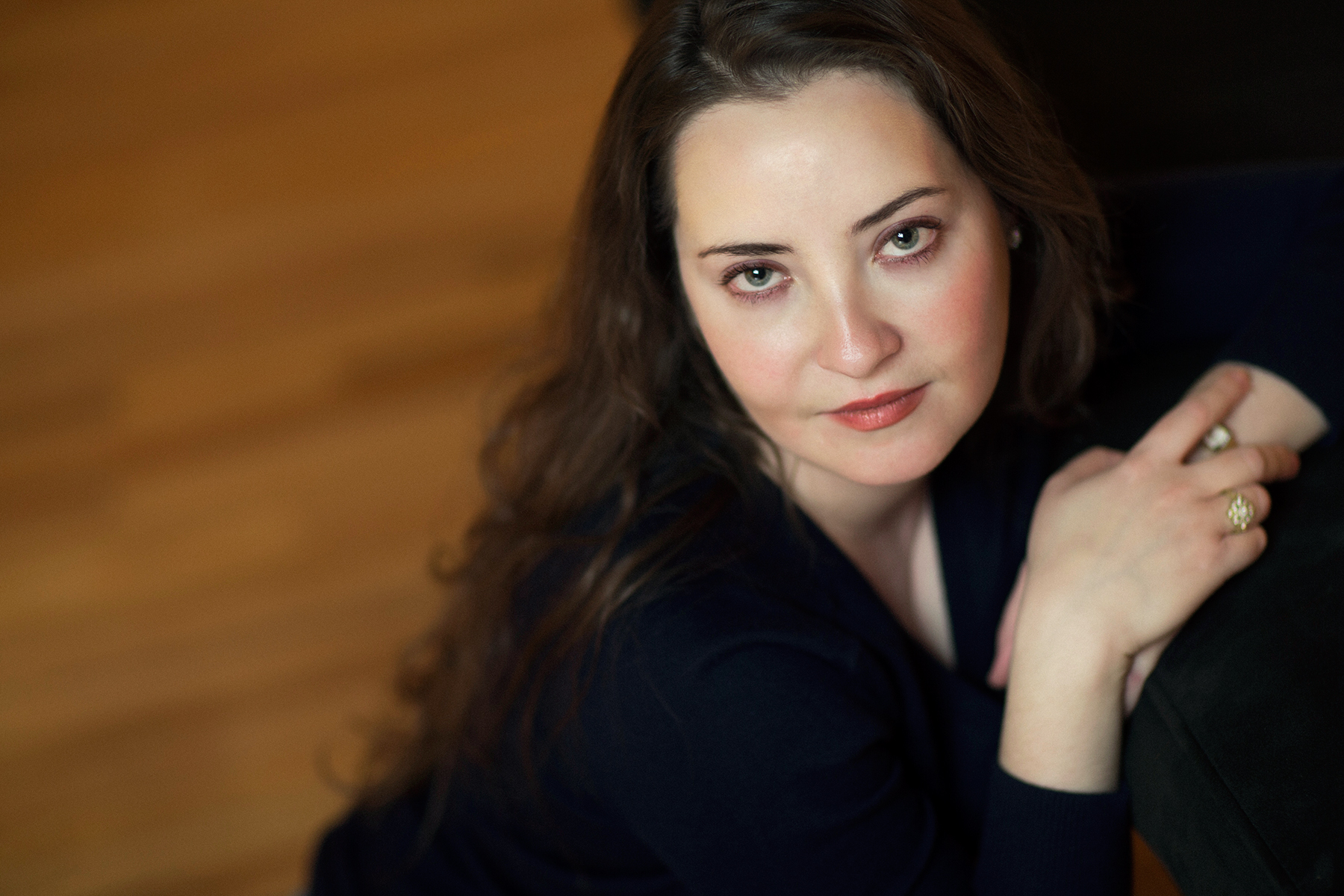
Olivia Clare author headshot

Photo credit: Aaron Mayes

Midwestern Gothic staffer Audrey Meyers talked with author Olivia Clare about her book Disasters in the First World, sentence-driven characters, feeling her way into an ending, and more.

**

Audrey Meyers: What’s your connection to the Midwest?

Olivia Clare: I lived in Iowa for two years while I attended the Iowa Writers’ Workshop for poetry. I’d never lived in the Midwest before. I remember anticipating encounters with cornfields, definitely, and I also knew I’d be joining a wonderful literary community in Iowa City.

I saw snow for the first time in Iowa. When I saw an ice scraper in the trunk of a friend’s car, I had to ask them what it was. I remember friends freezing while they smoked cigarettes on my back porch.

I was also a bit of a hermit, and much of my time was spent reading and writing. On some weekends I’d venture out on long drives. There’s a vastness in Iowa that allowed thoughts to come to the surface that hadn’t before.

AM: You’ve lived all over America from Louisiana to California to Texas. How have your travels impacted your writing?

OC: I’ve been fortunate to travel a good deal, and those places stay with me in my writing. For example, in June 2010 I went to Iceland just after Eyjafjallajokull erupted. I stayed in Reykjavik and in a rural dale called Skorradalur. I was in Iceland for about 6 weeks. After that trip, I wrote “Petur,” a story about a mother and son in Iceland just after the eruption of Eyjafjallajokull.

At the same time, travel and uprooting yourself over and over can be hard on the writing life. It’s difficult to establish a routine. My notes get lost on napkins or tickets or receipts. Or I’ll just neglect to write things down. So much of my writing happens when I’m feeling settled at my desk.

For the last 15 years or so, I’ve lived in about 10 different places, hopping around for various reasons. I once prided myself on being able to fit all of my belongings in my car. I’m settled in Texas now (I’m a professor at Sam Houston State University), and I’m very happy to call Texas home. I plan on some travel this summer.

AM: What is a disaster to you? How is this reflected in your book Disasters in the First World?

OC: Don DeLillo says that “catastrophe is our bedtime story.”

My story collection is thinking through what constitutes a disaster. Acts of nature—volcano eruptions, meteorites, droughts. But also: domestic disasters, individual disasters, personal—infidelity, anxiety, loneliness, estrangement.

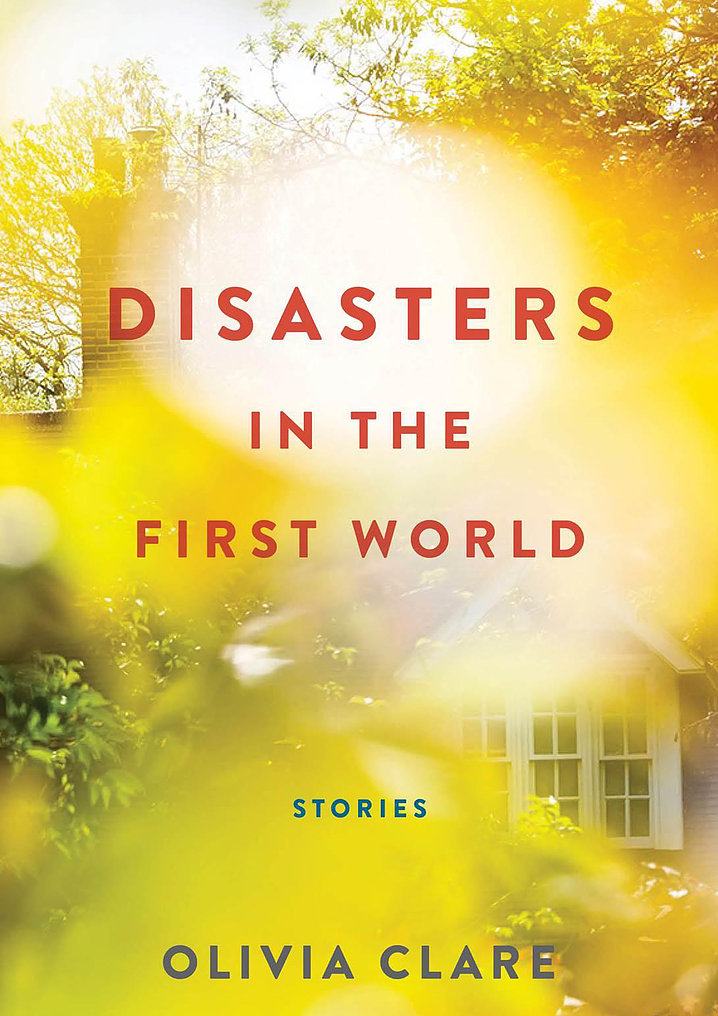
Disasters in the First World book cover

AM: Why did you decide to write thirteen stories within Disasters in the First World? How does each piece of this structure relate to overall theme of the book?

OC: I originally had 14 stories, but I wanted to cut one of the stories in the end, and my editor agreed. I’ll admit that at first I was a touch superstitious about that; the number 13 felt ominous to me. But then I had a different thought: “unlucky 13” could be thought of as a disastrous number. Thirteen is a great number for the book, I decided.

AM: How do your characters represent humanity?

OC: My characters are constantly struggling with intimacy and how to achieve it—intimacy in friendships, familial relationships, romantic relationships. They struggle with their sensitivity and what to do with it.

AM: What aspects of human nature do you focus on in Disasters in the First World?

OC: I write a good deal about longing and the uncertainty that comes with it. Wanting to believe in things that aren’t there. Wanting to speak to things that aren’t there…a certain kind of longing that reaches to and past other humans. Those are the aspects of human nature I’m most interested in for the book.

AM: What genre or style of fiction would you label Disasters in the First World? Why?

OC: I think of these stories as character-driven. But they’re sentence-driven, too. The characters will often tell me where the stories need to go, certainly. Sometimes the sentences tell me the story, too. If I’m struggling with plot, I keep trusting the sentences, one by one. They’ll lead the way.

AM: How do you know when a story is finished?

OC: My background in poetry helps me with this. I often approach the ending of a story the way I approach the ending of a poem. Sometimes the ending will come to me in the rhythm of a sentence. I know the rhythm that I want, and I have to put in the words. I put my ear to work quite a bit in my writing, and that’s especially true for the ending. Sometimes I’ll know the tone of the ending before I know what words go there.

I often feel my way into the ending, and that’s a particular feeling that poems—reading and writing poems—have taught me. I think of it this way: sticking the landing, but giving it a little lift, too.

AM: What’s next for you?

OC: I’m finishing a novel that takes place in southern Louisiana, just after Hurricane Katrina. After that, I have plans for a book of linked stories about three sisters. It’s possible that manuscript will become a novel; if it does, I’ll have a manuscript of short stories going at the same time. I’m too committed to the short story to abandon the form for too long. New poems are underway, too.

**

Olivia Clare is the author of a short story collection, Disasters in the First World, from Black Cat/Grove Atlantic. She is also the author of a book of poems, The 26-Hour Day (New Issues, 2015). Her fiction has appeared in Granta, n+1, Boston Review, Southern Review, and The O. Henry Prize Stories 2014, among other publications. Her poems have appeared in Poetry, Southern Review, London Magazine, FIELD, and elsewhere. She holds master’s degrees from the Iowa Writers’ Workshop and the University of Southern California, as well as a PhD from the University of Nevada. She is an Assistant Professor in Creative Writing at Sam Houston State University.

|

No Comments

|

Views From The Heartland: Sera Hayes


Midwestern Gothic staffer Ben Ratner spoke with photographer Sera Hayes about her creative process, the intersection of photography and literature, and more.

Sera Hayes was born and raised in the Midwest and graduated from Knox College in Galesburg, IL. She’s worked in the publishing and tech industries in Chicago and actively practices photography. Sera is available for freelance photography work and open to collaboration. http://serahayes.format.com/ Contact: serahayes@gmail.com

* * *
Ben Ratner: What is your connection to the Midwest?

Sera Hayes: I was born and raised in St. Louis, Missouri, attended Knox College in Galesburg, Illinois, and I’ve resided in Chicago for the last nine years. I’ve traveled to many different parts of the country but I’ve always thought of the Midwest region as “home”.

BR: What launched you into the world of photography?

SH: I’ve been interested in and actively practicing photography since high school when I first started experimenting with digital and Polaroid cameras. I’m drawn to film and visual art, but I’m not skilled at drawing or painting. Photography as a medium has always been an accessible and intuitive creative outlet for me. It feels like second nature at this point because it’s been essential to the way I process the world and my experiences for most of my life.

BR: What do you think photography as a medium can add to the literary profile of the Midwest?

SH: I won’t pretend to be an expert on the literary profile of the Midwest, but I can speak from personal experience with Midwestern literature as someone who has roots in the Midwest (and a sense of its insecurities). I think there are a lot of misconceptions about the Midwest in general. It’s a region that sometimes feels overlooked by the rest of the country and the world in terms of interest/desirability. The landscape, though varied, doesn’t appear as dramatic at first glance here as it does in the East, West, Southwest, etc. I think the best writing about the Midwest exposes the subtle beauty in what might have been previously dismissed or overlooked–giving depth to a specific place and the people who live there. Photographs of the Midwest have their own way of telling these stories and can also express this sense of place and symbolism.

BR: If there is a common subject that runs throughout your work, it’s small-town America. What is it about this part of the country that captivates you so?

SH: When I was growing up, my family was a road trip family. I have memories of pulling off of the highway on the way to our destination to visit a diner, a historical marker, or a roadside attraction. I also lived in Galesburg, Illinois for four years in my early 20s and experienced living in a small town in a way that I hadn’t before. Small-town America visually resonates with me, partially because of these life experiences but also because it tends to be an aesthetic, thematic microcosm of bygone American eras. The manufacturing history, pastoral scenes, faded hints of a flawed American Dream through sometimes crumbling infrastructure–cracks in the foundation of capitalism. The kindness, strength, and optimism that can be found in people in spite of disenfranchisement, economic struggle, or personal tragedy. These things clearly aren’t isolated to these areas, but I get a raw sense of that history here and its connection to our present.

BR: I’ve noticed that neon signs are a recurring theme in your photography. Most of the time, however, they are unlit. Can you describe your intention behind this creative choice?

SH: I do have a bit of a vintage neon sign obsession. Re: lit vs. unlit, in all honesty sometimes it’s less of a specific choice and more a matter of the time of day that I’ve encountered something I want to photograph. I’m sometimes traveling by myself when I’m photographing these signs and many of them are in disrepair—they’re attached to old motels, etc. in areas unfamiliar to me in terms of safety. So I usually err on the side of caution (particularly as a woman) when I’m photographing things alone at night. However there are times when I specifically know I want to photograph a particular sign at a certain time. Time of day can completely change the mood in a photograph of a neon sign. If I want to capture a quiet, eerie, mysterious nighttime mood, I make that specific choice. If I want to show the weathered colors/bones of a sign as a signal of time passed, daylight works best for me.

BR: We have a few of your photos here that are new to the MG site. Can you take us through your creative process? How did you come across each moment and why did you feel the need to capture it?

SH: Choosing what I’m going to capture is pretty intuitive for me, so I don’t really have an extensive creative process. I typically have some type of camera with me at all times and I tend to seek out places that I know I’ll find visually interesting. For these moments specifically:

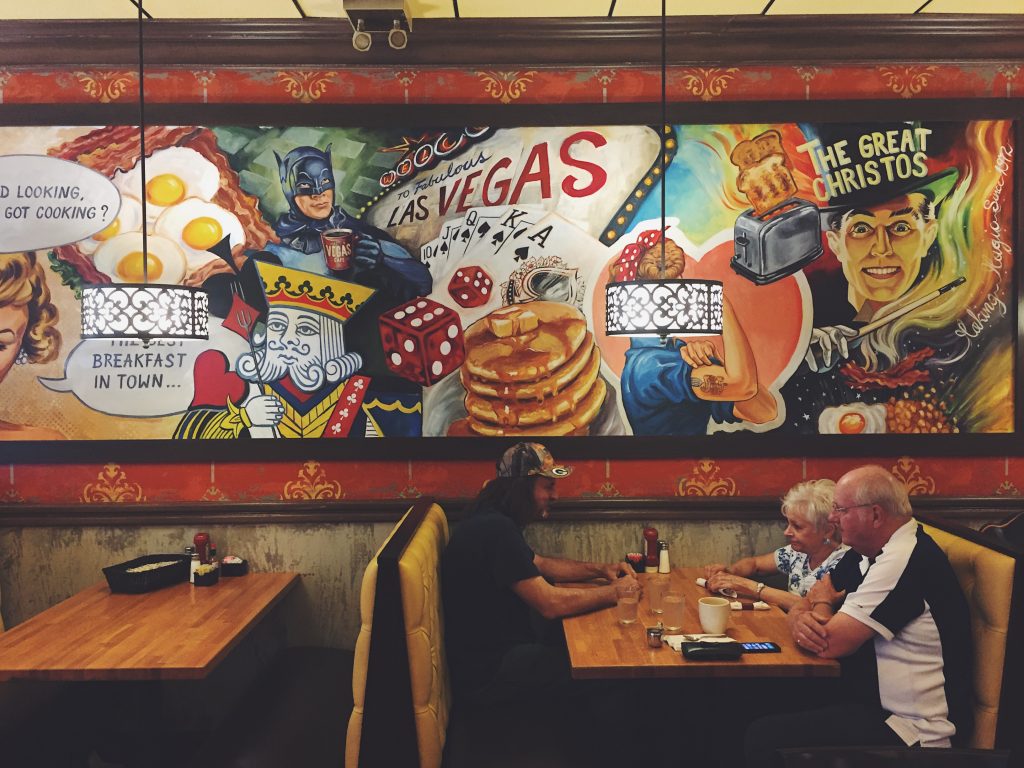
This is a diner in a small town in Illinois I stumbled across. It was meant to be somewhat Vegas-themed but there was also a hodge-podge of random nostalgic Americana/Hollywood imagery—Elvis, Batman, Frank Sinatra, I Love Lucy, etc. I noticed this group of people having breakfast together. I wondered about their stories and how they came together for the meal—perhaps they live in the town, maybe they were just passing through, maybe they’re related. I liked the contrast of this very real human scene with the cartoony, garish nostalgia surrounding them.

This is a camera/photography store in downtown Chicago that was founded in 1899. I’ve always loved the sign and the fact that it’s stood the test of time–with modern skyscrapers built just around the corner. I’ve heard that it was frequented by Vivian Maier. I specifically intended to take a photo of the sign itself, since I’ve always admired it, but wanted another level of visual interest in the scene. So this is a case where the “decisive moment” came into play for me, since I waited for multiple people to walk by before deciding to capture a person walking their dog. I wanted it to evoke the street level bustle and activity this camera shop has seen over the years.

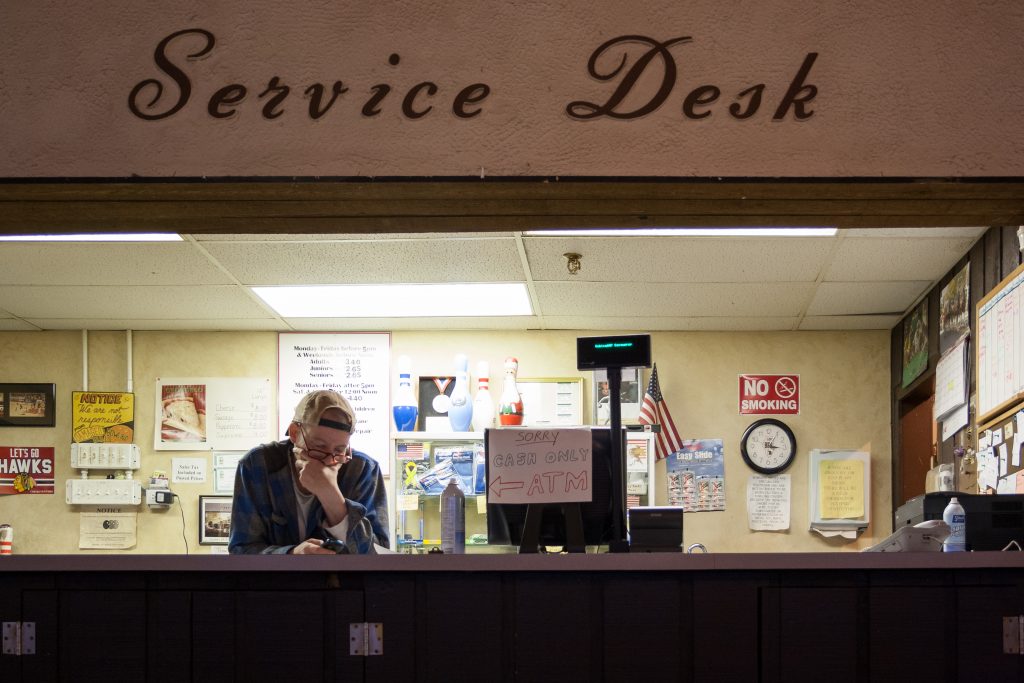
Sometimes I choose one specific location and challenge myself to take photos that represent a sense of the place. This is one from a series of photos I took at an old bowling alley in the middle of the day. It was almost completely empty. I captured this moment because I liked the juxtaposition of the “Service Desk” lettering with the pose of the person standing below it. There’s also a hand-written “CASH ONLY” sign on the register juxtaposed with the cell phone being held, offering just a hint of modern technology. I love that back wall because it offers so many signifiers of time and place.

BR: Is there a Midwestern author that speaks to your soul?

SH: Most recently: Peter Orner, Chad Simpson, and Toni Morrison.

BR: What’s next for you?

SH: I look forward to working on personal photography projects and continuing to capture the Midwest.

Contact: serahayes@gmail.com

***

Our Views from the Heartland series is a new series we started to give some recognition to the incredible photographers who submit their photos to us regularly. In it, we talk with some of our favorite photographers who we feel capture the essence of the Midwest in their incredible photos. Each month, we’ll post a new interview with a photographer in which we discuss their creative process, the intersection of photography and literature, and other fascinating topics.

|

No Comments

|

Contributor Spotlight: Tanya Seale

Tanya Seale author photoTanya Seale’s story “Dissolving Lori” appears in Midwestern Gothic‘s Summer 2017 issue, out now.

What’s your connection to the Midwest, and how has the region influenced your writing?

I was transplanted to the Midwest as a young woman, hoping it would be a stop on the way to somewhere more exciting. I’ve birthed and reared two pretty remarkable human beings, earned two degrees, experienced love, heartache, friendship, betrayal, heartbreak, and great loss here. I’ve also made lifelong friends whose heart and soul are the Midwest. I’ve taken trips, and I’ve come home – what has become home – again. So I suppose I’ve created a life in the Midwest that, for me, has held some pretty exciting moments. These are all wells for my writing – the places, the people, the remembrances. When it’s time to move on from here, I can see myself being nostalgic in many ways, knowing that this stop has served my imagination well.

What do you think is the most compelling aspect of the Midwest?

When I first moved here, it was the four distinct seasons that made me love the Midwest most. And even still, the wakening in spring each year stuns me; the foliage in fall makes me catch my breath. Plus, we get just enough snow in winter and plenty enough heat in summer. But also, there are great characters born here. Midwesterners are smart, scrappy, traditional salt-of-the-earth. Each year, the river crests and the levee breaks, but not before the sandbags appear.

How do your experiences or memories of specific places—such as where you grew up, or a place you’ve visited that you can’t get out of your head—play a role in your writing?

We all tell stories about places we’ve been and the people who have shared those places and spaces, whether we’re reenacting a pickle jar disaster scene we saw on aisle 4 at the Shop ’n Save, or attempting to relay the exquisite beauty of an extraordinarily colorful sunset. I grew up in West Texas, and then I grew up again, even more, as mentioned above, in the Midwest. Those two regions smell and taste and look and sound and feel different from one another. They each have their own voices, and their own characteristics, and so naturally, they play a very important role in my storytelling. For writers, our places and spaces should become authentic characters that actively participate in the story.

Discuss your writing process — inspirations, ideal environments, how you deal with writer’s block.

My process is as confusingly ethereal as anyone else’s, really. I often experience writer’s block, and I often choose to cook, garden, invest in a new Netflix series, exercise, scrub toilets, anything to avoid the task at hand. But discipline is at least half of the process, isn’t it? If I can’t think of anything else to say, I make myself write about having nothing to say. Usually that gets old after a few minutes. There is never an ideal environment, there is no inspiration. There is only this chair, this laptop, this empty page, and these few moments.

How can you tell when a piece of writing is finished?

A piece is finished when I am making it different, not better.

Who is your favorite author (fiction writer or poet), and what draws you to their work?

It’s really hard to choose a favorite. You all know that, right? I read a whole lot of plays (because I also write plays) and I read quite a bit of young adult fiction as well. But I like Chekhov, Faulkner, Gabriel García Márquez, Jhumpa Lahiri . . .. I could go on. The only book that has ever knocked me off kilter for weeks, though, was Looking for Alaska by John Green. The first time I read it, I was on a road trip home to visit family in Texas. I finished the last pages in the car on the way there, and I could do nothing but weep covertly for hours, staring out the passenger’s side window. I spent the entire trip thinking about how perfect that book is, and how devastated I was that I couldn’t even talk about it, because no one else in my non-writerly, real-life world had read it or would be interested in reading it.

What’s next for you?

I just finished writing a full-length dramedy called Homesick about recent empty-nesters Karen and Rick, whose marriage is on the verge of collapse. In this play, I break the fourth wall and use the audience as a marriage counselor. It’s sort of a nod to Ibsen, but with contemporary subject matter. I will be sending that out for development and/or production opportunities, and I will be cooking, gardening, investing in a new Netflix series, exercising, scrubbing toilets beginning a new project.

Where can we find more information about you?

You can find me at tgseale.com

|

No Comments

|

Midwest in Photos: Leaving Home

“I wish I could leave you certain of the images in my mind, because they are so beautiful that I hate to think they will be extinguished when I am. Well, but again, this life has its own mortal loveliness. And memory is not strictly mortal in its nature, either. It is a strange thing, after all, to be able to return to a moment, when it can hardly be said to have any reality at all, even in its passing. A moment is such a slight thing. I mean, that its abiding is a most gracious reprieve.” – Marilynne Robinson, Gilead.

Photo by: Robert Henway

|

No Comments

|

Interview: Catherine Lacey

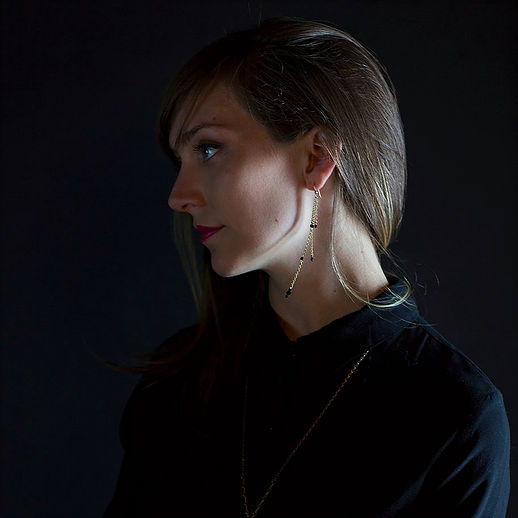
Catherine Lacey author photo

Photo credit: Willy Somma.

Midwestern Gothic staffer Kathleen Janeschek talked with author Catherine Lacey about her book The Answers, constructing the ideal relationship, marbles vs. dog shit, and more.

**

Kathleen Janeschek: What is your connection to the Midwest?

Catherine Lacey: A rather tenuous one. In the last couple years I’ve been traveling almost constantly, but I moved my home base to Chicago in 2016 because it’s where my partner, Jesse Ball, lives and teaches. However, I quickly whisked him off to Missoula, Montana where I was teaching for a semester. Now we’re back. So, the last year has been a rather midwestern one. We even drove through a blizzard.

KJ: Both of your novels have been set in New York City, but you live in Chicago. What inspires you to write about one city while living in another?

CL: Because book publishing takes so long, I actually wrote all of The Answers while I was living in New York, which was home for nine years. Half of the first one is set in New Zealand, which I wrote because I had been to New Zealand and wished I had never left.

KJ: Your latest novel, The Answers, centers on Mary, a woman who suffers from chronic pain. How did you approach the subject of chronic pain? What kind of research did you do?

CL: Having a body, as vulnerable as anyone’s, is enough research if you pay close enough attention. I’ve never been as ill as Mary is at the book’s opening, but I’ve had some frustrating health problems that gave me a window into what that would be like.

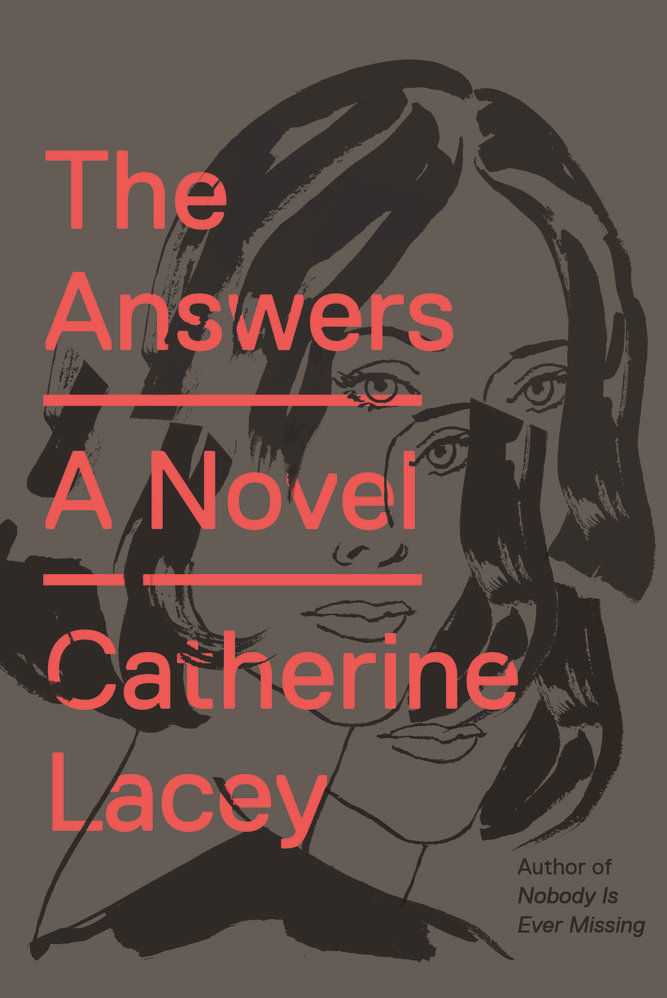
The Answers Catherine Lacey book cover

KJ: Another character of the novel is Kurt Sky who is attempting to create the perfect girlfriend by having a multitude of women each portray different aspects of a relationship. What inspired you to write about someone who viewed relationship in fragments?

CL: When I began writing the novel in 2013 the idea and impossibility of constructing some sort of ideal relationship was on my mind, so it came out in my work. It’s actually not clear to me whether Kurt thinks of all the women he’s hired as a “the perfect girlfriend.” He is, at least, hoping that the experiment will make discoveries that could make a “perfect” relationship possible.

KJ: Do you consider this portrayal a commentary on human connections in modern life?

CL: No.

KJ: Why did you choose to make the middle section of the novel – the part dominated by Kurt’s girlfriend experiment – third person, while keeping the opening and ending sections first person?

CL: I just had this sense that the perspective needed to shift in order for the scope of the book to function as it does now. I fumbled around with other ideas, but this is the one that took.

KJ: The Answers manages to be both an emotional narrative and a big ideas book. How do you balance plot and concepts in your writing?

CL: I honestly do not know. I’ve learned everything by accident. When I write I tend to feel like I am bushwhacking instead of following a path.

KJ: Though definitively literary fiction, The Answers has science fiction vibes. What are some of your science/speculative fiction influences?

CL: I can think of three books that influenced, directly and indirectly, this aspect of The Answers: Helen DeWitt’s Lightening Rods; Kobe Abe’s The Face of Another and Yevgeny Zamyatin’s We. My knowledge of real science fiction is pretty limited, though.

KJ: How has writing your second novel compared to the first? Do you think you’ve learned anything?

CL: Writing the first one sort of felt like I was wandering around blindfolded, wearing big mittens, trying to pick up marbles off the floor without slipping on them in the process. Writing the second novel…well, honestly it was pretty much the same thing except I realized halfway through it that a third of the marbles I’d picked up were actually little hardened pieces of dog shit and I had to throw them away and find more marbles. In the year and a half since I finished writing The Answers I have been working very differently, so maybe it took two novels to learn something? I don’t know if I can describe what is different now, but something is different and I’m happy about it. I’ll probably unlearn it and have to learn some other way to be.

KJ: What’s next for you?

CL: I’ll probably walk my dog and go to the bookstore. Later it will be time for dinner. The sun will go down, then come up. Then it will be time to sit and think for a while.

**

Catherine Lacey is the author of the The Answers and Nobody is Ever Missing. She was a 2016 Whiting Award winner, was a finalist for the NYPL’s Young Lions Fiction Award and has earned fellowships from the New York Foundation for the Arts, the Omi International Arts Center, the University of Montana. In 2017 she was named one of Granta’s Best Young American Novelists. Her work has been translated into German, Italian, Spanish, Dutch and French. Her first short story collection, Certain American States, will be published in 2018.

|

No Comments

|

Summer 2017 issue is here!

Just in time for the tail end of summer, we’re thrilled to announce that the Midwestern Gothic Summer 2017 issue is here!

With a beautiful cover illustration by Teagan White, we are hopelessly in love with how this issue turned out.

The Summer 2017 issue is available in paperback ($12) and eBook formats ($3.99), including Kindle, iPad, Nook, and PDF. Pick up a copy

The Summer 2017 issue contains fiction from: Phyllis Beckman, Nick Caccamo, Linnea Guerin, Robert Hinderliter, Kyle Impini, Harris Lahti, Natalie Teal McAllister, Devin O’Shea, Tanya Seale, Kali VanBaale, Michelle Webster Hein, Erika T. Wurth, and Alyssa Zaczek.

And poetry from: Kelli Bartelotti, Milton Bates, Jacquelyn Bengfort, Holly Brown, Annah Browning, Anders Carlson-Wee, Rob Cook, Yahya Frederickson, Ron Gibson, Jr., Hannah Kroonblawd, Douglas Luman, Beth Marzoni, Nicole Mason, Jen Rouse, Anthony Sutton, Heather Swan, Michael Walsh, and John Yohe.

And nonfiction from: Whit Arnold, Michael Fischer, David Franke, Caitlin Hill, RaeNosa Hudnell, and Natalie Tomlin.

Plus photography from: David McCleery, Dallas Crow, Tom Darin Liskey, and Michelle Pretorius.

Shop for the Midwestern Gothic Summer 2017 issue

Or subscribe and save up to 33%

|

No Comments

|

Contributor Spotlight: Harris Lahti

Harris Lahti author photoHarris Lahti’s story “Highways of Damage” appears in Midwestern Gothic‘s Summer 2017 issue, out now.
What’s your connection to the Midwest, and how has the region influenced your writing?

I have family in Minneapolis, Minnesota. My girlfriend, out near Willmar. We visit frequently. More indirectly, my great grandfather moved there from Finland as a homesteader. Like him, my grandfather worked in the lumber trade. And my father attended graduate school at the U. So Minnesota has always been a place of intrigue for me.

The initial draft of “Highways” actually took place between upstate New York and Philadelphia. Like Minnesota, as opposed to contrary belief, upstate New York has its fair share of cornfields and cow pastures. But they’re miniature in comparison. And when I was writing the piece, I was lucky enough to attend a wedding in rural Minnesota, and experience its vast expanses of farmland and uncapped skies. Those visuals really helped break the story wide open by deepening the main character Roy’s loneliness.

What do you think is the most compelling aspect of the Midwest?

The vast spaces. I grew up in New York’s Hudson Valley, and I’m used to my horizons terminating quickly into swells of green. So to see those never-ending Minnesotan skies is a refreshing experience. All those stars! It doesn’t get any better.

How do your experiences or memories of specific places—such as where you grew up, or a place you’ve visited that you can’t get out of your head—play a role in your writing?

My writing is definitely local. I think all good writing is. Aside from “Highways,” I generally set my stories in two places: Albany and the surrounding Adirondack area. All my free time in Albany was spent skateboarding and partying, so whenever I write about Albany a manic vibration always creeps into the piece. The Adirondacks, where I grew up, not so much. Those pieces more gravitate toward loneliness and nostalgia. What I’m getting at: placing a character in either environment will conjure its own headspace based on my own experiences, with its own specific voice. Or at least this is how it occurs to me in retrospect. Who can really say.

Discuss your writing process — inspirations, ideal environments, how you deal with writer’s block.

I’m not sure if I believe in writers block. If you’re having trouble writing, in my opinion, you’re probably just not interested enough in what you’re writing about. This happens to everyone, of course. When I’m not interested, a lot of times I’ll re-write the story from scratch while swapping the POV or tense. This allows for the piece to catch the light in different ways, so to speak. Sometimes this helps move things along. Other times, not so much. At that point, it’s just a matter of believing in the piece, sticking with it, straining it through the colander of my brain until I can get at the pure thing.

How can you tell when a piece of writing is finished?

If I like the piece, I won’t let it go until it’s published. Aside from that, I have idea. Basically, when I reach my wits end. Or a teacher tells me it’s time to send it out. I can be neurotic about language, wanting everything to be perfect, but unfortunately my idea of this changes daily. Luckily, I have some amazing teachers who aren’t afraid to shoot me straight.

Who is your favorite author (fiction writer or poet), and what draws you to their work?

Right now, Fleur Jaeggy. She’s a Swiss writer whose work I’ve seen described as Champagne Gothic. MG should do an interview with her! I read her collection, Last Vanities, over and over. And I just got through I am the Brother of XX. It’s haunting stuff. Unlike anything I’ve ever read. The writing is fragmented and bizarre things will pass you by in a single breath, almost without notice. Then, later on, you’ll be staring into the refrigerator and ask yourself: So the twin brothers slept together in that story, didn’t they? Or, that woman hanged herself, huh? I like that feeling– when a story’s strangeness catches up with you. For me, that’s the gold standard.

What’s next for you?

I’m floating around a few short stories, editing a few more. I have a novel-in-stories I’m working on. All exciting things. I’m an associate editor at Juked, a reader for FENCE, and I’m about to enter my final year at Sarah Lawrence College, which has been a really amazing experience so far. I hope it never ends.

Where can we find more information about you?

I have a couple stories available online at Juked and Bull: Men’s fiction. Aside from that, I’m sad to say there’s not much else on the internet. More to come, hopefully. Thanks for this opportunity!

|

No Comments

|