Interview: Anders and Kai Carlson-Wee

November 30th, 2017
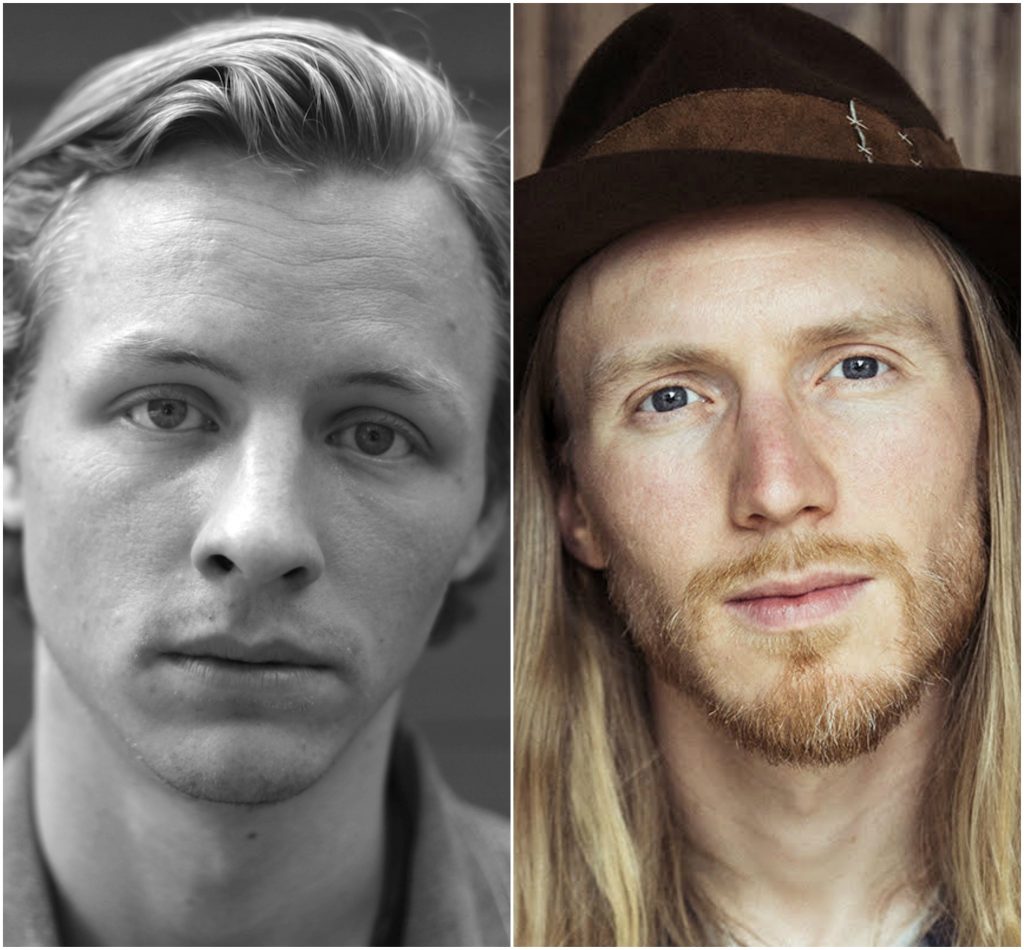
Midwestern Gothic staffer Meghan Chou talked with co-authors Anders Carlson-Wee and Kai Carlson-Wee about their collection Mercy Songs, hitchhiking across the Midwest, exploring new mediums of poetry, and more.

**

Meghan Chou: What’s your connection to the Midwest?

Anders Carlson-Wee: We grew up in Minnesota. Our parents are both Lutheran pastors and served congregations in Northfield, Fargo-Moorhead, and Minneapolis. Our great-grandparents were part of a wave of immigrants from Norway who settled in Minnesota around 1900. When I bicycled across the country twice in the 2000s, I had the most illuminating, heartfelt, and layered conversations with strangers in the Midwestern states (although the craziest stories from those travels came out of the South). I moved back to Minneapolis two years ago, after being away for thirteen years. I would say much of who I am is Midwestern, and that influences how I think, act, and write.

Kai Carlson-Wee: Anders and I grew up in a small town in southern Minnesota, called Northfield. We lived a block from a cereal factory and a train yard and spent the bulk of our time roaming around town on our bikes. It was a very American childhood. We raced go-carts down the street and stuff like that. When we got older our family moved up to Fargo, North Dakota, where we went to high school. Fargo was more blue collar, more prairie, but still very Midwestern. You wouldn’t exactly call it a destination city, it was more of a place people got lost in or stranded in and somehow failed to leave. When I graduated from high school I moved out to California to be a professional rollerblader. I felt more comfortable on the coast, more myself, but I kept bouncing back and forth. I went to college in Minnesota, moved to Portland, moved back. I think my spirit belongs to the stuff out west, but my heart is stubbornly Midwestern.

MC: The theme of brotherhood is strong in many of the poems in Mercy Songs. How do you, as brothers, inspire each other and how did growing up in the Midwest influence your relationship with one another?

ACW: While Kai and I were growing up in northern Minnesota we were serious rollerbladers, and skated semi-professionally for a while. Together we designed and built a skate park in our garage, using materials we stole from the half-finished homes on our block. The garage skate park gave us a place to skate every day during Fargo-Moorhead’s subzero winter, although it wasn’t much warmer in there. When you share an interest with a brother, you’ve got a partner in crime—someone to commiserate with, someone to plan with. And you have someone keeping you in check. On school nights, we’d skate for up to five hours, often going back out into the cold after dinner for more. I don’t think either of us would have stayed as focused without the other one. As for being from the Midwest, our landlocked small-town life didn’t offer many options—for entertainment, for friends, for ideas—and I think that helped Kai and I form an extra strong bond. It also shaped our imaginations. I think of the Midwest as having a deeply physical imagination; this takes form in everything from the protestant work ethic, to the suspicion of things that are too far “out there,” to a trust in, and love for, the things of the earth: the things you can see and touch and smell and hear and feel. This isn’t all positive. Or healthy. But I think it’s had a profound impact on how Kai and I think, on how we relate to each other, and on how we write.

KCW: Well, we grew up skating together, and when you’re a skater, especially a rollerblader, you get a lot of adults trying to tell you to quit. Cops, security guards, teachers, parents, even your friends. You start to develop an anti-authority thing and you become pretty insular and self-reliant. When we first moved to Fargo, Anders and I didn’t have any friends so we turned to each other for support. We spent hours and hours skating in our garage learning tricks on the ramps and rails we built. When we went street skating we had all these confrontations with authority figures and random people who wanted to mess with us and we developed a bond around that. We had to watch out for each other. I don’t know if the Midwest made it any different, but there’s a way in which the Midwest is easily dismissed by the larger, more cosmopolitan zones in this country. I think Anders and I both have a chip on our shoulder about systems or individuals who assume hierarchical positions of power. We tend to empathize with underdogs and outcasts, and the place we grew up in probably informed that.
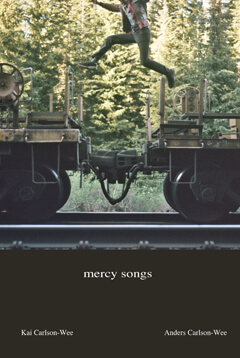
Mercy Songs book cover by Anders and Kai Carlson-Wee

MC: In Mercy Songs, a collection the two of you co-wrote, the poems alternate voices and play off of one another like a call and response. What are the benefits and difficulties of co-writing a collection of poems?

ACW: As brothers, we’ve been having an ongoing conversation our whole lives; Mercy Songs is a natural extension of that conversation, but the book makes it accessible to an audience, which allows the world to interpret and sculpt our voices for its own needs. That’s scary, but also liberating. I think it lets us move forward, and let go, in a sense. It’s also been very cool to be able to read together from the book, enacting the call-and-response format for a live audience.

KCW: The poems in Mercy Songs were written independently of each other, but they were written about similar experiences, so the connections between them are mostly accidental. It’s not like we sat down and said, let’s write a chapbook about traveling together, it was more like we noticed there were similar themes in our work, characters, ideas, landscapes, etc., and the poems already had resonance. The project of putting the book together was more like shuffling cards, so the construction was actually pretty easy. I think the danger of doing a project like this is that the poems might feel out-of-sync, either too similar, or too different, and our goal was to arrange things in a way that felt harmonic and had some sort of narrative flow. Not sure if we pulled it off, but that was the idea.

MC: Many of the poems in Mercy Songs revolve around your adventures train-hopping cross-country together. There are references to “bulls” (the train security guards) and descriptions of the intense heat. How did these trips change your perception of the Midwest and the landscapes you write about?

ACW: Train-hopping is one of the hardest things I’ve ever done. It leaves you utterly submitted to the world—the elements, the weather, the unceasing pulse forward—and reduces you to your basic desires and needs: water, food, shade, sleep, companionship. It cracks your skin, bloodshots your eyes, parches your throat, rattles your spine, and steals your mind away to the edge of reason and sanity and self. It’s an overwhelming tactile experience. And it’s not uncommon to experience hallucinations, waking dreams, spatial disorientation. Every time I’ve hopped trains I’ve heard voices. I don’t mean I thought God was talking to me; I mean you’re so worried about getting caught, so shaken by the train’s heaves and clinks and hisses, so strained by the long nights in the alternating dark and sharp light of railroad yards, so worn out from the waiting and hiding and the nothing happening but jolts and flashes and speed, that you start needing the stimulus around you to mean something—you start needing the world to pertain to you. I think this is the intrinsic primitive impulse that births religion, storytelling, and art. We need the world to pertain to us, and for us to pertain to it. We crave this. A sense of order. Of cause and effect and consequence. For me, train-hopping has been a way to experience that need, sharply. But all art and religion deals with this need. Poetry offers acute access to it. As for a specific location, such as the Midwest, train-hopping gives you the experience of passing through a place—a rush of time and perspective, which alters what remains the same, as your position changes. And like I was describing, it also takes you into a condition where you can peel back the veil, slightly and momentarily, like a good poem can do.

KCW: I don’t think it changed anything, exactly, but putting the book together made me think about the particular culture we’re trying to illuminate. Ever since I was young, I’ve been interested in the gothic side of the Midwest, the dark and weird shit. People have explored this element in the south, but they haven’t really nailed it down in the Midwest. When you think about literary representation, you have the family dramas of Willa Cather, stuff like Jonathan Franzen’s Freedom, the quirkiness of Garrison Keilor, the lonely isolationism in Stoner and Winesburg Ohio, the natural beauty and subtlety of Robert Bly, but none of these versions line up with the weird idiosyncratic violence and surrealism I experienced when I was younger. Films like Fargo by the Coen Brothers and Badlands by Terrence Malick are more invested in this quality. Music albums like Separation Sunday by The Hold Steady and Rooster by Charlie Parr are also in this direction. Traveling around the country helped me see different versions of American weirdness, but there’s a particular quality in the Midwest that I’m interested in writing about. It has to do with spiritual poverty and the way people use pleasantry and morality to justify violence and to combat an existential dread of the land.

MC: Your joint short film, Riding the Highline—which won a Special Jury Prize at the Napa Valley Film Festival, among other awards—incorporates visuals with recitations of poetry as you ride from Minneapolis, Minnesota, to Wenatchee, Washington. What did you learn from documenting this trip about the connection between poetry and film as well as the power of combining the two?

ACW: Riding the Highline allowed us to frame two lyric poems with the larger narrative context of the film’s story, which seems to have resonated with a wide audience. And it continues to allow us to sneak poetry into a huge range of venues: high school auditoriums, dive bars, art exhibitions, college classrooms, film festivals, hobo gatherings, art crawls, and lots of people’s living rooms (via the internet). We’ve had people come up to us and quote lines from our poems, often saying something like “I’ve never read much poetry, but now I will.”

KCW: Poetry and film both operate on a linear timeline. They’re both potent, powerful mediums, and can convey a lot of feeling in a small amount of space. Film is more superficial, but it creates more of a total atmosphere. Poetry is generally deeper, more internal, but also more subtle in the way it hits your emotions. If the two are combined in a natural, harmonic way, the results can be powerful. When we’ve screened Riding the Highline at film festivals, people always ask why we wanted to combine the two mediums, what genre we’re trying to invent. But I don’t know, to me it just seems like an obvious thing to do. I get a little tired of reading poems in books. Black and white, print on page. I love books, but I don’t see why writers aren’t expanding their ideas of what poetry can become. When you look at what’s happening with something like Instagram poetry, you can see there’s a real interest there, an appetite. Rather than laughing at how awful it is, I think we should take some notes and start seeing these forms as a sign of health, of new directions in poetry.

MC: What is the most memorable trip the two of you have taken together and how did it affect your life philosophies?

ACW: One time Kai and I hitchhiked from Minneapolis to Chicago by way of Wisconsin, and we had the most insane rides. Every person that picked us up was more unhinged than the one before. We got a ride from a young man who’d had a heart attack from doing too much coke on his eighteenth birthday. We got a ride from a single mom and her five-year-old son, who sat beside us eating a Happy Meal; she kept saying if we were any bigger she wouldn’t have picked us up. We got a ride from a man with fresh wounds on his face, the result of fighting his friend when his friend caught him stealing his four Labrador puppies; he said he stole the puppies because his friend was letting them die of heatstroke in a backyard cage, and he picked us up because he needed someone to give the puppies water; they sat on our laps and drank from a sour cream container (a much, much, much longer story). That trip affected my life philosophy about Wisconsin.

KCW: My favorite trip with Anders was a hitchhiking trip we took back in 2006. I had just graduated from college, Anders had recently finished high school, and our plan was to hitchhike from Minneapolis to Chicago with no real agenda. I think I had just broken up with a girlfriend and was feeling slightly nihilistic about everything and we just wanted to get on the road and take things as they came. Somehow, every ride we caught was extremely weird, and we ended up riding with this guy named Rick who was wildly spun out on meth. He had six little St. Bernard puppies in the car and he was talking a mile-a-minute and ranting conspiracy theories about George W. Bush. We honestly thought he was going to kill us, but then he didn’t, and everything turned out okay. We ended up at a Phil Lesh concert and then accidentally attended the gay Olympic games in Chicago, where everyone thought we were a couple. The whole trip took place in a week but it seemed like an endless surreal dream. Still one of the most memorable trips we’ve taken.

MC: After returning from these trips of solitude and excitement, how do each of you find places and time to write in your daily lives?

ACW: I live in Minneapolis and write poetry full-time. I dumpster dive for most of my food and live a humble life. I piece together an income from touring, publishing, teaching, awards, grants, etc., but I wouldn’t be able to sustain this lifestyle for very long without the generous fellowships I’ve received from the NEA, Vanderbilt University, and the McKnight Foundation. Those three fellowships have paid for the lion’s share of my life for the last five years, and I am forever grateful.

KCW: Almost everything I write is autobiographical and based on experience, so I need these periods of adventure and wandering around. I need weeks of doing things randomly, without agendas. If I’m being too responsible with my life, my poetry gets fake. It’s not that it gets bad exactly, it just gets repetitive and boring and starts to parody itself. I never want to get to the point where I’m writing poetry for the sake of writing poetry, either because I’ve committed myself to a poetry “career” or because I’ve established too much of my identity around previous work. I want my poems to keep springing from inspiration and impulse, rather than expectation. Right now, I’m lucky enough to be on an academic schedule, so I can travel and write during the summers. During the school year I have three days a week to do whatever I want, and I usually spend that time at coffee shops, working on poems, reading, taking photos around the city. This makes me a difficult person to date or be friends with, but I don’t really mind. I think at the end of my life I’ll regret not having more friends, but I’ll regret less the poems I’ve written, the time I spent alone.

MC: What’s next for each of you?

ACW: I’m finishing my first full-length poetry collection and spending the summer in Guadalajara. Starting in the fall, I’ll be touring heavily. If you want me to tour through your town/school, email me: anderscarlsonwee@gmail.com

KCW: My first full-length collection of poems, RAIL, is coming out with BOA Editions in Spring 2018. I’ve been working on the cover and have started production on a series of short films, which I’m hoping to release with the book. The idea is basically to make a visual version of the poems, with video, audio, photographs, etc. I want it to be a stand-alone piece, rather than a series of music videos. Hopefully it doesn’t suck.

**

Anders Carlson-Wee is a 2015 NEA Creative Writing Fellow and the author of Dynamite, winner of the 2015 Frost Place Chapbook Prize. His work has appeared in Ploughshares, New England Review, AGNI, Poetry Daily, The Iowa Review, Best New Poets, The Best American Nonrequired Reading, and Narrative Magazine, which featured him on its “30 BELOW 30” list of young writers to watch. Winner of Ninth Letter’s Poetry Award, Blue Mesa Review’s Poetry Prize, and New Delta Review’s Editors’ Choice Prize, he was runner-up for the 2016 Discovery/Boston Review Poetry Prize. His work has been translated into Chinese. He lives in Minneapolis, where he serves as a McKnight Foundation Creative Writing Fellow.

Kai Carlson-Wee is the author of RAIL (BOA Editions, 2018). He has received fellowships from the MacDowell Colony, the Bread Loaf Writers’ Conference, the Sewanee Writers’ Conference, and his work appears in Ploughshares, Best New Poets, New England Review, Gulf Coast, and The Missouri Review, which awarded him the 2013 Editor’s Prize. His photography has been featured in Narrative Magazine and his poetry film, Riding the Highline, received jury awards at the 2015 Napa Valley Film Festival and the 2016 Arizona International Film Festival. A former Wallace Stegner Fellow, he lives in San Francisco and is a lecturer at Stanford University.
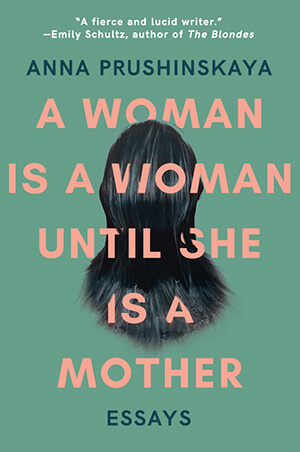

A Woman Is A Woman Until She Is A Mother reviewed

We’re thrilled to share the first of what we’re sure will be many stellar reviews and interviews for A Woman Is A Woman Until She Is A Mother by Anna Prushinskaya!

The folks over at Michigan Quarterly Review interviewed Prushinskaya, while The Coil was kind enough to review the newest MG Press title, and here’s what they had to say:

“Either that one of the one they head the review with Prushinskaya’s essays are an intriguing compilation of a woman’s flight through child bearing, told with care, pain, and freshness.” — Surmayi Khatana, The Coil

Read the full review on The Coil‘s website.

A Woman is a Woman Until She is a Mother book cover by Anna Prushinskaya
 

Meanwhile, in an interview with Cameron Finch from Michigan Quarterly Review, Prushinskaya discussed her collection, being born into a different mother, identity and more.

As Prushinskaya explains in the interview, “the title of the book is ‘a woman is a woman until she is a mother’ in part to reflect that our experiences are our own, are varied, though sometimes others might try to tell us otherwise by placing us into categories like ‘woman’ or ‘mother’ or etc.

Read the full interview at Michigan Quarterly Review.

Anna Prushinskaya A Woman is A Woman Until She is a Mother
 

For more information about A Woman Is A Woman Until She Is A Mother, and to purchase your copy, see the book page on our site.

|

No Comments

|

Views from the Heartland: Tara Reeves

Tara Reeves author photoMidwestern Gothic staffer Ben Ratner spoke with photographer Tara Reeves about her creative process, showing people things they’ve never seen, and more.
Tara Reeves grew up in southern California before moving to Chicago for college. She studied photography at the Illinois Institute of Art. Tara enjoys documentary photography as well as traveling, reading, and finding the best donut Chicago has to offer.

***
Ben Ratner: What is your connection to the Midwest?

Tara Reeves: I moved to Chicago 7 years ago for college from southern California. My grandparents grew up in the Midwest and oddly enough I ended up here.

BR: What launched you into the world of photography?

TR: I became interested in photography in high school. I found the action of capturing a moment in time fascinating. I also heard a quote from Diane Arbus which read, “I really believe there are things nobody would see if I didn’t photograph them.” She inspired me to want to show people things they’ve never seen or would never see.

BR: What do you think photography as a medium can add to the literary profile of the Midwest?

TR: I think photography and literature go quite well together. Writing allows you to create a place in your mind, while photography can capture what an actual place is like.

BR: Tell me a little bit about your experience in Chicago at the Illinois Institute of Art. In what ways did this experience change the way you see the region?

TR: I had never been to the Midwest before moving to Chicago. I became great friends with people from small towns in Wisconsin and Illinois. I visited their homes a few times so I got to see a way of life that I never experienced. It was the complete opposite of what I was used to; quiet, isolated, open.

BR: We have a few of your photos here that are new to the MG site. Can you take us through the inspiration behind them? How did you come across each of these shots and what is it that they convey to you?


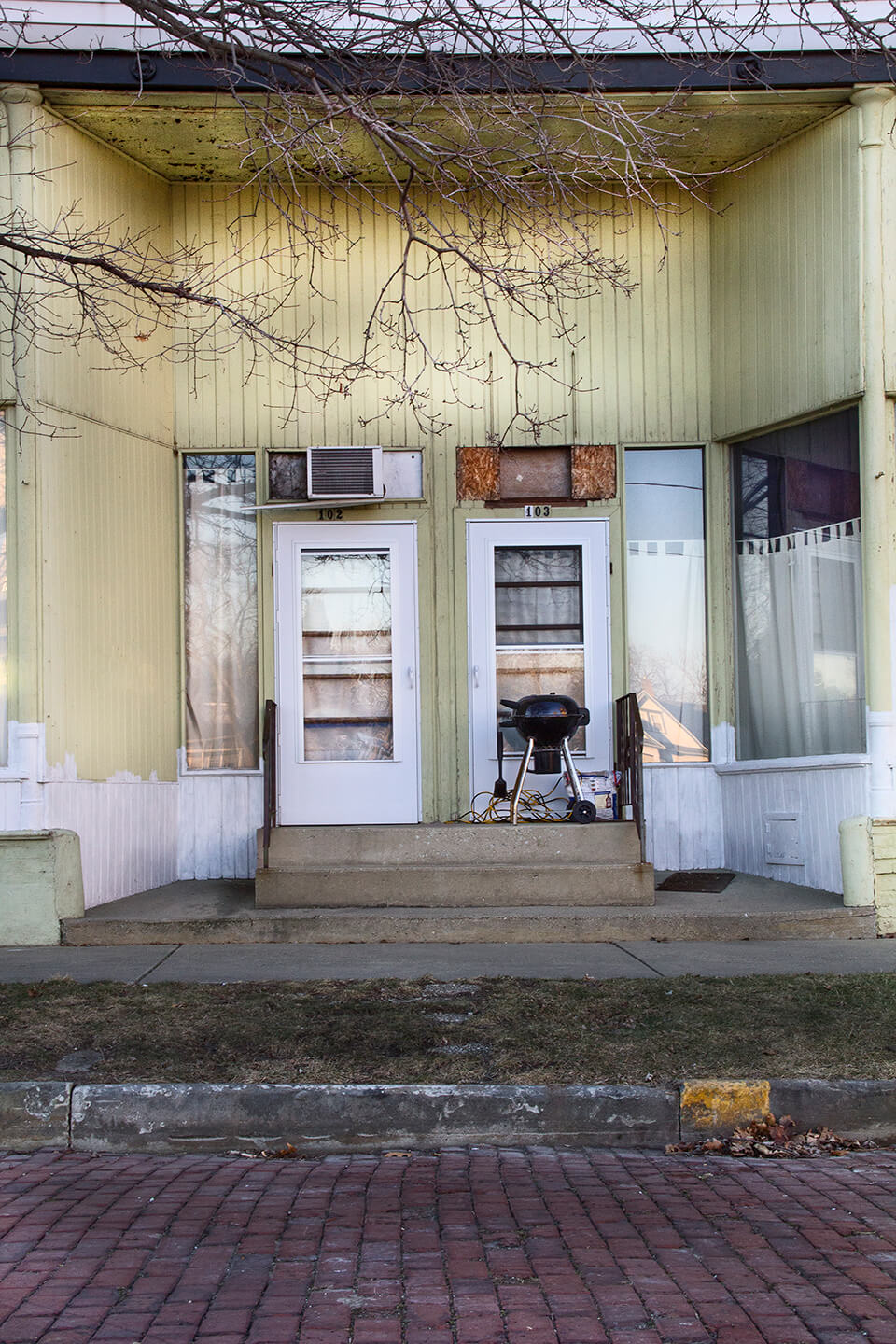
Tara Reeves Views from the Heartland photo "Danforth"

Danforth

Danforth: I took this photo with a friend who introduced me to several small towns around where she grew up. She’s from a small town in Illinois and knew I was working on this project at the time. What I always found interesting is how buildings like this stayed desolate and items, like this grill, were just left and nobody bothered to do anything with it. I always wonder what was here. Why is it empty now? And even though it’s bare, the green and warm lighting somehow make you feel positive about it.


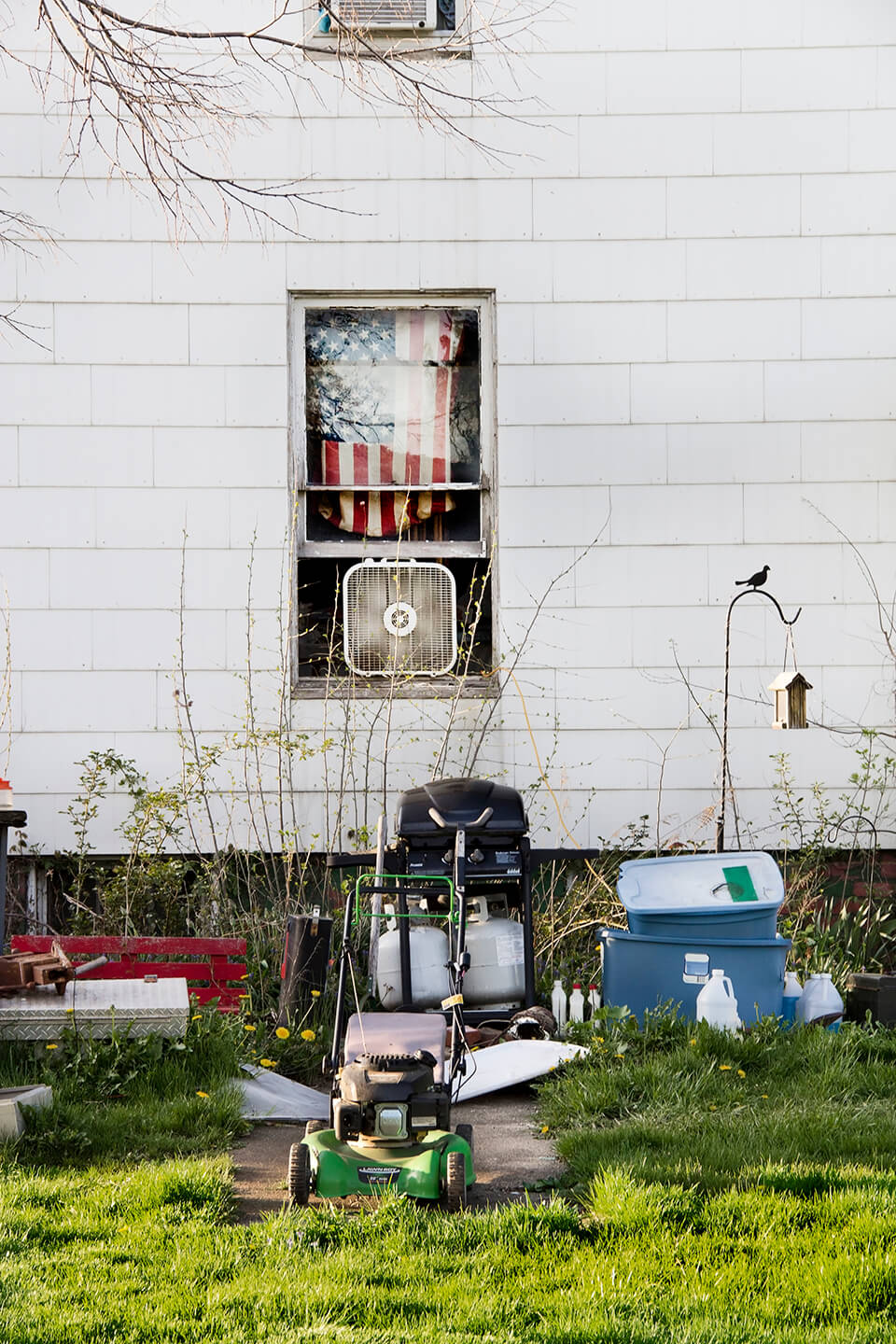
Tara Reeves Views from the Heartland photo "LeRoy_4"

LeRoy_4

LeRoy_4: This photo was taken on a solo trip of mine. I was at the point where I was looking up towns with low populations that I could photograph for my final project in college. I was actually terrified to take this photo because a few minutes before the family who lived in the house had left and I didn’t know when they’d be back. I quickly realized that there’s a sense of trust amongst the community in small Midwestern towns. This family left all kinds of things on their yard, whereas I’m so used to locking it all up in a garage or having three locks on the door of my apartment. The American flag also sticks out to me. I feel like this image captures the Midwest and is something that people who grew up here can relate to.

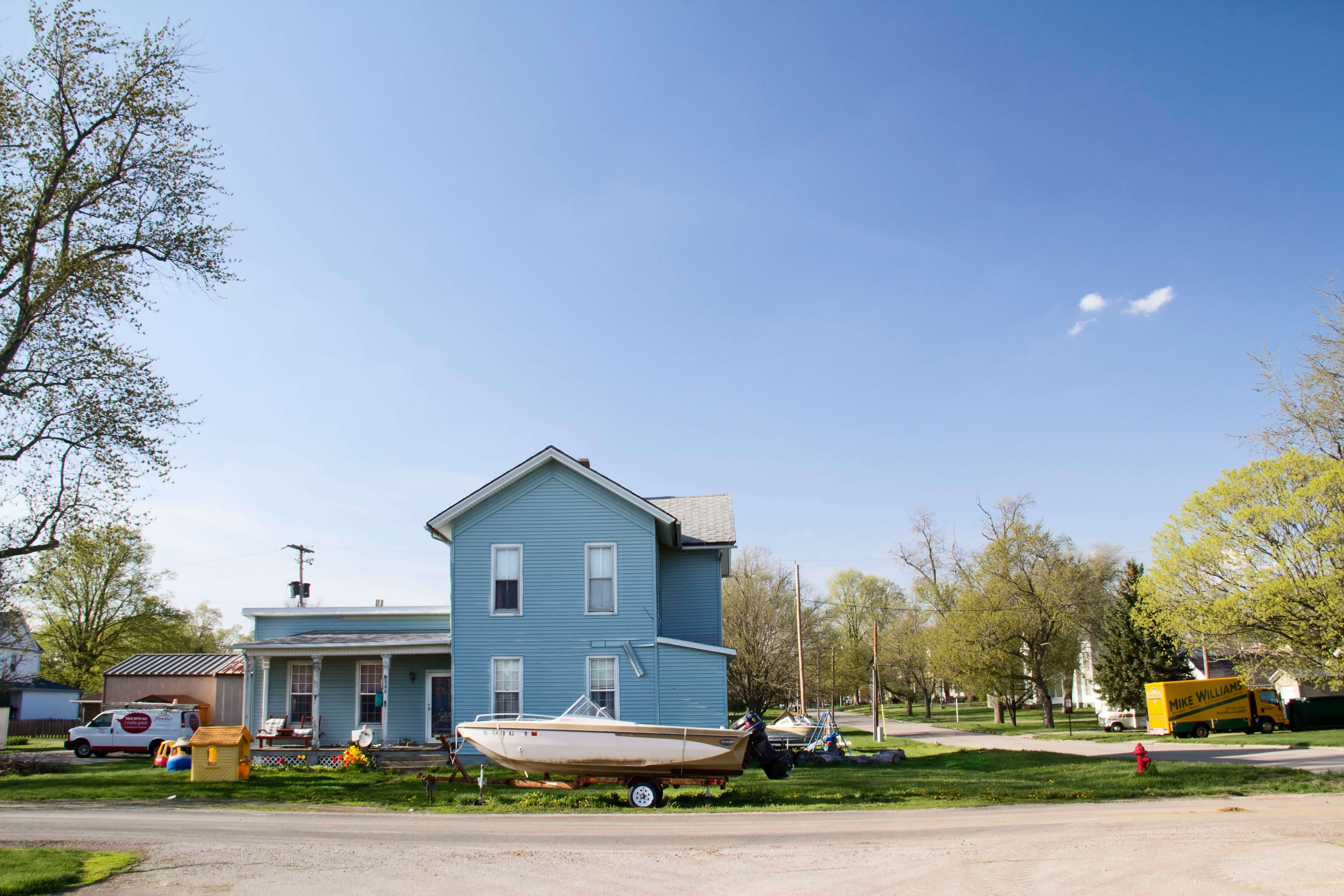
Tara Reeves Views from the Heartland photo "LeRoy_3"

LeRoy_3

LeRoy_3: This photo was taken on the same as the other image in LeRoy. This photo makes me laugh because they also leave everything in their yard for people to take. The funniest part is the boat because this town is in the middle of Illinois, so not exactly close to a lake. This photo also makes me happy. I feel like a lot of people picture the Midwest only in the winter, so having taken this photo in the Spring I was able to capture the blooming trees, green grass, and big blue sky. This photo reminds me of when winter turns to Spring and how good the sun feels again.

BR: One subject is conspicuously absent throughout your work: human beings. Why do you omit people from your photography? How does capturing a sense of place change when its people are nowhere to be seen?

TR: This wasn’t intentional at first. I went out to shoot for this project in school and came back with zero photos of people. There aren’t people in my photos because I didn’t run into anyone while photographing. I was documenting towns of around a thousand people, so I wanted to portray the quiet and absent feeling you’d experience if you were there. Not seeing people was very weird for me since I’ve only lived in large suburbs or cities, which is what started this series in the first place.

BR: Is there a Midwestern author that speaks to your soul?

TR: Gillian Flynn is one of my favorite current authors.

BR: What’s next for you?

TR: Currently I’m photographing as a hobby. I use film and digital cameras, which is a lot of fun. I’m still living in Chicago, but trying to figure out where to go next.

***
Our Views from the Heartland series is a new series we started to give some recognition to the incredible photographers who submit their photos to us regularly. In it, we talk with some of our favorite photographers who we feel capture the essence of the Midwest in their incredible photos. Each month, we’ll post a new interview with a photographer in which we discuss their creative process, the intersection of photography and literature, and other fascinating topics.

|

No Comments

|

Contributor Spotlight: Alyssa Zaczek

Alyssa Zaczek author photoAlyssa Zaczek’s story “Salt in the Pan” appears in Midwestern Gothic‘s Summer 2017 issue, out now.

What’s your connection to the Midwest, and how has the region influenced your writing?

I was born in Chicago and raised in the southwest suburbs. After college, I moved to Saint Cloud, Minnesota, where I currently live and work. My entire family lives in the Midwest, and has always lived in the Midwest.

While many people (writers or no) on either coast might believe life in the Midwest to be more mundane, more beige, I think part of the intrigue of the region is the perceived mundanity. As a writer, it’s my job to tease out the exciting, attention-holding details from day-to-day life in this place, and to simultaneously embrace and subvert those stereotypes. As a child and teenager, I bemoaned the lack of culture in the Midwest, because I felt that had I been raised on either coast my writing would naturally be influenced by those very recognizable energies. I didn’t feel as though I, as a Midwesterner, had an identity. But as I grew as a writer and as a person, I realized that the region absolutely does have a personality all its own, one that is characterized somewhat by a lack of character—a kind of negative space, a dark matter. Something, from within the nothing. I think the Midwest is a canvas, both a character and a setting onto which we as writers can project the thoughts, feelings and ideas of our time.

What do you think is the most compelling aspect of the Midwest?

Speaking again of the perceived mundanity of the region (truly, it’s not just cornfields and butter sculptures out here), I think that to some degree there is a public perception of “a Midwesterner” as milquetoast—very bland, very middle-of-the-road, very stereotypically white and conservative. And I’m sure those people exist here. But if you scrape the surface of the Midwestern population, not only is it incredibly diverse, but the people themselves have rich inner lives that are not to be overlooked. Midwestern people are the most compelling aspect of the Midwest, because they are never entirely what they seem.

How do your experiences or memories of specific places—such as where you grew up, or a place you’ve visited that you can’t get out of your head—play a role in your writing?

My memories play an extremely tactile, sensory role in my writing. I’m blessed with a vivid memory, and I do lean on it to bring detail to my work. In what I read and what I write, I love a lush setting, so I draw upon my memories to bring life to scenes in a way that feels real. In “Salt in the Pan,” which can be found in the Summer 2017 issue of Midwestern Gothic, much of the plot and action revolves around wheat fields. I tapped into my own memories of growing up surrounded by farmland, and I think those details helped to elevate the wheat field into more than a setting—it’s a character unto itself.

I also think that the more specific and weird your memories are, the better suited they are for use in fiction. You know that exhausted phrase, “Truth is stranger than fiction?” It’s true, but I’d venture to add an addendum: Your truth is stranger than fiction. While your memories of your grandmother’s house, or the lake with the pebble beach, or your childhood lemonade stand might seem boring to you, that’s only because those stories live in your head. If you let them move around a bit, stretch their legs, you might be surprised by who is moved by them.

Discuss your writing process—inspirations, ideal environments, how you deal with writer’s block.

I’ve always hated the phrase “process” when it applies to writing, because it implies that writing is something that can be broken down into easy, manageable steps, like the scientific method. Writing, for me, has always been the great untamable beast. In a perfect world, I would sit down every morning in a well-stocked library in my home and write for three or four hours every day, handily meeting my daily word count and cranking out a book a year. In reality, I write when and where I can—on the couch, at work, on my phone, on airplanes; I’ve even tapped out paragraphs of prose in my notes app while driving (yes, I know this is terrible and yes, I have stopped since the incident in question). My writing process is messy and temperamental and a gigantic pain in my ass. Writer’s block is a constant companion, though I’ve recently discovered that, much like a spider in the corner of your shower, it’s less scary if you pretend it isn’t there.

I am at the stage in my career where I am still trying to learn about myself, and learn what my best practices are. I am trying to embrace the maddening spontaneity of inspiration while wrangling myself into some kind of regular writing schedule, some kind of rhythm and flow that I can tap into by gentle force. Right now, my mantra is “forward motion.” I’ve never responded well to stagnancy—I fall so easily into writer’s block and depression—so I must, must keep moving forward. Even if it’s only a few paragraphs a day, that is enough, so long as there’s more words on the page today than there was yesterday.

How can you tell when a piece of writing is finished?

When I’m seriously working on a piece it develops its own energy in my mind, its own vibrations. As I’m working, I can feel holes in a piece—need to nip that line here and tuck that line there, something’s missing in that paragraph, that bit is too full of words, that bit not full enough—and I seek to fill them. It’s very much done by feel. I struggled with “Salt in the Pan” when it was in its third or fourth draft, because I felt the holes, but couldn’t pinpoint exactly where they were. That’s when I turned to a critique partner for a new set of eyes on it, and it worked miracles. I know a piece is done when I can feel its energy sing in my mind as I read it—when I get that feeling, I know I can be satisfied with the work I’ve done.

Who is your favorite author (fiction writer or poet), and what draws you to their work?

Audrey Niffenegger (a former professor at my alma mater and a Midwesterner to boot) wrote my favorite book of all time, The Time Traveler’s Wife. It was one of those books that at first glance, I thought I’d hate—ugh, another sappy romance novel for middle-aged moms, right? But it sucked me in because of details—Clare’s wine-colored velvet dress on her first date with Henry, the concert at the legendary Aragon Ballroom, two Henrys learning to pickpocket in the halls of the Art Institute of Chicago. At one point the characters drive down the exact highway my family and I took to get to our summer vacation spot in Michigan each year. It’s a book that couldn’t have happened without the Midwest. It’s also deeply romantic, surprisingly funny, and has a boatload of truth shimmering just under the surface of its science-fiction premises. I could go on and on.

What’s next for you?

By day, I’m a journalist—I write features for a local paper that exists within the USA Today family of newspapers—so that takes up a great deal of my time and creative energies. But I’m in the process of completing my debut novel, which is a young adult story. Middle grade and young adult books are very near and dear to my heart, as they were my closest friends and companions growing up. Young adult literature made me who I am, and I’m so thrilled to (hopefully) contribute to that corner of the literary world with my work.

Where can we find more information about you?

I’ll get around to making a website eventually, but in the meantime, follow me on Twitter: @AlyssaDZaczek. And if you’re following me because you read my work in Midwestern Gothic and/or read this interview, drop me a line and let me know! I love to meet my fellow writers and Midwesterners—just so long as you’re comfortable with the ludicrous amount of puns and memes I retweet when I’m not talking about writing.

|

No Comments

|

Midwest in Photos: Hats Off

“I lean back, as the evening darkens and comes on. / A chicken hawk floats over, looking for home. / I have wasted my life.” – James Wright, “Lying in a Hammock at William Duffy’s Farm in Pine Island, Minnesota.”

Photo by: Katie Raymond

|

No Comments

|

Interview: Stephen Kiernan

Stephen P. Kiernan author photoMidwestern Gothic staffer Meghan Chou talked with author Stephen Kiernan about his book The Baker’s Secret, researching World War II, finding lightness in tragedy, and more.

**

Meghan Chou: What’s your connection to the Midwest?

Stephen Kiernan: My connection to the Midwest is that I am an American. We may not act like it these days, but we are still part of a larger whole.
Also I lived in Iowa for several years in the 1980s. For a while I taught in the Artists in the Schools program, which introduced me to people and places all over the state. I loved it there.

MC: The Baker’s Secret follows a young baker, Emma, in the small seaside French village of Vergers the day before D-Day. Why did you decide to focus the novel on the course of only one day? What are the advantages and disadvantages of such a condensed timeline?

SK: The job of the novelist, to my mind, is to tell the richest possible story in the shortest possible duration. My effort was to attempt to capture all the suffering and triumph, oppression and cunning, of an occupied people not through a portrayal of the years they were forced to live that way, but in the course of a single exemplary day. The fact that the occupying army is uncovering Emma’s network throughout the day, and that the reader knows an invasion is coming but the characters do not—to me these are potent sources of suspense.
Think of it this way: If the story were even one day longer, wouldn’t it be cumbersome and slow?

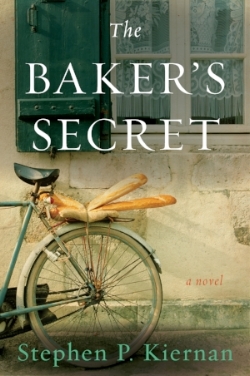
The Baker's Secret book cover by Stephen Kiernan

MC: Every day, Emma decides to sneak the villagers two loaves of bread made from the flour rations meant for German occupying troops. How does this small act of rebellion from an ordinary woman sustain hope for the community that help will eventually come?

SK: “There are no great deeds. There are only small deeds done with great love.” — Mother Theresa

MC: Emma learns her craft from Ezra Kuchen. However, since Ezra is Jewish, the Nazis arrive to take him away at gunpoint. How does Emma’s relationship with her mentor, Ezra, and the Germans’ treatment of him influence her decision to rebel?

SK: Emma begins the novel as powerless as a person in that time could be: female, young, unarmed, unparented, her fiance conscripted, her mentor Uncle Ezra taken away, a grandmother with dementia her endless responsibility. She is the least likely heroine. Yet it turns out she has learned generosity from Uncle Ezra. She has learned kindness from the vulnerability of her fellow villagers. She has learned stubbornness from that same difficult grandmother. Her entire life has been preparation for the role she assumes in her village.
One other factor came from my research. France lost so many young men in World War I (the equivalent loss today in America would be about 17 million people) that the male population had not recovered by 1944. Men who did remain were either conscripted, put to forced labor, or killed. Therefore many of the heroes of World War II in France were women. Emma exemplified the courage and determination of the French people to withstand and survive the occupation.

MC: Despite the hope Emma gives her community, she herself remains pessimistic about the chances of an Allied forces invasion to end the dark times in Vergers, France, and the rest of Europe. Does the oxymoronic idea of pessimism creating optimism play a role in other parts of The Baker’s Secret? What does this say about the human spirit?

SK: A large section of the novel is called “Want.” The lesson Emma learns in that time is that wanting something makes you vulnerable. She loves Phillippe, for example, so the young man is forced to work in a foreign factory. Therefore she steels herself against her own wants, denying what the reader can see she actually desires with every cell of her being. Even when help arrives, she can barely believe it.

MC: The events of World War II are dark and troubling, yet The Baker’s Secret contains moments of humorous reprieve, such as when the Nazis do not search a pigpen due to the odor. How do you bring light moments naturally and appropriately into a story that takes place in a dark time in history?

SK: I have spent the last 18 years working in end of life care—hospice, palliative care, advance directives—stemming in large part from my first book, a nonfiction study of the subject, called Last Rights. Over and over I have been delighted to find that even the most tragic circumstances include moments of hilarity, or lightness at least. It makes sense to me that the absurdity of Nazism would likewise be comical. (I also joined a long tradition: The Enormous Room, E.E. Cummings’ sparkling novel of World War I captivity; Slaughterhouse-Five, Kurt Vonnegut’s dark comedy about the firebombing of Dresden; Catch-22, Joseph Heller’s hilarious World War II farce.)

MC: How did you research the time period, specifically to accurately portray the dialogue?

SK: I began my research by reading deeply about D-Day, its events and context, and there is a rich literature on the topic. The best work I encountered was D-Day by Stephen Ambrose. His book relied on oral histories from the day’s soldiers archived at the Eisenhower Center in New Orleans. I read translations of French diaries, histories and novels written during the war (a dependable source for the tone of dialogue). I interviewed a veteran of the Omaha Beach invasion (a man so humble and dismissive about his heroism, by the end of the conversation I felt about one inch tall). I visited the International Museum of World War II in Massachusetts, which enabled me to hold every one of the weapons that appears in my novel, to feel their heft and size. And of course, I went to Normandy and visited the places where history was made, to see and smell and touch the setting of my novel. (This in itself was a moving experience, which I chronicled in an essay “The Instruments of War” that appeared in Electric Literature recently: https://electricliterature.com/search?q=stephen%20kiernan&ref=opensearch)

MC: Other authors have addressed the topic of World War II and the invasion of Normandy, as is the case with much historical fiction. How did you distinguish The Baker’s Secret from other novels in the genre in order to let your originality show through?

SK: All of the books I read had certain things in common: They emphasized the battle, they were about soldiers, and they neglected the French people. At the very start of my research, I learned that 5,200 Americans died that day—an incredible feat of courage and sacrifice—and that 11,800 French people died. More than double. I saw an opportunity to tell an untold story. My novel has about four pages of battle in it, and only two Allied soldiers even have a name. This is a novel about the occupied people, and the courage and sacrifice that they showed too.

There’s a larger point for me, as well. The deeper I researched, the more I became convinced that D-Day was an unusual and exceptional day from all of human history—but the experience of the occupied people echoed many many instances of oppression before and since. I believe there was an Emma in Leningrad during the long siege. I like to hope that there is an Emma in Aleppo today. That is why I removed all references to Germany, France, Nazism and even the year. It is the reason aspects of the novel, particularly the language, move toward the realm of a fable. There may be a universal human experience which showed brilliantly on D-day, but that transcends even that spectacular day and time.

MC: What’s next for you?

SK: I am knee-deep in a new novel and just finding momentum. At the moment I can’t say much because I don’t know much. But I do know that the central character is a keen and determined woman, that it is an adventure story of a swashbuckling sort, that it includes a love story with more sex than all my prior books combined, and that it spans the entire planet.

**

As a journalist and novelist, Stephen P. Kiernan has published nearly four million words. His newspaper work has garnered more than forty awards—including the George Polk Award and the Scripps Howard Award for Distinguished Service to the First Amendment.

Author of the novels The Hummingbird, The Curiosity, and The Baker’s Secret, he has also written two nonfiction books, Last Rights and Authentic Patriotism.

Stephen was born in Newtonville, NY, the sixth of seven children. A graduate of Middlebury College, he received a Master of Arts degree from Johns Hopkins University and a Master of Fine Arts degree from the University of Iowa Writers’ Workshop. He has chaired the board of the Young Writers Project, served on the Vermont Legislative Committee on Pain and Palliative Care, and served on the advisory board of the New Hampshire Palliative Care Initiative.

|

No Comments

|

Contributor Spotlight: Kali VanBaale

Kali VanBaale author photoKali VanBaale’s story “The Girl in the Pipe” appears in Midwestern Gothic’s Summer 2017 issue, out now.
What’s your connection to the Midwest, and how has the region influenced your writing?

I’m a born and bred Midwesterner and I’ve lived in Iowa my entire life, for better or for worse. Having grown up on a farm, my emotional connection to the land is strong and definitely comes through in my writing. Once a farm kid, always a farm kid, wherever I go. But I’m also influenced by what I live with and see every day—Midwestern attitudes and complexities, that mix of hard work, generosity, and polite passive aggression.

We’ll talk all kinds of shit behind your back but if your house burns down we’ll be there first thing in the morning with hammers and nails to help you rebuild it. And probably bring you some kind of casserole, too.

What do you think is the most compelling aspect of the Midwest?

For me, the most compelling aspect of the Midwest is the space. No doubt it drives some personalities crazy, everything so far apart and landlocked, but my personality needs room to breathe, stretch my legs, hear my own thoughts in silence. I can look out the back windows of my house and see nothing but sky. My strange soul often craves isolation, I think, because the vast horizons and quiet fields of my childhood still run in my bloodstream.

How do your experiences or memories of specific places—such as where you grew up, or a place you’ve visited that you can’t get out of your head—play a role in your writing?

Sense of place permeates every aspect of my writing because place has been such a powerful force in shaping who I am today. I grew up on a farm far from any towns, let alone cities. I learned from an early age how to entertain myself and to value the combination of hard work and imagination. I also learned what it means for your life to literally be dependent on the ground beneath your feet and the sky above your head to put food on your table and clothes on your back. That powerful thread creeps into my writing often—the primal relationship humans can develop with an environment.

Discuss your writing process—inspirations, ideal environments, how you deal with writer’s block.

I write every morning, Monday through Friday, from 8 a.m. to noon, without fail. I’ve always said that my discipline and tenacity are far stronger than my actual talent. I don’t experience writers block because I’ve trained my brain that at 8 a.m., when I close the drapes, turn on my lamp, and sit down at my desk, it’s time to write. No excuses.

I also teach creative writing online in the same office, at the same desk, so when I break for lunch, I turn off the lamp and open the drapes back up. That way my workspace looks different during the afternoon teaching time. It’s a good trick.

As for writing process, I’ll say upfront that mine is horribly inefficient. I tend to start with vague story ideas—a character, moment, or scene that interests or haunts me—and write my way into it. It can take dozens of 50- to 100-page drafts and false starts just to figure out what it is exactly I’m even writing about.

I write the majority of my first drafts long hand in spiral notebooks, and they’re very messy and skeletal, full of scribbles and arrows and notes in the margins. I then type my handwritten pages on the computer and clean up as I go. Once I have a somewhat working typed first draft, I go back in and pretty much dismantle it. Rewriting, revising, moving around, cutting, adding. In my current work in progress, I cut 20,000 words and two whole characters at one point. My stories come to life in the revision stages, for sure, so I’ve learned to embrace revising, no matter how many drafts it takes or how messy it gets.

How can you tell when a piece is finished?

Honesty, I can’t. I’m never done. Thank God for deadlines, otherwise I could revise a single story for the rest of my life. If I have some kind of deadline in place, then I have an end point to work towards.

I hate reading any of my published work for that very reason. I still see things I want to edit and change. I have to constantly tell myself that was the best story you could write that day for who you were in that moment, and just let it go.

Who is your favorite author and what draws you to their work?

Twenty years ago, I read a novel called The Book of Ruth by Jane Hamilton, and it stands as the book that made me want to become a writer. I can’t explain why, or what it was about that book in particular, I just loved it. And I’m a crazy huge fan of Jane Hamilton the person. She’s a super cool lady. Smart, funny, and incredibly insightful. I’ve met her a few times at conferences and she’s always so generous and only a tiny bit afraid of me when I have super fan freak outs.

I also love the works of Sherwood Anderson and Richard Yates. Revolutionary Road knocked me sideways and I return to that novel often whenever I’m struggling without something in my own writing.

I have a long list of friends whose writing I really admire, too. At the top would be Donald Quist for his complex and insightful world views, and Mathieu Cailler, who always somehow manages to convey his joy of writing in his writing. Plus, he’s figured out some secret sauce to publishing short stories I’m still trying to get my hands on.

What’s next for you?

I’m hard at work revising my fourth novel, which partly involves the real-life abductions of Des Moines paperboys Johnny Gosch and Eugene Martin in the 1980’s. As soon as it’s finished I’ll turn it over to my agent. She also represents my third novel, The Cure for Hopeless Causes, which is currently out on submission with editors. Eek.

I’ve also been chipping away at a short story collection for several years and have vowed to finish it once and for all within the next year because I’m sick of looking at it.

And finally, I teach fiction and nonfiction workshops for the Lindenwood University MFA in writing program, and craft workshops for various writing conferences and organizations, like the Iowa Writers’ House.

Where can we find more information about you?

I have a website, www.kalivanbaale.com, I’m on Facebook as Kali VanBaale Author, on Twitter @kalivanbaale, and Instagram @kaliprocrastinating.
And that’s exactly what I’m doing whenever I’m on social media: procrastinating.

|

No Comments

|

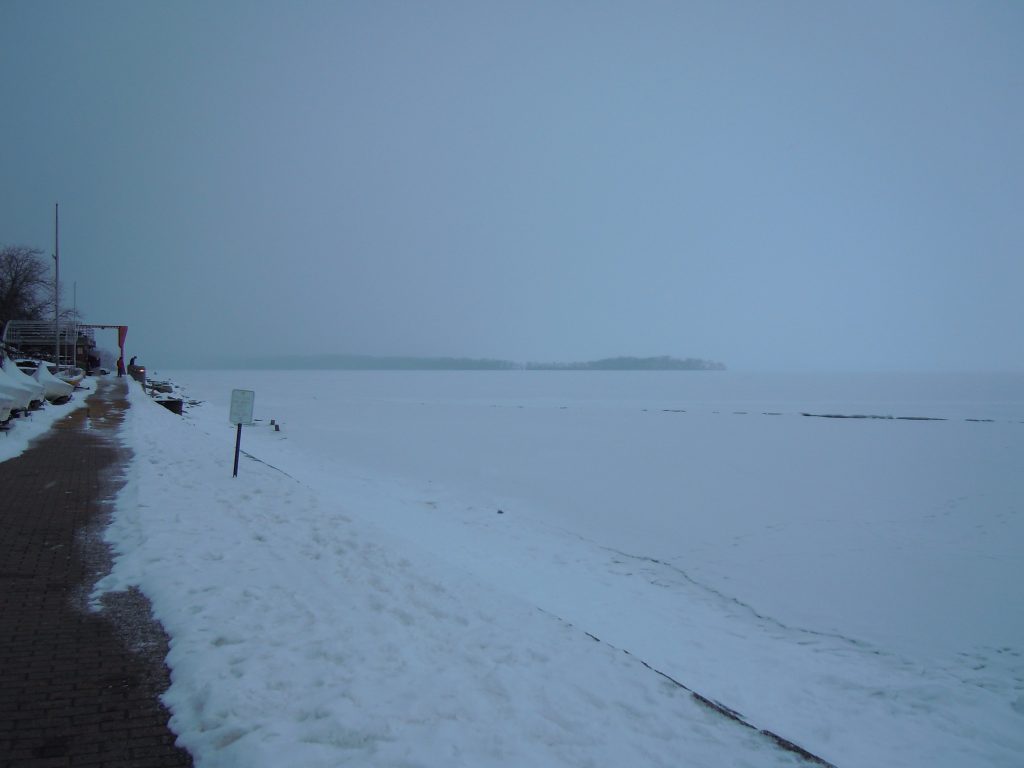
Midwest in Photos: Frozen Lake Michigan – Madison, Wisconsin

“As for the coldness, I have never seen it like this. I mean, coldness that makes like it wants to kill you, like it’s telling you, with its snow, that you should go back to where you came from.” – NoViolet Bulawayo, We Need New Names.

Photo by: Sarah Weinman

|

No Comments

|

Interview: Michael Bazzett

Michael Bazzett author headshotMidwestern Gothic staffer Marisa Frey talked with author Michael Bazzett about his work The Interrogation, the fluid nature of identity, learning to incorporate humor, and more.
**

Marisa Frey: What’s your connection to the Midwest?

Michael Bazzett: I was born in Chicago. My family moved to Minnesota when I was in first grade. I’ve lived in various towns in Minnesota for roughly 40 of my 50 years, the last 17 in Minneapolis.

MF: How does living in the Midwest influence the way you approach writing?

MB: There’s a lot that remains unspoken in Minnesota. The way people talk has been informed by a Scandinavian reticence, and conversations often have subtext. Wry understatement is big. That’s definitely shaped my aesthetic, and probably explains why I’m drawn to Polish poets like Wislawa Szymborska and Zbigniew Herbert: their Cold War aesthetic that responded to repression by saying things sideways and telling it slant.

Yet what is said is usually pretty direct and plainly said, which I think has informed my diction and my approach as well, as I favor a certain kind of transparency in my language. I don’t mind difficult poems, but I do mind difficultly for the sake of difficulty. That feels Midwestern to me, that natural wariness toward pretension and feeling at home in sardonic humor.

MF: The Interrogation explores one man’s different ages and desires, resulting in multiple, sometimes contradictory facets of the self. What was your process for writing and thinking about this?

MB: The short answer would be that I asked a lot of questions, hence the title. I was interrogating what it means to keep it real amidst the late-stage capitalism we’re marinated in, asking what it means to live an authentic life amidst so much artifice and virtuality, wondering to what extent we carry our childhood with us forever, what it means to be vulnerable, what it means to be a man, what it means to be white, what it means to be human and humane.

I think our identities are much more fluid than we generally think. The idea of a stable self has some utility, true, and thus it persists. Yet we literally shed our skin every seven months or so. We’re remarkably relational creatures: change our context and we change. It’s not just a metaphor, it’s bio-chemistry. We’re rivers and filters and mirrors as much as we are self-contained things, and that’s why somewhere along the line, someone used a verb to name us: we’re human beings (or humans being.)

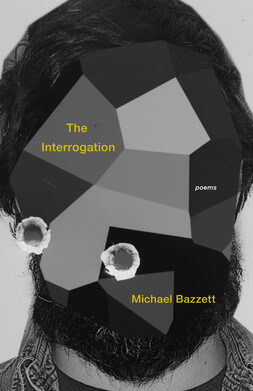
The Interrogation book cover by michael bazzett

MF: What is a key question you were hoping to answer or offer some insight on in The Interrogation?

MB: How to embrace the pain & wonder of wide awakeness.

MF: While your collection projects a darkly fantastic world—a man with no mouth speaks, an older and younger version of the same person sit down for a conversation—the simplicity of the lines creates a conversational tone. What draws you to this style?

MB: I know my poems can sometimes come across as a bit strange, yet I’m being as honest as I can. The truth is usually weird. And a lot of the work stems from asking “What if?” Maybe you feel like your voice is lost in the cacophony of the world? Make it literal: the man has no mouth. Once the imagination has done its work, the weirdness needs grounding, so I try to make the writing as clear and hard as glass. I want it be, as Seamus Heaney once said: Exact. Truthful. Melodious.

MF: How has your writing changed over time, in form and content?

MB: I used to stare at trees and consider how they are the lungs of the hillside and then strive to capture that in some spare, meditative lines. There are more people in my poems now, and the work has gotten weirder, which is another way of saying I’ve gotten more honest. It’s also funnier. I didn’t used to allow myself to do that, to use humor’s blade in that way, but comedy can be very transgressive; you can say things you can’t say elsewhere. And it creates a new entry point into a poem, a different doorway that might swing open a little more readily for some readers. I love it now when people refer to my work as a gateway drug to the hard stuff, i.e. real poetry.

MF: Do you think poetry—or writing, more broadly—should respond to the political and social climate of the moment?

MB: If poets are taking their task of undeceiving the world to heart, I don’t see how it can’t. Calling things what they are is a radical act. Facts have become so destabilized in today’s world, poetry is the place to look for truth. We need to imagine ourselves some new realities.

MF: What’s next for you?

MB: I have a book length translation of the Popol Vuh, the creation epic of the Maya, coming out the spring of 2018 from Milkweed Editions, and I’m currently working on some new poems that derive all of their energy directly from the sun, via photosynthesis.

If at all possible, I’d also like to go troll hunting in Norway.

**

Michael Bazzett is the author of The Interrogation (Milkweed Editions, 2017), Our Lands Are Not So Different (Horsethief Books, 2017), and You Must Remember This (Milkweed Editions, 2014), which received the 2014 Lindquist & Vennum Prize for Poetry. Bazzett has received the Bechtel Prize from Teachers & Writers Collaborative and a fellowship from the National Endowment for the Arts. He teaches at The Blake School and lives in Minneapolis, Minnesota. Learn more at michaelbazzett.com.

|

No Comments

|

Interview: Edward McPherson

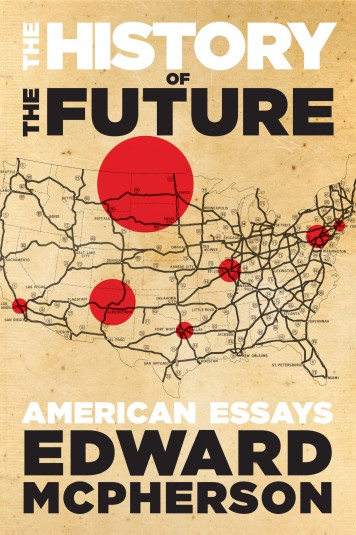
Edward McPherson author photoMidwestern Gothic staffer Meghan Chou talked with author Edward McPherson about his book The History of the Future: American Essays, shaping an essay collection, the multiple perspectives of history, and more.
**

Meghan Chou: What’s your connection to the Midwest?

Edward McPherson: For the past five years I’ve lived in St. Louis, where I teach at Washington University. (I married someone from Missouri, so before that I had visited the state a fair amount.) I also spent four years in Minneapolis. But I moved there after eight years of living in New York City, and I was born and raised in Texas, so my connection with the Midwest remains that of a curious outsider.

MC: The History of the Future features seven essays, each set in a different city of the United States: St. Louis, Gettysburg, Los Angeles, New York, the Trinity site, North Dakota, and Dallas. How did you decide which cities to focus on and what significance does each hold to you personally?

EM: I wrote the book one essay at a time, desperately hoping the whole thing might cohere into something greater than the sum of its parts. I started out wanting to write about Dallas, my hometown, because I hadn’t written much about it and I thought it was interesting that they were rebooting the famous TV show (Dallas) just as the city was nearing the anniversary of the Kennedy assassination. Who shot JFK/Who shot JR? (Alienation, anger, conspiracy… How do we handle history that refuses to stay in the past?) From there, I just followed my nose to whatever place felt most compelling. Not every idea worked out, but soon a pattern emerged: I was interested in the ways that the past might intrude (unexpectedly, uncomfortably) into the present. The subject matter kept shifting, obviously—the book is a collision of disparate topics—but in all the essays, I was either returning to a place I knew well (and had a personal connection to: Dallas, Gettysburg, New York, St. Louis) or posing as a tourist (as problematic as that is) in order to see something I felt I needed to experience firsthand (the site of the first atomic detonation, the oil fields and man camps of North Dakota, doomsday bunkers in Los Angeles, etc.). So I baby-stepped my way to a book; it took five years and got darker as things in this country seemed to take a grim turn.

The History of the Future book cover by Edward McPherson

MC: In order for a collection to work as successfully as The History of the Future, the essays need to hold a common theme or connection. What connections did you want the reader to follow between the seven essays, specifically with regards to the presence of violence and oppression in each of the cities?

EM: I’m a fan of this quote from Ben Greenman that I’ve tacked up over my desk: “A book of essays can be a constellation. Individual pieces shine like stars, but to see the whole project as a unified thing requires a mythology. You need faith to make out a shape around all those dots of light, to believe in the bear or the swan.” I was always writing a book—not just individual pieces for publication—so I knew I wanted the essays to converse, to complicate and perhaps even contradict each other, in places. But you can’t just repeat yourself and you can’t hit a theme too squarely on the head (else it becomes trite). You have to have faith that your aesthetic/artistic/intellectual/moral preoccupations will bind the thing together while also creating some friction. In terms of violence and oppression, that wasn’t hard—scratch any surface in America and you’ll find it. What I became interested in was a kind of American amnesia, how trauma in the past was being forgotten or sanitized—for political purpose, or simply due to distraction or nostalgia or what-have-you)—and yet you couldn’t understand our current reality (or imagine where we might be going) without really trying to look at those past wounds.

MC: You spent time at the University of Minnesota as both a student and teacher, but Minnesota is not one of the states represented in The History of the Future. Why did Minnesota not fit well with the greater collection and the reflections you wanted to express?

EM: Oh, I had ideas for Minnesota! But none of them held my interest in the end. (Famous last words—perhaps I’ll write about them in the future?) Plus once the North Dakota essay grew so long (at about 80 pages), I didn’t want the book to get too top-heavy on the upper Midwest. As I was rounding out the collection, I tried for some sort of geographical coverage, though plenty of places were left out. For instance, there’s nothing directly about the Deep South, though of course there’s so much material there. I just couldn’t imagine writing about the south and not addressing racism, which was already the focus on the long essay on St. Louis. Early on, I knew the book could never be complete.

MC: As a follow up, do you observe a cultural disconnect between the Midwest and other regions of the United States?

EM: I think the idea of a disconnected Midwest (“coastal elites,” “flyover states,” “MFA vs NYC,” blah blah blah) is too easy, too simple, particularly given our interconnected daily lives. (Thanks, internet.) People are people; art is art; there’s culture everywhere. So my short answer is a firm “no.” But I also like the idea of places being PLACES, that is, distinct. (Otherwise, why get off the couch? This book is a travelogue, of sorts.) What I’m interested in is getting to know the particular texture of a place, wherever that is. And
I do enjoy the underdog mentality that comes from being a writer no longer living in NYC—we’re outside the rat race, we’re apart from the noise, we can let strange inner lives bloom. And of course there are the fabled creature comforts: access to nature, plenty of parking, a slightly bigger apartment. But obviously artists all over the country are doing vital work—in big cities, in towns, in the wilderness. It’s comes down to personal choice and working method.

MC: As the title, The History of the Future, suggests, time plays an important role in this collection. How do your reflections on the past, present, and future merge in these essays?

EM: I’ve always enjoyed the line attributed to Mark Twain: “History doesn’t repeat itself; it rhymes.” I’m interested in history for the way it not only enlarges our understanding of the past, but opens up new perspectives on the present—which then might give us an inkling of where we might be headed. The title—which comes from a line from Whitman—is a nod to how the book boomerangs between the past and the future (with us stuck muddling through the present). Of course there is no singular “History” with a capital H, and so in my writing I always find myself trying to contend with, make sense of, and/or expand the stories of others who have come before me.

MC: How did you balance historical analysis with personal memoir and what power does each element contribute to the essays in this collection?

EM: The book mixes journalistic attempts with more personal essays, but ultimately the power is the same for each—narrative drawn from life. I’m telling stories, trying to put myself (and the reader) under the sway of an empathetic imagination. I think “analysis” suggests too stark an objectivity. I don’t pretend to any such completeness (I’m suspicious of any tale told too easily). Each essay is a container for doubt. Hopefully the reader gets caught up in a widening kind of investigation that doesn’t end too easily (if it ends at all). Then the next move is theirs to make.

MC: What’s next for you?

EM: I’m currently mulling over my next nonfiction project—which will be a single subject that I approach episodically (but more through chapters than in individual essays—in other words, the connective tissue will be a bit stronger, more apparent). How’s that for being thematically vague? I’m too superstitious in the early stages of a book to talk too much about the idea, else I lose interest. I also plan to revise a collection of short stories that I’ve been returning to over the years.

**

Edward McPherson is the author of three books, including The History of the Future: American Essays. He has written for The New York Times Magazine, The Paris Review, Tin House, The American Scholar, The Gettysburg Review, Salon, The Southern Review, True Story, Guernica, and Talk, among others. He has received a Pushcart Prize, the Gulf Coast Prize in Fiction, and a Minnesota State Arts Board grant. He teaches creative writing at Washington University in St. Louis.

|

No Comments

|