Interview: John Wray

April 21st, 2016

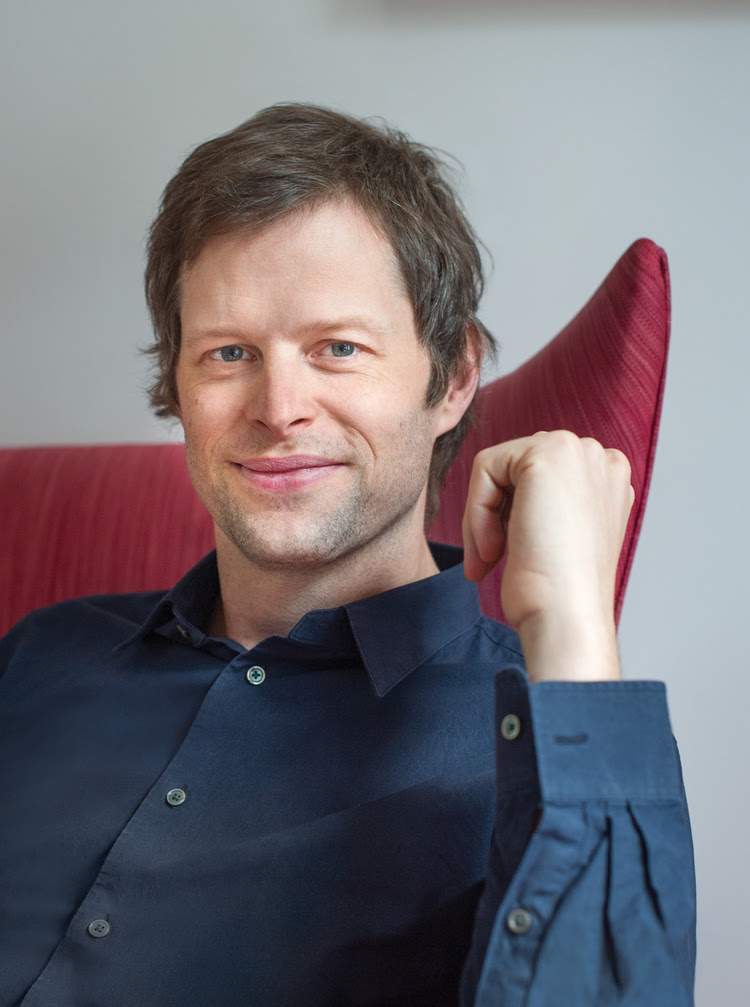
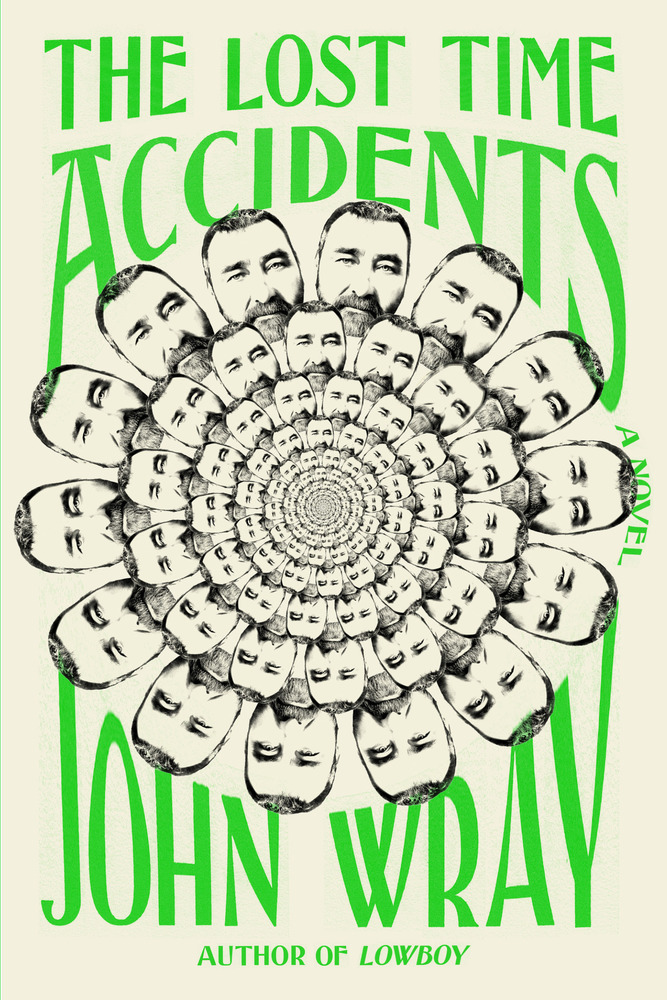
John WrayMidwestern Gothic staffer Rachel Hurwitz talked with author John Wray about his book The Lost Time Accidents, time travel, representing mental illness, and more.

**

Rachel Hurwitz: What’s your connection to the Midwest?

John Wray: I spent five years in Ohio, attending Oberlin College and then just hanging around. I was one of those questionable characters who had so much fun in college that they didn’t want to leave.

RH: You’re a citizen of both the United States and Austria. How do you think this has affected your writing style and what you write about?

JW: I think it’s had an effect on pretty much every aspect of my life and personality, to be honest. It made certain things more difficult, growing up—I had a hard time separating English and German, as a small child, and was in the remedial reading group in school until the third grade—but having seen that there places outside of the United States where people had very different ways of looking at things encouraged a critical view of America (and, of course, of Austria as well) from a very young age. Once I’d gotten over my confusion, that is.

RH: Additionally, what made you choose to attend Oberlin College to study biology during your undergraduate career? Because of this, what does the Midwest mean to you?

JW: Buffalo, New York, where I was raised, has more in common with Chicago, for example, than with New York City, culturally speaking—once I’d moved to Ohio, I began to see my hometown as a curious extension of the midwest. (Later I learned that this was largely due to the flow of trade via the Great Lakes to the Erie Canal back in the city’s heyday.) To be honest, I chose Oberlin because Oberlin chose me—I was a terrible student in high school, a very depressed and angry kid, and was incredibly fortunate to be accepted there. I’m not sure what or where I’d be today if I hadn’t had that stroke of luck. Oberlin had an enormous influence on every aspect of my worldview, from politics to aesthetics to my taste in pop music. I can’t praise it enough. No wonder I had such a hard time leaving!

RH: In your newest novel, The Lost Time Accidents, the protagonist, Walter, has been “exiled from the flow of time.” How did this flexibility in location and time lend itself to your creativity in writing the novel?

JW: It was both tremendously freeing—anything can happen! the customary rules and regulations don’t apply!—and more difficult for that same reason. The great challenge to writing a novel in which past and present and future need not follow meekly one after another is to make sure that the experience isn’t confusing or simply frustrating for the reader. It needs to be exciting, liberating—and, above all, entertaining. Time travel should be fun, as well as a little frightening.

9780374281137

RH: In The Lost Time Accidents it is mentioned “chronology is an illusion, if not a deliberate lie,” which sounds slightly similar to thoughts in Kurt Vonnegut’s Slaughterhouse-Five. Did you intend for any similarities between these two novels?

JW: Absolutely. I’ve loved Vonnegut since grade school-the first novel of his that I read, appropriately enough, was ‘Venus on the Half Shell,’ which he wrote pseudonymously, as one of his own characters, the science fiction author Kilgore Trout. Trout was a significant influence on Orson Tolliver, the ‘starporn’-penning character in The Lost Time Accidents—and most of all, the obvious joy Vonnegut took in creating (and, later, impersonating) a cantankerous writer of questionable merit. My novel is many things at once, more or less by design; and one of them is certainly an homage to Vonnegut, among many other beloved authors of my youth.

RH: Your novel Lowboy follows a schizophrenic protagonist through the New York Subway system and mental illness seems to plague the characters in The Lost Time Accidents as well. Why does mental illness play a prevalent role in your works?

JW: One of the aspects of the human experience that fiction can explore most effectively—far more effectively, in my opinion, than film or theater or visual art—is subjectivity. The question, so central to consciousness, of where the boundary between consensus reality and our biased understanding of it lies, is the territory of the novel, and has always been a fascinating one for me. It may be what drew me to fiction in the first place. And madness is, in a certain sense, the most extreme expression of this question.

RH: What is the most difficult facet of the writing process for you? How do you manage or deal with this difficulty?

JW: Dear lord—is it possible to answer ‘everything’? I don’t find any part of the writing process easy, to be honest. My goal is always to write books that feel as though they wrote themselves, but certainly that couldn’t be farther from the case. I’m weeping tears of self-pity as I write this. Boo hoo!

RH: What’s next for you?

JW: The beach! After seven years of writing this book, I need to relearn how to be a human being. Humans like to go to the beach, right?

**

John Wray is the author of The Lost Time Accidents, Lowboy, Canaan’s Tongue, and The Right Hand of Sleep. The recipient of a Guggenheim Fellowship, a Whiting Award, and a Mary Ellen von der Heyden Fellowship from the American Academy in Berlin, he was named one of Granta‘s Best Young American Novelists in 2007. A citizen of the United States and Austria, he currently lives in New York City.

Contributor Spotlight: Alina Borger

Alina Borger’s piece “Family History, c. 1970” appears in Midwestern Gothic Issue 21, out now.

What’s your connection to the Midwest, and how has the region influenced your writing?

I was born and raised in the Midwest, went to college here, and now am raising my family here. I’m not sure I can extricate myself or my work from the Midwest and have anything left.

What do you think is the most compelling aspect of the Midwest?

Well, it’s home. But also, it’s practically Eden-lush, fertile, full of rivers and lakes-and just as hidden. And the people here are sturdy and generous and deeply thoughtful and odd in all kinds of beloved ways.

But at the same time, it’s not a monolith. I’m talking now more about Iowa City or Grinnell than I am about Glen Ellyn or Naperville. But twenty years ago, it’d have been the opposite.

How do your experiences or memories of specific places—such as where you grew up, or a place you’ve visited that you can’t get out of your head—play a role in your writing?

Almost everything I write starts with a specific place, actually. That’s maybe even more true in my fiction than in my poetry, since most of my poems lately begin at my mother’s kitchen table. One of the main challenges of writing (for me) is knowing a place well enough to evoke it on the page with just a few gestures in its direction, and the Midwest is really the only place I know like that, know with my eyes closed.

Discuss your writing process — inspirations, ideal environments, how you deal with writer’s block.

Whoa. This is a big question. Most of my work comes from personal experience and emerges into a broader context as it develops. A poem might begin with a memory or a tiny domestic drama, but at some point, I’ll realize I’m writing about something much larger. A central image in the poem might open up into a metaphor or the poem might take a turn that pushes it outward.

As for environments, Most days, I write for an hour or so in my studio, but I’m also perfectly happy to sneak in fifteen minutes anywhere I can. Coffee shops and hotel lobbies and Friday afternoons in the computer lab with the students in writing club.

And about writer’s block, I’m an odd duck. Beginning a piece of writing is never a problem for me—I love new ideas and I find it liberating to look at an empty page, my cursor blinking at me cheerfully. In fact, part of what I love about the poetry component of my work is the potential to start with a blank page each time I begin a new poem.

I save my terror for the middle. Facing a not-quite-there poem or a half-finished fiction manuscript often calls on all my creative tricks and tools—doodling in cafes, writing down my dreams, and keeping notebooks in every conceivable corner of the house. Occasionally when I’m stuck in the muddy middle, I’ll use my affection for the blank page as a tool, dropping the manuscript in a hidden sub-folder and writing new scenes, each as its own new document. Other times, I’ll write an ending that will never work just to get myself out of that middle space, then spend months writing new scenes and working my way up to a real ending.

How can you tell when a piece of writing is finished?

When I desperately want my husband to read it, I know I’m feeling good about it. That’s not to say it won’t need more revision (often a LOT), but that’s how I know I have a revised draft worth its salt.

Who is your favorite author (fiction writer or poet), and what draws you to their work?

Impossible! My go-to list: Jane Austen, Sharon Olds, Ted Kooser, Elizabeth Bishop.

But I’ve recently come through a phase of reading a lot of Mary Oliver poems. I love the simplicity of her images juxtaposed with really startling, revealing thoughts about our place in the universe.

In fiction, I’m firmly committed to Rainbow Rowell and Jandy Nelson just now. I don’t know any contemporary writers who are doing character better.

What’s next for you?

I’m working on two manuscripts-a poetry manuscript and my third novel. The novel has most of my attention just now.

Where can we find more information about you?

My website, www.alinaborger.com is full of information. But I also tweet pretty regularly @AliBG, and I love making new writer friends there!

|

No Comments

|

Interview: Andrew Mozina

Midwestern Gothic staffer Rachel Hurwitz talked with author Andrew Mozina about his book Contrary Motion, politeness, the path to becoming an author, and more.

**

Rachel Hurwitz: What’s your connection to the Midwest?

Andrew Mozina: I grew up in a suburb of Milwaukee, went to college at Northwestern, bounced around Chicago, earned a graduate degree in St. Louis, and have lived in Kalamazoo, MI, for the past sixteen years. Except for about four years in Boston, I’ve lived in a Midwestern city my whole life.

RH: How did growing up outside of Milwaukee influence your writing? Has living in Kalamazoo since then changed your view of the Midwest and how you integrate it in your writing?

AM: Two traits that I associate with Midwesterners—politeness and irreverence—have really influenced my writing. I see politeness and irreverence as two sides of the same coin: the more constrained by politeness you feel, the sharper your irreverence might be. It’s no accident that The Onion started in Madison, WI, and Second City grew up in Chicago. I’ve honored these traits by being an earnest smartass: most of the humor in my writing turns into pathos, and most of my pathos is for situations that also strike me as darkly funny. I love a deadpan tone that can tilt either way. Also, I experienced a lot of blowing and drifting snow in Milwaukee, and that’ll certainly harden your sensibility. In fact, even though my new novel is entirely set in the spring, the whole mood of Contrary Motion is of a man in flip flops and shorts standing in a field during a blizzard.

Kalamazoo has reminded me that there are many “Midwests” out there—from the big city midwesternness of Chicago to the midwesternness of places like Kalamazoo and the rural areas around it. As far as the effects of living in Kalamazoo go, well, sticking with the weather, the snow is generally wetter—we’re right on the edge of the lake effect—and less likely to blow and drift. It’s also much cloudier in Kalamazoo, which makes its atmosphere bleaker and suits a small city where a lot of people are hanging on by their economic fingertips. Despite all of its awesome elements, Kalamazoo is an obscure place and a good setting for people running aground or off the rails. I think my second book of stories, Quality Snacks, has a sort of forlorn, rustbelt mood that has some aspects of Kalamazoo in it.

RH: It seems like you have an interesting path into your writing career as you attended Law School for a year before receiving a Master’s in Creative Writing and Doctorate in English Literature. Can you talk about that experience?

AM: I was an econ major and didn’t think seriously about writing fiction until my senior year of college, when I was already admitted to law school. The transition from law student to writing student was fairly traumatic. I was going from a stable career that I was pretty sure I could do to an unstable pursuit that I was wildly uncertain about whether I could succeed at. I ended up getting a Ph.D. in literature in part to fill in my background—I was woefully under-read (and have never really caught up).

RH: How did this lead you to a career as a professor at Kalamazoo College?

AM: Once I got my writing and lit degrees, I looked for a teaching job. Though it sounds cheesy, I really loved the curriculum at Kalamazoo—the senior project, the study abroad program, the emphasis on internships. I like teaching, though it doesn’t leave as much time for writing as I’d hoped when I went into it.

RH: Your newest novel, Contrary Motion, follows a concert harpist who is working towards an impending audition, while everything in his life explodes around him. Why did you decide to have music be such a critical part of the novel and why does Matthew, the protagonist, play the harp of all instruments?

AM: Like most things to do with writing, it was part serendipity and part intentional. My wife plays the harp, so I was familiar with that world. I’m also interested in the problem of performance anxiety, especially the idea that an extreme drive to do well can be self-defeating. A public performance is inherently dramatic, and music is one of the few art forms that usually depends on a live performance with no do-overs or edits. Focusing on an audition really brought that out. Improv comedy is probably the most vulnerable form of performance, and I decided to work that into the novel as well.

I also wanted to explore gender and sex in the book. A very high percentage of harpists working today are either straight women, lesbian women, or gay men. There are not a lot of straight male harpists like Matt out there, especially in the US. I wanted a sense of Matt going against the grain of gender expectations, of being at odds with things in general, which would be an example of contrary motion and would also accent his issues with sex.

RH: Additionally, what drew you to setting the novel in Chicago?

AM: I’ve lived in Chicago and I love the city, so the details of the place were available to me and it was fun to be there imaginatively. It’s also a really good city for harpists. The principal harpists of the Chicago Symphony and the Lyric Opera are great players and draw a lot of students. There are enough freelance opportunities for a harpist like Matt to scrape by. And Chicago also happens to be a global center for harp manufacturing, with two major harp makers, Lyon & Healy and Venus Harps. I wanted Matt to experience mechanical problems with his harp and to make a visit to a harp factory.

RH: Contrary Motion is your first novel, as your previous works have been short story collections. Was it difficult to switch to a different form of writing for this novel? Did you have any tricks for working with an extended plot such as outlining or pre-working chapters?

AM: Stanley Elkin, a fantastic and under-read writer, said that novels are about chronic characters and short stories are about acute characters, and Matt is a chronic character; his issues as a person are those he’s faced his whole life, and I thought it would take a major movement of action to test whether he’d make any progress on them. I wanted to throw a lot at him—the loss of his father, romantic difficulties, his relationship with his daughter, playing harp at a hospice, and preparing for the audition. With all of the changes and challenges he’s facing, he’s really auditioning for a whole new life. I knew braiding all of that together was a novel-length story.

My guiding tricks were to use the present tense and to confine the action of the novel to roughly the two months leading up to and including the audition. Without doing an outline, I came up with some scenes that I knew I needed and started writing them in chronological order. Eventually I used a day planner for the exact months and year in which the novel takes place and filled it in with the basic events from the novel’s timeline. All that helped me manage the logistics of a long story, but the first draft still had a quiet, short-storyish ending; it took a few tries to come up with a novel-worthy ending.

RH: Similarly, are you the type of author who writes linearly (as in the story comes together chronologically from start to finish) or do you instead work in sections and rearrange the pieces afterwards? Do you recommend one or the other to your students, or do you think it strictly comes down to personal preference?

AM: I knew I was writing toward the audition as the last major action of the book, but the first draft was basically linear. I write recursively, “from the top,” over and over, which means I read over and polish what I’ve already written dozens of times, sometimes hundreds of times, before I extend the story with a new scene. I need to feel what’s already there is reasonably OK before I move on. Once I had a complete draft, the major revisions I did were less linear. I did a lot of adding and cutting throughout the book and some shuffling of incidents.

I’m wary of making process suggestions to students unless the student has gotten stuck. Every writer has their own way, I think. Eventually, you have to make decisions about how things are going to be. If a student is putting off major decisions for too long, I intervene.

RH: What’s next for you?

AM: I’m drafting stories that are about various pariah figures—individuals or classes of people the general public judges to be emblematically bad. I’m hoping that one of those stories in particular will turn out to be a novel.

**

Andy Mozina is the author of the debut novel Contrary Motion (Random House/Spiegel & Grau). His first story collection, The Women Were Leaving the Men, won the Great Lakes Colleges Association New Writers Award. His second collection, Quality Snacks, was a finalist for the Flannery O’Connor Prize and other awards. Mozina’s fiction has appeared in Tin House, The Southern Review, The Missouri Review, and elsewhere. He is a professor of English at Kalamazoo College and lives in Kalamazoo with his wife, Lorri, and his daughter, Madeleine.

|

No Comments

|

Contributor Spotlight: Danny Caine

Danny Caine’s piece “The Middle West” appears in Midwestern Gothic Issue 21, out now.

What’s your connection to the Midwest, and how has the region influenced your writing?

I was born and raised in the suburbs of Cleveland. I recently moved to Lawrence, Kansas for graduate school, and only after moving away from Cleveland did I realize how much it shaped my worldview. Every landscape of my childhood shaped the way I see the world, from Applebee’s by the offramps to the blighted houses of the East Side. This is my world, and I haven’t really figured out a way to write about anything else.

What do you think is the most compelling aspect of the Midwest?

I think it can be best summed up in the experience of cheering for the Cleveland Browns. You know any given season is going to have a pretty high quotient of misery, not to mention ungodly cold weather, but you’re nothing if not proud. This pride-in-misery builds community. The nod from one Browns fan to another is like how Jeep owners look at each other. It’s a Cleveland thing. You wouldn’t understand.

How do your experiences or memories of specific places—such as where you grew up, or a place you’ve visited that you can’t get out of your head—play a role in your writing?

My current project, of which “The Middle West” is a kind of title poem, is an effort to capture the Midwestern landscape as I remember it. It’s a love story, but too often love stories only blossom in the glitzy cities of cinema. How many love stories can you think of that are set in New York or Paris? Now how many love stories can you think of that are set in the strip malls of Cleveland’s southern suburbs? People fall in love out here too. People hold hands in parking lots where gulls perch on light poles over seas of only asphalt. People go on dates at Bob Evans. Their stories are just as lovely.

Discuss your writing process — inspirations, ideal environments, how you deal with writer’s block.

I need a line first. I usually start with that single line which is the pebble that hits the windshield to make the spider crack. For “The Middle West,” it was the line about $2 margarita night. If I can’t think of that line, I listen. Whenever someone says something great, I write it down. I have a list of lines to bail me out of writers block. One of them is “the smell of other people’s backseats in summer.” I haven’t written the rest of that poem yet, but I will someday.

How can you tell when a piece of writing is finished?

I could answer this a few ways. First, when I feel comfortable reading it out loud. Second, when it gets published (and if that’s the measure, I’ve only “finished” a handful of poems). I realize both of those are dependent on outside validation, but I think that an audience really is a part of me deciding when something is done. Once it leaves my hands and I give it to someone else, there’s not much else I can do, is there?

Who is your favorite author (fiction writer or poet), and what draws you to their work?

Erika Meitner’s newest book Copia is really fantastic in ways a lot of Midwestern Gothic authors would appreciate. She tells these really image-heavy, totally affecting stories that are set in dead malls and Wal-Marts and Detroit and Niagara Falls—places that feel familiar to me but often get ignored for more exotic or “lovely” places. I also read a tremendous amount of fiction, and I’ve recently finished reading everything Elenea Ferrante has written. She’s incredible. I’m drawn to her because her books feel classic and current at once: she’s telling a story for the ages with a keen contemporary eye and ear.

What’s next for you?

I have one more year of my MFA left, then, who the heck knows.

Where can we find more information about you?

My website is dannycaine.com. Twitter: @mistercaine. Instagram: @dannycaine.

|

No Comments

|

Interview: Diane Seuss

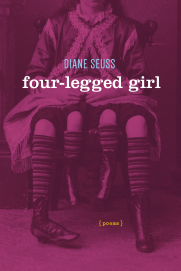
18editcolorMidwestern Gothic staffer Rachel Hurwitz talked with poet Diane Seuss about her poetry collection Four-Legged Girl, the poems inside of us, lushness, and more.

**

Rachel Hurwitz: What’s your connection to the Midwest?

Diane Seuss: I was raised in small towns along the Michigan-Indiana border: Three Oaks, Edwardsburg, and Niles. I left for years at a time, but when I lived in other regions I always felt like I had vertigo of the imagination. When I lived in New York City, for instance, I could never find the horizon line, and for that reason I felt unreal to myself. As you know, writers tend to have their region, the source of their myths and metaphors. For me, it’s land that many would consider un-beautiful, but many would consider me un-beautiful as well. A writer ought to write from the land where their people’s bones are buried, if they can find them.

RH: You have been on faculty at Kalamazoo College since 1988 and the MacLean Distinguished Visiting Professor in the English department at Colorado College, so educating upcoming poets is clearly a huge part of your life. What inspired you to begin teaching at the collegiate level?

DS: I never really had a life plan. I didn’t live with a focused degree of intention until recently. Both of my parents became teachers in circuitous ways. My father, after serving in the Navy during World War II, got his GED and then a teaching certificate. My mom went to college for the first time after he died young of a rare illness, probably linked to his time on the ship, and she then became an English teacher. It was a profession she knew from watching him and his colleagues, and as she has said, she wasn’t much of a waitress. I grew up listening to my mom typing her college papers about Joyce and Woolf on her old manual typewriter, and then talked with her about her lesson plans and the books her students were reading once she began teaching. I guess teaching is in my blood, given all that. I apprenticed to my parents, my mentors, as my barber grandfather apprenticed at his dad’s side. My graduate degree is in social work, and I worked in domestic assault, community mental health, and private practice for several years before I was asked to teach a course at Kalamazoo College as an adjunct. I’d been writing poems all along, and had started to publish. I’d taught writing workshops for women in the community, alongside my clinical work, for years. My teaching went well at K, and I was asked back again and again. I had ideas about what a creative writing program could look like, how it might be shaped, and after a while there was a program that relied on my presence. I found myself doing social work, teaching creative writing, building a writing career, and raising a young child all at the same time. Something had to give. Ultimately, teaching won (and my marriage lost). I am passionate about the process of students claiming their imaginations and learning how to climb inside a poem. They’ve kept me young and aged me, both at the same time.

RH: What is the most important revelation you have acquired about writing, or life in general, from your students?

DS: I guess I’d say that I’ve witnessed the fact that we all have poems inside of us, and that the work to release them is tough. All of my students have had the capacity to attune their ears to the music of language and to uncage their imaginations. Learning to listen and to self-witness is valuable in and of itself, no matter what the student ends up doing after college. I continue to be surprised by the students’ resilience and by their capacity to create, and also by how “difficult it is to get the news from poems,” as Williams writes, but how much they continue to need that news.

RH: Is there any particular kernel of wisdom or bit of knowledge that you typically give to your students or others who are just starting their literary careers?

DS: Persist. There are so many talented writers out there (thank God) and often the difference between establishing a literary career and not is dogged persistence and self-discipline, which sounds like a drag but is actually the only form of spiritual practice that ever held water for me. In terms of writing itself, never stop revising your position in relation to language. I’ve used the metaphor of a bead on a string, endlessly gliding between the two ends. Narrative and song, image and diction, wholeness and fragmentation, personality and rhetoric—never get comfortable. Never stop second-guessing whatever you do that is habitual.

RH: Many of your poems have a strong sense of place—a time, a space, even a feeling of location—even if the name of that place is never explicitly stated. How did this arise in your poetry?

DS: The place I grew up, in the rural Midwest, and when I grew up, in the 1960s, shaped how I see and experience the where. As you can imagine, without internet, social media, cell phones, Netflix, with perhaps two TV stations on a good day, and one TV show geared toward children, media was not, for me, a location. There was also no pressure to perform, no awareness that there was something beyond the present tense to aspire to. We lived for a time next to the village cemetery, which became my playground, even the platform for the theater of my imagination. A milkweed pod was a puppet. A horse on the other side of the fence was a god. I was very lucky, in that parents didn’t fear children being assaulted or murdered, and I wasn’t assaulted or murdered. I came to know myself within that setting; I only understood myself as real within a non-virtual landscape. Even when I eventually lived in a vast urban space I was sensitized to the external details that hold us up, whether we see them or not. I see them.

RH: Your latest collection of poems, Four-Legged Girl, has been called “lush as in overgrown, as in erotic, as in drunk. Lush as in botanical, both in content and florid execution” by the literary journal ZYZZYVA. Do you think this is an adequate representation of your work?

DS: I love that review, and I think Maggie Millner, its author, is a brilliant writer. She was right on in her description of what I hoped for in Four-Legged Girl. The longest poem in the collection is called “I can’t listen to music, especially ‘Lush Life,’” and that jazz standard, written in the mid 1930s by Billy Strayhorn, really sets the tone for much of the book. Lushness, in the song, is erotic and swoony, yes, and also refers to the use of the word as a noun for someone who is over-the-edge, a drinker, a person lost to nightlife and shadows. I loved that double-usage, and I think it frames the book’s narrative line and emotional landscape. Its speaker contemplates her life as a lush lush. Hopefully, by the end, she comes to a kind of present-tense lushness that is synonymous with poetry.
9781555977221

RH: Similarly, your poems seem to range in tone from light and comical to intense and dark. Where do these stark contrasts come from in your inspiration and tone? Do you prefer writing one to the other?

DS: For me, the two are all tangled up in each other—the comic and the dark—like a squash vine and a patch of deadly nightshade. It’s one distinction, I think, of writing from the Midwest. Yes, dark humor is a literary tradition in many regions inside and outside of the U.S., but the Midwest has a particular brand that I’m not sure how to put into words. It’s linked to the Southern Gothic but it has its own flavor, like my southern friends have different recipes for their funeral salads than we do up here. Many in Michigan are from families that migrated up here from the south. We almost remember that particular brand of jackassery, but we’ve lost even the distinction of being southern jackasses. Meteorologists, even if our weather is dramatic, rarely mention the Midwest. We’re a poltergeist region, trapped between areas with actual identities. Mid-career, midlife, middle of the road. That entrapment, that near-invisibility, is part of our tradition of dark comedy and one of its tropes. Also, if a Midwesterner gets too intense they get razzed. And if they get too funny they’re seen as trying to rise above the ranks. That’s a long answer to a good question, and I’m not sure I’ve answered it. (P.S. My mom makes a funeral salad called “Green Gag.”)

RH: Your poems seem to vary greatly in style and form—some are long and structured with clear stanzas, while others, such as “Song in my Heart,” are much shorter and freeform. Do you plan the form prior to writing your poems or is that a natural part of the process? Do you implement your structure in editing or is it present from the get-go?

DS: The skeletons of my poems usually, though not always, emerge as I’m writing the poem, but revision for me is about fiddling with structure. As you can tell, I’m not as much into the architecture of my poems as many contemporary poets are. I see structure as the bones that deliver the flesh, which could be considered a weakness, in both poetry and embodiment.

RH: Who do you consider to be the greatest influence on yourself and your work—either literary or personally?

DS: May I have two? The first is my mentor, Conrad Hilberry, who found me after reading one of my poems when he judged a little contest that I’d entered without realizing it was only for adults. My entry was typed single-spaced, with no awareness of a left margin, on a piece of paper I tore out of a notebook. He came to Niles to do a poet-in-the-schools gig at the high school in town and sought me out at my high school outside of town, which was basically in the middle of a cow pasture. From there, he sent me books, got me help to go to college, including one by Diane Wakoski, called Inside the Blood Factory. He never told me to simmer down or hold my horses. Second, my mom, her voice, her hilarity, her endurance, her solitude, her lack of vanity, her independence, and her funeral salad.

RH: What’s next for you?

DS: My next book of poems, Still Life with Two Dead Peacocks and a Girl, will be out in 2018 from Graywolf Press. It concerns art with a capital A, specifically, early still life painting, and the connection between still life, which occupied the lowest rung on the art historical ladder, and the rural Midwest, and traditional women’s work, both in the house and on the canvas. It sounds stuffy but it isn’t. Writing that manuscript was the most powerful experience of my life. It pretty much roiled off of me, out of me, like water breaking or gas pouring out of a broken pump. I’m currently in revision mode for that book, and beginning to work on something new that will resemble a memoir, tentatively titled Auto-Body.

**

Diane Seuss’s most recent collection, Four-Legged Girl, was published in 2015 by Graywolf Press. Her second book, Wolf Lake, White Gown Blown Open, won the Juniper Prize and was published by the University of Massachusetts Press in 2010. Her fourth collection, Still Life with Two Dead Peacocks and a Girl, is forthcoming from Graywolf Press in 2018. She has published widely in literary magazines including Poetry, The Iowa Review, New England Review and The New Yorker. Seuss is Writer in Residence at Kalamazoo College.

|

No Comments

|

Issue 21 is Now Available!

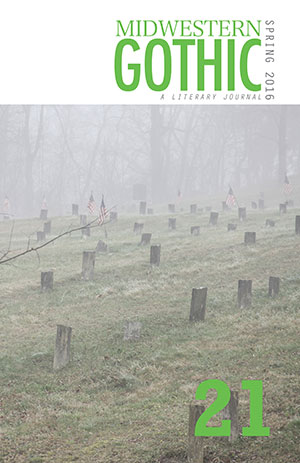
Midwestern Gothic Issue 21 Spring 2016We’re thrilled to announce that Issue 21 (Spring 2016) of Midwestern Gothic has arrived! This issue marks our 5-year anniversary, in addition to new work that explores urban and rural, fractured settings, and nostalgic memories from exciting voices in the region.

Issue 21 is available in paperback ($12) and eBook formats ($2.99), including Kindle, iPad, Nook, and PDF. Buy your copy

Issue 20 features fiction from: Nina Buckless, Carrie Cook, Curtis Dickerson, John Fino, Zachary Gruchow, Rachel Hall, Perry Janes, Gwen E. Kirby, C. William Langsfeld, Matthew Olzmann, Gregg Sapp, John Scaggs, Jill Stukenberg, Amy Weldon, Kate Wisel, and L.L. Wohlwend.

Plus poetry from: Alina Borger, Danny Caine, Fiona Chamness, Andrew Collard, Andrew Malcolm Dooley, Trista Edwards, David Hamilton, Dennis Hinrichsen, Rochelle Hurt, Michael Lambert, Michael Lisieski , Caitlin Pryor, Mark Ramirez, Lee Colin Thomas, and Sarah Ann Winn.

Shop for Midwestern Gothic Issue 21 (Spring 2016)

Or subscribe and save up to 33%!

|

No Comments

|

Contributor Spotlight: Joseph Johnston

Joseph Johnston’s piece “The Chimney Effect” appears in Midwestern Gothic Issue 20, out now.

What’s your connection to the Midwest, and how has the region influenced your writing?

I was born in Central Michigan and then spent my grade school years in Colorado. I moved back for high school and have lived in Michigan ever since. Went to college in the middle of the mitten and have resided in the Detroit area since 1998. The region has a huge influence on my writing. Nearly everything I write is set here, either overtly or subconsciously. I suppose it’s only natural to have what you consider home inform your writing, but certain areas and buildings in my hometown of Alma, Michigan as well as the back roads of the Upper Peninsula and Thumb region could almost be considered a muse. My mind always perks up and listens when I’m around them.

What do you think is the most compelling aspect of the Midwest?

There’s an old-fashioned problem-solving sensibility that many Midwesterners possess, the ability to quickly find solutions to anything that might get in ones’ path, no matter how huge. Hell, we reversed the flow of the Chicago river to solve a typhoid fever problem. Seasonally, things tend to run to the extremes, with massive snowfall and bitter cold on one end followed by intensely hot and miserably humid summers. Getting through these extremes every year toughens up the body and the soul and necessitates a fair amount of problem solving. This can have its drawbacks, however. Physical problems can be solved but often there’s a stoicism to us, an unwillingness to talk about what lies beneath the physical. A stubbornness that can be borderline dangerous. That can be a pain. Ultimately, though, it’s that hardiness and problem-solving sensibility in the people that I find irresistible. I should also mention the landscape. It’s unmatched. We have the whole world within a couple hours’ drive. Forests, sand dunes, lakes that look like oceans, rivers, waterfalls, giant cities both on the move and in decay, farmland, miles of open road, seas of grass, mountains. Everything.

How do your experiences or memories of specific places—such as where you grew up, or a place you’ve visited that you can’t get out of your head—play a role in your writing?

More and more they occupy larger places within my work. I think the longer I exist the easier it is to access the steel trap of a memory I’m cursed with. I find myself mining these archives for story. In fact my story for this issue began with a couple of childhood memories of being on back roads with a bad car battery. I don’t know what caused these memories to start playing like reruns behind my eyeballs but I couldn’t get them out of my head until I worked them into something. The more I do this, the more this happens. Buildings and people and tiny moments and entire seasons of moments will invade my head and I’ll feel like I did when they first occurred or when I first encountered them. Furthermore, my head and heart are constantly open to new experiences and new moments and new events and places and I file them away for potential use down the road. Everything is always wide open. I sometimes wish I could shut it off and just exist, but I wouldn’t know how to.

Discuss your writing process — inspirations, ideal environments, how you deal with writer’s block.

I used to wait and only write during moments I was particularly inspired. As I got older, these moments of inspiration came in fewer and fewer installments and I realized that to be a writer I had to put in more work. I try to discipline myself to write every day, for at least a couple of hours, regardless of inspiration level. I’ll generally have a number of flash-fiction pieces going at any given time, and one or two larger stories, and outlines for the video literature projects I do. I always read stories of the great success other writers have working in the early morning, but I just can’t get myself there. My time is night, late at night, after the kids are asleep and their lunches packed and the laundry folded and dishes washed. And even if I don’t want to, I make myself work. I have a tiny roll-top in the corner of the living room and that’s where I have the most luck. When I’m tired of working at the desk, I have a little tablet with a keyboard that I’ll tote down to the kitchen table or set atop the coffee table or take out to the patio in the summer. I’ve tried the coffee house thing like most writers probably try but I’m always too preoccupied with the people watching to get anything down on paper. The Evernote software has been a huge boon to me. If I have an idea for something while I’m out and about, I can enter it right into the story from my phone and don’t have to rely on napkins or old receipts. I hardly ever use notebooks anymore, sadly. Notebooks are cool! When I’m stricken with writer’s block on one project I can usually just switch to another. If I’m REALLY blocked I’ll generally catch up on e-mail correspondence with old friends or I’ll look up poetry prompts and try to improve my poetic voice. Or I’ll just do more research. Falling into esoteric Wikipedia holes has stirred me back on track more than once. If I’m absolutely flummoxed and the idea of staring at a blank screen is less appealing than jumping in front of a truck, I’ll switch to carpentry or honking on a harmonica out in a field or something.

How can you tell when a piece of writing is finished?

I’m dreadful when it comes time to know when a piece is finished. I’ll revisit a piece twenty times before a submission deadline and then only notice after it’s been submitted that there is a gleaming error or typo or otherwise alternate way I’d like to tell a story. For me, I suppose a piece might never truly be finished. I only get something as finished as it can be before I have to turn it in. However, once a piece has been published I don’t tend to revise it further, no matter how badly I’m compelled. There’s danger in repeating yourself. There is wisdom in letting things go and moving on.

Who is your favorite author (fiction writer or poet), and what draws you to their work?

I’d have to say Sam Shepard. I majored in theatre in college and in one of my first acting classes I was assigned a scene from Shepard’s True West. I ended up pouring through every Shepard play I could find. I knew Sam Shepard was an actor when I was a young boy, from his role as Chuck Yeager in The Right Stuff. Didn’t realize he was a playwright until that acting class. Then in my late twenties I discovered he also wrote fiction, which I also devoured. It was interesting because at each of these stages in my life I was drawn to this one artist, but for entirely different artistic media. His literary focus is primarily the lonely American west and the loss of the American dream, things that resonate with me and my experience here in the Midwest.

What’s next for you?

My brother and I are wrapping up a documentary about the famous Kronk boxing gym in Detroit. It’s part of a series of documentary shorts that will be compiled into a feature of old Detroiters returning home to tell stories. I’m compiling and editing a chapbook of my fiction. And as ever I’m constantly writing and making music which usually results in a piece of video literature once or twice a year.

Where can we find more information about you?

I try to update my website regularly at http://joe-johnston.com and you can always follow me on Facebook at https://www.facebook.com/uraniumcity.

|

No Comments

|

Ghost County: Happy Pub Day!

It’s official, Ghost County, John McCarthy’s debut poetry collection is ready for your enjoyment!

With glowing advance praise from acclaimed poets like Adrian Matejka, Adam Clay, Sandy Longhorn, Charlotte Pence, and Chad Simpson, we couldn’t be more excited about these poems that meditate on the Midwestern experience.

In John McCarthy’s debut collection, lifetimes are spent traveling in pickup trucks across the Midwest, exploring spaces between love and its imperfect manifestations. Ghost County drives blue-collar back roads and guides readers through personal meditations about heritage, loss, and the desire to reimagine the past and future. Dateless baseball trophies, the world’s largest catsup bottle, and swivel set televisions illustrate a Midwest that is recognizable and echoes with its own poetry, affirming the traditions and experiences that bind this region to self and self to region.

You can buy the book as a paperback or eBook from major online booksellers. Shop for Ghost County Now.

|

No Comments

|

Contributor Spotlight: Kevin McIntosh

Kevin McIntosh’s story “Two Sister” appears in Midwestern Gothic Issue 20, out now

What’s your connection to the Midwest, and how has the region influenced your writing?

Childhood in Illinois and Indiana, college and young adulthood in Minnesota. Cities, suburbs, rural small towns––a pretty fair cross-section of Midwestern life. I came of age in Oak Park, Illinois, down the street from the old Hemingway place. Ernie famously dissed our hometown as a place of “broad lawns and narrow minds,” yet he took his Midwestern lens to Italy, France, Spain, Cuba. I’ve spent the last thirty years on either coast, but my fiction, too, cannot escape those roots. The Midwest, no less than Paris, is a moveable feast.

What do you think is the most compelling aspect of the Midwest?

We Midwesterners have both a strong pride of place and a chip on our shoulders; we’re quintessentially American––the Heartland­––yet Flyoverland too. I think of that Minnesotan, F. Scott Fitzgerald, and his stand-in, Nick Carraway: How do I get into the dining clubs at Princeton? An invitation to Gatsby’s? Envying the cooler Coasts, yet standing back in judgment all the while.

How do your experiences or memories of specific places—such as where you grew up, or a place you’ve visited that you can’t get out of your head—play a role in your writing?

The ethos of the Midwest, more than any one place, is in my head and my fiction. The tension of good people­––or people who aspire to goodness––confronting the seven deadlies. Midwestern Gothic holds far more interest for me than the southern brand. Screwed-up people doing screwed-up things? In lesser hands than Faulkner and Flannery, where’s the tension in that? Fargo and In Cold Blood have such impact because, though horror happens everywhere, it shouldn’t happen in the Midwest.

Discuss your writing process — inspirations, ideal environments, how you deal with writer’s block.

I’ve been a teacher the past twenty-five years, so most of my writing happens in the summer. Between teaching and raising children, I haven’t had the luxury of writer’s block. If writing is going to happen, it will be in those available moments. I have had the luxury of writing at several arts colonies––nice work if you can get it.

How can you tell when a piece of writing is finished?

I just finished revising the ending to a story I published seven years ago, so I guess I’m like the painter who wants to add a little umber to his work as it hangs on the museum wall. I’m not sure that’s a good thing.

Who is your favorite author (fiction writer or poet), and what draws you to their work?

Tolstoy, Austen, Dickens, Eliot, Joyce: like many, I kneel at their altars. They attempt so much; even their less-great works are great in aspiration. And, of course, the Midwesterners: Hemingway, Fitzgerald, Cather, Sinclair Lewis, Munro (she belongs with us!) They are so grounded in place, local or exotic, and all its implications. And the writing is so precise on a sentence level. Of living writers, I’m currently infatuated with Elena Ferrante (whoever she may be). That girl is writing the hell out of Naples.

What’s next for you?

I recently finished a New York City teacher-novel that I’m beginning to shop around. I’m also intrigued with writing some non-fiction about education and the teaching life.

Where can we find more information about you?

My social media footprint is nil at this point, but an early short story is online at: http://greysparrowpress.sharepoint.com/Pages/Fall2010ShortStoryMcIntosh.aspx

|

No Comments

|

Contributor News

Rachel Hall, who has work coming up in Issue 21 (Spring 2016), will see the publication of her collection, Heirlooms, in September from BkMk press.

Mark Maire, who had work featured in Issue 14 (Summer 2014), was announced as the winner of the 2015 Emergence Chapbook Series Prize, with his chapbook Clear Day in January. In addition, he won the 2015 Codhill Poetry Award for his manuscript Meridian.

Lee Colin Thomas, who has work coming up in Issue 21 (Spring 2016), had recently publications in One (issue 7) Sharkpack Poetry Annual (issue 2), and Water~Stone Review (v. 18). In addition, a poem of his was a finalist for Narrative’s 7th Annual Poetry Contest.

Sarah Ann Winn, who has work coming up in Issue 21 (Spring 2016), recently won the Alternating Current Luminaire Award for a poem in her chapbook, Portage.

John Woods, who has work featured in Issue 13 (Spring 2014), recently saw his story, “White, a story in A Warm Place,” published in Meridian.

Congratulations, all!

|

No Comments

|